بريشّا
Brescia
Brèsa (Lombard) | |
|---|---|
| Città di Brescia | |
     .jpg&filetimestamp=20191204043115&) Clockwise from top: night view of Brescia with the New Cathedral and the Tower of Pégol (right); castle of Brescia; Capitolium (UNESCO Heritage); panorama of Brescia; Old Cathedral; and Piazza della Loggia | |
 Flag  الدرع | |
Nicknames:
| |
| Motto: Brixia fidelis ("Brescia the faithful") | |
Location of Brescia | |
  Brescia موقع Brescia في لومبارديا  Brescia Brescia (لومبارديا) | |
| الإحداثيات: 45°32′30″N 10°13′00″E / 45.54167°N 10.21667°E | |
| البلد | إيطاليا |
| المنطقة | Lombardy |
| المقاطعة | Province of Brescia (BS) |
| First settlement: Celtic settlement: Roman settlement: | 1200 BC 7th century BC 89 BC |
| الحكومة | |
| • العمدة | Laura Castelletti ([[قائمة الأحزاب السياسية في إيطاليا|I]]) |
| المساحة | |
• الإجمالي | 90٫34 كم² (34٫88 ميل²) |
| المنسوب | 149 m (489 ft) |
| أعلى منسوب | 874 m (2٬867 ft) |
| أوطى منسوب | 104 m (341 ft) |
| التعداد (2025)[1] | |
• الإجمالي | 200٬352 |
| • الكثافة | 2٬200/km2 (5٬700/sq mi) |
| صفة المواطن |
|
| منطقة التوقيت | UTC+1 (CET) |
| • الصيف (التوقيت الصيفي) | UTC+2 (CEST) |
| الرمز البريدي | 25121-25136 |
| مفتاح الهاتف | 030 |
| Patron saint | Sts. Faustino and Giovita |
| يوم القديس | 15 February |
بريشا Brescia مدينة صناعية في شمال إيطاليا على بعد 92 كم من ميلانو جهة الشرق، ضمن إقليم لومبارديا وهي عاصمة مقاطعة بريشا.
History
Ancient era
 |
Various myths relate to the founding of Brescia: one assigns it to Hercules, while another attributes its foundation as Altilia ("the other Ilium") by a fugitive from the siege of Troy. According to another myth, the founder was the king of the Ligures, Cidnus, who had invaded the Padan Plain in the late Bronze Age. Colle Cidneo (Cidnus's Hill) was named after that version, and it is the site of the medieval castle. This myth seems to have a grain of truth, because recent archaeological excavations have unearthed remains of a settlement dating back to 1,200 BC that scholars presume to have been built and inhabited by Ligures peoples.[3][4] Others scholars[من؟] attribute[لماذا؟] the founding of Brescia to the Etruscans.[بحاجة لمصدر]
The Gallic Cenomani, allies of the Insubres, invaded in the 7th century BC, and used the town as their capital. The city became Roman in 225 BC, when the Cenomani submitted to the Romans. During the Carthaginian Wars, 'Brixia' (as it was called then) was allied with the Romans. During a Celtic alliance against Rome the city remained faithful to the Romans. With their Roman allies the city attacked and destroyed the Insubres by surprise. Subsequently, the city and the tribe entered the Roman world peacefully as faithful allies, maintaining a certain administrative freedom. In 89 BC, Brixia was recognized as civitas ("city"), and in 41 BC, 48 years later, its inhabitants finally received Roman citizenship. Augustus founded a civil (not military) colony there in 27 BC, and he and Tiberius constructed an aqueduct to supply it. Roman Brixia had at least three temples, an aqueduct, a theatre, a forum with another temple built under Vespasianus, and some baths.[بحاجة لمصدر]
When Constantine advanced against Maxentius in AD 312, an engagement took place at Brixia in which the enemy was forced to retreat as far as Verona. In 402, the city was ravaged by the Visigoths of Alaric I. During the 452 invasion of the Huns under Attila, the city was besieged and sacked. Forty years later, it was one of the first conquests by the Gothic general Theoderic the Great in his war against Odoacer.[بحاجة لمصدر]
Middle Ages

In 568 (or 569), Brescia was taken from the Byzantines by the Lombards, who made it the capital of one of their semi-independent duchies. The first duke was Alachis, who died in 573. Later dukes included the future kings of the Lombards Rothari and Rodoald, and Alachis II, a fervent anti-Catholic, who was killed in battle at Cornate d'Adda in 688. The last king of the Lombards, Desiderius, also held the title Duke of Brescia.
In 774, Charlemagne captured the city and ended the presence of the Lombard kingdom in northern Italy. Notingus was the first (prince-)bishop (in 844) who bore the title of count (see Bishopric of Brescia). From 855 to 875, under Louis II the Younger, Brescia became de facto capital of the Holy Roman Empire. Later the power of the bishop as imperial representative was gradually opposed by the local citizens and nobles, resulting in Brescia becoming a free commune around the early 12th century. Subsequently, it expanded into the nearby countryside, first at the expense of the local landholders, and later against the neighbouring communes, notably Bergamo and Cremona. Brescia defeated the latter twice at Pontoglio, then at the Grumore (mid-12th century) and in the battle of the Malamorte (Bad Death) (1192).
In 1138, Brescia experienced a communal revolt against the local Bishop Manfred led by radical reformer and Canons regular Arnold of Brescia.[5] This revolt broke out due to the city's involvement in the ecclesiastical and political conflict that resulted from the 1130 papal election. This controversial election divided the College of Cardinals and caused a schism between Pope Innocent II (who had the minority vote) and Antipope Anacletus II (who had the majority vote). During the early 1130s, when Anacletus had power over Brescia, he appointed Bishop Villanus to the diocese, but in 1132 Innocent regained control and installed Manfred. Despite Manfred supporting the reformed clergy, which Brescia had historical supported with its proximity to Milan and the Pataria reform movement in the 11th century, Manfred was cast out as he clashed with the growth of the commune and the local nobility.[6][7] The revolt began around 1135 and was manageable at first, but by 1138 Manfred was forced to seek papal support and left for Rome. Arnold is believed to have joined the revolt around this time, as contemporary historian John of Salisbury records that Arnold only "so swayed the minds of the citizens that they would scarcely open their gates to the bishop on his return."[8] Manfred was therefore forced to return to Rome and was likely witness to the Second Council of the Lateran in 1139, after which he obtained Pope Innocent's support and had Arnold exiled from Italy. Arnold's home was Brescia, but he would never return to the city; instead he developed his reform ideology while in exile and continued to dissent against the Church. He worked with intellectual Peter Abelard (who he potentially studied under in the 1110s) who was condemned of heresy at the Council of Sens 1141 and went on to join the Commune of Rome in 1148, which led to his execution by Frederick Barbarossa and Pope Adrian IV in 1155.[9]

During the struggles of the 12th and 13th centuries between the Lombard cities and the Holy Roman emperors, Brescia was implicated either in league with the emperors or against them. In the Battle of Legnano the contingent from Brescia was second in size to that of Milan. The Peace of Constance (1183) that ended the war with Frederick Barbarossa confirmed officially the free status of the comune. In 1201 the podestà Rambertino Buvalelli made peace and established a league with Cremona, Bergamo, and Mantua. Memorable also was the siege laid by the Emperor Frederick II in 1238 on account of the part taken by Brescia in the Battle of Cortenova (1237). Brescia came through this assault victorious. After the fall of the Hohenstaufen, republican institutions declined in Brescia as in the other free cities and the leadership was contested between powerful families, chief among them the Maggi and the Brusati, the latter of the (pro-imperial, anti-papal) Ghibelline party. In 1258 the city fell into the hands of Ezzelino da Romano.
In 1311 Emperor Henry VII laid siege to Brescia for six months, losing three-fourths of his army. Later the Scaliger of Verona, aided by the exiled Ghibellines, sought to place Brescia under subjugation. The citizens of Brescia then had recourse to John of Luxemburg, but Mastino II della Scala expelled the governor appointed by him. His mastery was soon contested by the Visconti of Milan, but not even their rule was undisputed, as Pandolfo III Malatesta took possession of the city in 1406. However, in 1416 he bartered it to Filippo Maria Visconti duke of Milan, who in 1426 sold it to the Venetians. The Milanese nobles forced Filippo to resume hostilities against the Venetians, and thus to attempt the recovery of Brescia, but he was defeated in the Battle of Maclodio (1427), near Brescia, by general Carmagnola, commander of the Venetian mercenary army. In 1439, Brescia was once more besieged by Francesco Sforza, captain of the Venetians, who defeated Niccolò Piccinino, Filippo's condottiero. Thenceforward Brescia and the province were a Venetian possession, only disrupted by the French conquest in 1512.
Early Modern era
,_Mappa_di_Brescia_a_inizio_Settecento.jpg&filetimestamp=20080611222620&)  |
Brescia has had a major role in the history of the violin. Many archive documents very clearly testify that from 1490 to 1640 Brescia was the cradle of a magnificent school of string players and makers, all styled "maestro", of all the different kinds of stringed instruments of the Renaissance: viola da gamba (viols); violone; lyra; lyrone; violetta; and viola da brazzo. So you can find from 1495 "maestro delle viole" or "maestro delle lire" and later, at least from 1558, "maestro di far violini" that is master of violin making. From 1530 the word violin appeared in Brescian documents and spread in later decades throughout north of Italy, reaching Venezia and Cremona.[بحاجة لمصدر]
Early in the 16th century, Brescia was one of the wealthiest cities of Lombardy, but it never recovered from its sack by the French in 1512.[بحاجة لمصدر]
The "Sack of Brescia" took place on 18 February 1512, during the War of the League of Cambrai. The city of Brescia had revolted against French control, garrisoning itself with Venetian troops. Gaston de Foix, recently arrived to command the French armies in Italy, ordered the city to surrender; when it refused, he attacked it with around 12,000 men. The French attack took place in a pouring rain, through a field of mud; Foix ordered his men to remove their shoes for better traction.[10] The defenders inflicted heavy casualties on the French, but were eventually overrun, suffering 8,000 – 15,000 casualties.[11] The Gascon infantry and landsknechts then proceeded to thoroughly sack the city, massacring thousands of civilians over the next five days. Following this, the city of Bergamo paid some 60,000 ducats to the French to avoid a similar fate.[بحاجة لمصدر]
The French occupied Brescia until 1520, when Venetian rule resumed. Thereafter, Brescia shared the fortunes of the Venetian republic until the latter fell at the hands of French general Napoleon Bonaparte.[بحاجة لمصدر]
In 1769, in the Brescia explosion, the city was devastated when the Bastion of San Nazaro was struck by lightning. The resulting fire ignited 90،000 kg (90 t; 200،000 lb; 99 short ton) of gunpowder stored there, causing a massive explosion which destroyed one-sixth of the Brescia and killed 3,000 people.[بحاجة لمصدر]
In 1799, during the French Revolutionary Wars, the fortress, occupied by French troops, fell to the advancing allies of the Second Coalition (see Capture of Brescia).
19th century and later

In the Napoleonic era, Brescia was part of the various revolutionary republics and then of the Napoleonic Kingdom of Italy after Napoleon became Emperor of the French. After the end of the Napoleonic era in 1815, Brescia was annexed to the Austrian puppet state known as the Kingdom of Lombardy–Venetia.
Brescia revolted in 1848; then again in March 1849, when the Piedmontese army invaded Austrian-controlled Lombardy, the people in Brescia overthrew the hated local Austrian administration, and the Austrian military contingent, led by General Julius Jacob von Haynau, retreated to the Castello di Brescia. When the larger military operations turned against the Piedmontese, forcing them to retreat, Brescia was left to its own resources. Still, the citizens managed to resist recapture by the Austrian army for ten days of bloody and obstinate street fighting that are now celebrated as the Ten Days of Brescia. This prompted poet Giosuè Carducci to nickname Brescia Leonessa d'Italia ("Lioness of Italy") for it fierce resistance.
In 1859, the city was conquered by the Italian troops and Brescia was included in the newly founded Kingdom of Italy.
The city was awarded a gold medal for its resistance against Fascism in World War II.
On 28 May 1974, it was the seat of the bloody Piazza della Loggia bombing.
Geography

Topography
Brescia is located in the northwestern section of the Po Valley, at the foot of the Brescian Prealps, between the Mella and the Naviglio, with the Lake Iseo to the west and the Lake Garda to the east (but it has also other important lakes like Idro and Moro[12]). The southern area of the city is flat, while towards the north the territory becomes hilly. The city's lowest point is 104 متر (341 ft) above sea level, the highest point is Monte Maddalena at 874 متر (2،867 ft), while the centre of the town is 149 متر (489 ft). The administrative comune covers a total area of 90.3 متر كيلومربع (34.9 sq mi).
Modern Brescia has a central area focused on residential and tertiary activities. Around the city proper, lies a vast urban agglomeration with over 600,000 inhabitants that expands mainly to the north, to the west and to the east, engulfing many communes in a continuous urban landscape.


Climate
According to the Köppen climate classification, Brescia has a mid-latitude humid subtropical climate (Cfa). Its average annual temperature is 13.7 °C (57 °F): 18.2 °C (65 °F) during the day and 9.1 °C (48 °F) at night. The warmest months are June, July, and August, with high temperatures from 27.8 إلى 30.3 °C (82 إلى 87 °F). The coldest are December, January, and February, with low temperatures from −1.5 إلى 0.6 °C (29 إلى 33 °F).
Winter is moderately cold, but not harsh, with some snow, mainly occurs from December through February, but snow cover does not usually remain for long. Summer can be sultry, when humidity levels are high and peak temperatures can reach 35 °C (95 °F). Spring and autumn are generally pleasant, with temperatures ranging between 10 و 20 °C (50 و 68 °F).
The relative humidity is high throughout the year, especially in winter when it causes fog, mainly from dusk until late morning, although the phenomenon has become increasingly less frequent in recent years.
Precipitation is spread evenly throughout the year. The driest month is December, with precipitation of 54.6 mm (2.15 in), while the wettest month is May, with 104.9 mm (4.13 in) of rain.
| بيانات المناخ لـ Brescia (Brescia Ghedi Air Base) (1991–2020 normals, extremes extremes 1951–present) | |||||||||||||
|---|---|---|---|---|---|---|---|---|---|---|---|---|---|
| الشهر | ينا | فب | مار | أبر | ماي | يون | يول | أغس | سبت | أكت | نوف | ديس | السنة |
| القصوى القياسية °س (°ف) | 19.9 (67.8) |
22.0 (71.6) |
27.3 (81.1) |
30.6 (87.1) |
35.3 (95.5) |
38.0 (100.4) |
39.0 (102.2) |
38.4 (101.1) |
33.3 (91.9) |
29.0 (84.2) |
22.8 (73.0) |
17.0 (62.6) |
39.0 (102.2) |
| متوسط القصوى اليومية °س (°ف) | 6.5 (43.7) |
9.4 (48.9) |
14.8 (58.6) |
18.9 (66.0) |
23.8 (74.8) |
28.0 (82.4) |
30.4 (86.7) |
30.2 (86.4) |
25.2 (77.4) |
18.6 (65.5) |
11.9 (53.4) |
6.9 (44.4) |
18.7 (65.7) |
| المتوسط اليومي °س (°ف) | 3.1 (37.6) |
5.0 (41.0) |
9.7 (49.5) |
13.7 (56.7) |
18.6 (65.5) |
22.8 (73.0) |
25.0 (77.0) |
24.8 (76.6) |
20.2 (68.4) |
14.6 (58.3) |
8.7 (47.7) |
3.7 (38.7) |
14.2 (57.5) |
| متوسط الدنيا اليومية °س (°ف) | −0.3 (31.5) |
0.6 (33.1) |
4.6 (40.3) |
8.6 (47.5) |
13.4 (56.1) |
17.7 (63.9) |
19.7 (67.5) |
19.4 (66.9) |
15.2 (59.4) |
10.6 (51.1) |
5.6 (42.1) |
0.5 (32.9) |
9.6 (49.4) |
| الصغرى القياسية °س (°ف) | −19.4 (−2.9) |
−14.6 (5.7) |
−9.3 (15.3) |
−2.5 (27.5) |
0.2 (32.4) |
5.2 (41.4) |
9.4 (48.9) |
8.1 (46.6) |
3.8 (38.8) |
−5.8 (21.6) |
−8.2 (17.2) |
−15.2 (4.6) |
−19.4 (−2.9) |
| متوسط تساقط الأمطار mm (inches) | 53.1 (2.09) |
47.1 (1.85) |
53.9 (2.12) |
76.2 (3.00) |
91.1 (3.59) |
75.9 (2.99) |
62.0 (2.44) |
78.2 (3.08) |
96.4 (3.80) |
102.1 (4.02) |
106.7 (4.20) |
71.0 (2.80) |
913.7 (35.98) |
| Average precipitation days (≥ 1.0 mm) | 5.6 | 5.4 | 5.4 | 8.2 | 9.0 | 7.4 | 5.0 | 5.3 | 6.5 | 7.8 | 8.8 | 6.7 | 81.1 |
| متوسط الرطوبة النسبية (%) | 86 | 81 | 75 | 76 | 73 | 71 | 72 | 72 | 75 | 79 | 85 | 86 | 78 |
| Source 1: Istituto Superiore per la Protezione e la Ricerca Ambientale[13] | |||||||||||||
| Source 2: Servizio Meteorologico (humidity 1961–1990)[14][15][16] | |||||||||||||
Demographics
| السنة | تعداد | ±% |
|---|---|---|
| 1861 | 56٬878 | — |
| 1871 | 58٬539 | +2.9% |
| 1881 | 62٬899 | +7.4% |
| 1901 | 73٬033 | +16.1% |
| 1911 | 87٬210 | +19.4% |
| 1921 | 103٬636 | +18.8% |
| 1931 | 114٬607 | +10.6% |
| 1936 | 123٬332 | +7.6% |
| 1951 | 142٬059 | +15.2% |
| 1961 | 172٬744 | +21.6% |
| 1971 | 210٬047 | +21.6% |
| 1981 | 206٬661 | −1.6% |
| 1991 | 194٬502 | −5.9% |
| 2001 | 187٬567 | −3.6% |
| 2011 | 189٬902 | +1.2% |
| 2021 | 195٬906 | +3.2% |
| Source: ISTAT[17][18] | ||
As of 2025, Brescia has a population of 199,949, of whom 48.4% are male and 51.6% female. Minors (children aged 0–17) totalled 16% of the population compared to pensioners who number 24.6%. This compares with the Italian average of 16.5% (minors) and 22% (pensioners). Between 2024 and 2025, the population of Brescia grew by 0.85%, while Italy as a whole declined by 0.06%.[19] The current birth rate of Brescia is 7.9 births per 1,000 inhabitants compared to the Italian average of 8 births.
Brescia is one of the most cosmopolitan and multicultural cities in Italy. In 2018, the foreign-born residents represented 12% of the total population.[20][21] The largest immigrant group comes from other European nations (mostly Romania, Ukraine, Moldova and Albania), the others from South Asia (mostly Pakistan and India) and North Africa. The city is predominantly Roman Catholic, but due to immigration now has some Orthodox Christian, Sikh and Muslim followers.
In 2006 there were about 1,000 people of Pakistani origins living in Brescia.[22]
|
Foreign residents as of 2018
|
|


الحكومة


Since local government political reorganization in 1993, Brescia has been governed by the City Council of Brescia, which is based in Palazzo della Loggia. Voters elect directly 32 councilors and the mayor of Brescia every five years.
Subdivision
The city of Brescia is divided in 5 boroughs called zone. Each zona is subdivided into a different number of quartieri. Here is a list of Brescia's zone and quartieri:
| Zona | Population 31 December 2017 |
Map |
|---|---|---|
| Historical Centre | 41,856 | 
|
| North | 41,427 | |
| West | 37,082 | |
| South | 45,360 | |
| East | 29,844 | |
| Total | 196,305 |
|
Historical Centre
North
|
West
South
|
East
|
Main sights
The old town of Brescia (characterized, in the northeast, by a rectangular plan, with the streets that intersect at right angles, a peculiarity handed down from Roman times) has a significant artistic and archaeological heritage, consisting of various monuments ranging from the ancient age to contemporary.
UNESCO World Heritage monuments
| UNESCO World Heritage Site | |
|---|---|
 The Capitolium in the Roman forum | |
 Interactive map of Monumental area with the monastic complex of San Salvatore-Santa Giulia | |
| الموقع | Brescia, Italy |
| جزء من | Longobards in Italy: Places of Power (568–774 A.D.) |
| السمات | ثقافي: (ii), (iii), (vi) |
| مرجع | 1318-002 |
| مدرجة | 2011 (35 Session) |
| المساحة | 3.75 ha (0.0145 sq mi) |
| المنطقة العازلة | 84.13 ha (0.3248 sq mi) |
| الإحداثيات | 45°32′23″N 10°13′41″E / 45.539852777814°N 10.228133333342°E |
In 2011, UNESCO inscribed the monumental area with the monastic complex of San Salvatore-Santa Giulia in the World Heritage List, belonging to the group known as "Longobards in Italy: Places of Power (568–774 A.D.)".
Monumental area of the Roman forum
This is the archaeological complex where there are the best-preserved Roman public buildings in the northern Italy,[23][24] composed of:
- Republican sanctuary
- It is under the Capitoline temple. It has been built in the 1st century BC and it is the oldest structure of the forum. It consists of four rectangular rooms next to each other and inside them, there are the remains of the original mosaic floors and the wall frescoes, which from a stylistic point of view and state of preservation are comparable to those of Pompeii.[25] Since the spring of 2015, the western room has opened to the public, while the rest of the building is still undergoing archaeological excavation and restoration.
- The primary temple in the city, it was dedicated to the cult of the Capitoline Triad. It was built in 73 AD and consists of three cellae that have preserved much of the original polychrome marble floors,[25] while their interior walls are now a lapidarium displaying ancient Roman epigraphs collected in the 19th century. In front of the cellae, is a fragmentary portico, composed of Corinthian columns that support a pediment containing a dedication to the Emperor Vespasian. Almost entirely buried by a landslide of the Cidneo Hill, it was rediscovered in 1823 through various archaeological campaigns. During excavation in 1826, a splendid bronze statue of a winged Victory was found inside it, likely hidden in late antiquity to preserve it from pillage. After restoration completed in 2013, the site reopened as a new archaeological park.
- Roman theatre
- It is located immediately at east of the Capitolium. It has been built in the Flavian era and altered in the 3rd century. With its 86 m (282 ft) diameter, is one of the largest Roman theatres in northern Italy and originally it housed around 15,000 spectators. In the 5th century, an earthquake has heavily damaged the building. In addition, in later centuries, its remains were incorporated into new buildings built on top of it, largely demolished starting from the 19th century. Of the original structure are preserved the semicircular perimeter walls, the two side passages (aditus) and the remains of the proscenium, as well as many fragments of columns and friezes of the scaenae frons. Most of the orchestra and the ima cavea are still below ground. The archaeological excavations should resume in the coming years.
Near the Capitolium is located the Palazzo Maggi Gambara, an aristocratic palace built in the 16th century on top of the west ruins of the Roman theatre.
Monastic complex of San Salvatore-Santa Giulia


_int2.jpg&filetimestamp=20251116122355&)

The monastic complex of San Salvatore-Santa Giulia is an outstanding architectural palimpsest,[23][26] today transformed into the Museo di Santa Giulia, which contains about 11,000 works of art and archaeological finds.[27] During the period of Longobard domination, Princess Anselperga, daughter of King Desiderius, headed the monastery. It consists of:
- Basilica of San Salvatore
- It has been built in 753 by Duke of Brescia Desiderius, future Lombard king, and his wife Ansa. It is characterized by the simultaneous use of the Longobards stylistic elements and decorative motifs of classical and Byzantine art and it is one of the most important examples of High Middle Ages architecture in Italy.[28] The basilica has a nave with two apses and has a transept with three apses. It is located over a pre-existing church, which had a single nave and three apses. Expanded in the following centuries, it houses various works of art, including the Stories of St. Obizio painted by Romanino and Stories of the Virgin and the infancy of Christ by Paolo Caylina il Giovane,[29] as well as others from the Carolingian age.
- Church of Santa Maria in Solario
- It has been built in the mid-12th century as a chapel inside the monastery. It has a square base with an octagonal lantern and has two internal levels.[29] Four vaults, supported in the centre by an ancient Roman altar, covers the lower floor, while a hemispherical dome covers the upper chamber, that has, into the east wall, three small apses. Inside there are frescoes by Floriano Ferramola and two of the most important pieces of the treasure of the ancient monastery: the Brescia Casket (that consists of a small ivory box dating the 4th century) and the Cross of Desiderius (made of silver and gold plate, studded with 212 precious gems).[30]
- The nuns' choir
- It is placed between the Basilica of San Salvatore and the church of Santa Giulia. It has been built between the late 15th and early 16th century and it is on two levels. The lower level is the old churchyard covered for access to the basilica. The upper floor is the real choir, made up by a room covered by a barrel vault, which is connected to the east with San Salvatore by three small windows with a grating, on the west by Santa Giulia through an arch. The interior of the choir is entirely decorated with frescoes painted by Ferramola and Caylina, and inside are shown different funerary monuments of the Venetian age, including the Martinengo Mausoleum, a masterpiece of the Renaissance sculpture in Lombardy.[31]
- Church of Santa Giulia
- It has been built between 1593 and 1599. The façade, made of Botticino marble, is decorated with a double row of pilasters of the Corinthian order, separated by a rich marble frieze and connected to the sides by volutes. The inside consists of a spacious nave covered with a barrel vault. In the church, there are no sacred furniture and there are only a few scraps of the frescoes that originally decorated each surface. Although annexed to the monastery, it is not part of the Museo di Santa Giulia and is used as a conference room.[29]
In the former vegetable garden of this monastery have been discovered a group of Roman domus called Domus dell'Ortaglia that were used between the 1st and 4th centuries and they are some of the best preserved domus in northern Italy.
Other sights


Economy
The city is at the centre of the third largest Italian industrial area.[32] The local Confindustria, the AIB – Associazione Industriale Bresciana (Industrial Association of Brescia), was the first industry association founded in Italy in 1897.[33] The Brescian companies are typically a small or medium-sized, often family-run, ranging from the food to the engineering industry.
Agriculture

The viticulture is the most important agricultural sector of the Brescian food system. The municipality of Brescia is part of the production areas of five different wines: a DOCG wine, i.e. the Franciacorta,[34] three DOC wines (Botticino,[35] Cellatica[36] and Curtefranca[37]) and an IGT wine (Ronchi di Brescia[38]). In addition, in its old town, along the northern slope of the Cidneo Hill, there is the largest urban vineyard in Europe,[39] characterized by the cultivation of Invernenga, a local white grape variety present in Brescia since Roman times.[40]
Another very important sector is the production of olive oil, especially in the nearby area of Lake Garda. The European Union has recorded as PDO two typologies of extra virgin olive oils and they are Garda and Laghi lombardi.
Brescia is also the homeland of Italian caviar. In Calvisano, about 30 كيلومتر (19 mi) south of the city centre, is located the world's largest sturgeons farm[41] that produces annually 25 طن متري (25 long ton; 28 short ton) of caviar exported all over the world.[42]
Industry and services

The main industrial activities of Brescia are those mechanical, specialized in the production and distribution of machine tools. Also important is the production of motor vehicle, represented by the OM, which is the manufacturer of Iveco trucks, and the production of weapons, among which the Fausti, Beretta, Fabarm and Perazzi. Very important is the metallurgical industry. On the outskirts of town, there are two steel mills: the "Alfa Acciai" and "Ori Martin". Other crucial industrial activities are the production of cutlery and faucets, along with the textile, footwear and clothing, as well as the production of building materials and bricks. The intense industrial development has resulted in a high level of pollution in the outskirts of the city located near the disused chemical factory "Caffaro" that produced PCB. For this reason, this part of the city is in the list of SIN – Siti di Interesse Nazionale (Sites of National Interest). According to a study carried out by the Edison Foundation and Confindustria in 2015, Brescia is the province with the highest value added by industry in Europe.[43]
Brescia hosts the headquarters of several industry groups, including the Lucchini Group, the Feralpi and the Camozzi Group. Brescia is also home to the A2A Group (the result of the merger of ASM Brescia, AEM Milano and AMSA).
The financial sector is also a major employer, with the presence of several branches of banks and financial assets. The UBI Banca Group, fourth largest banking group in Italy, has several division headquarters in the city.
Tourism

The significant historical and artistic heritage of Brescia (since 2011 in the UNESCO World Heritage list) and the natural beauties of its surrounding area (like the Lake Garda, the Val Camonica and the Lake Iseo) have allowed the city to attract an increasing number of visitors. In 10 years, the number of tourists who visited Brescia has almost doubled from 142,556 in 2003[44] to over 280,000 in 2013.[45]
Additionally, Brescia is close to important tourist destinations (Milan can be directly reached in 45 minutes by train, Venice and Florence in about 2 hours) and is one of the cheapest cities in Italy in terms of hotel stays.[46][47][48] For these reasons, tourists often use Brescia as a base to explore the surrounding places.
Transport
Brescia Mobilità (BM) is the statutory corporation responsible for the transport network in Brescia; it operates one metro line (Brescia Metro) and 19 urban bus lines. Besides public transport, BM manages the interchange parking lots and other transportation services including bike sharing and carsharing systems.
Since 2004 in the city center of Brescia is active a traffic restricted zone or ZTL (إيطالية: Zona a Traffico Limitato). The objective of the ZTL, together with a program of pedestrianizations of the main squares and streets of the historical center, is to drastically reduce the chronic traffic jams that take place in the city of Brescia, promoting sustainable mobility and public transport, and decreasing the existing levels of smog that have become unsustainable from the point of view of public health.
Brescia Metro

The Brescia Metro is a rapid transit network that opened on 2 March 2013.[49] The network comprises one line, 13.7 كيلومتر (9 mi) long,[50] with 17 stations[50] between Buffalora and Prealpino, of which 13 are underground.
The first projects for a metro in Brescia date back to the 1980s, with the introduction of the first fully automatic light metro systems in other mid-size cities in Europe. Two feasibility studies were commissioned in 1987. The automatic light metro system was chosen as the best technology for the city. The first public tender was announced in 1989. But this project was then cancelled in 1996.
In 1994, the first application for public financing was issued. The public financing form the central government arrived in 1995, while other funds arrived in 2002 from the Region. The international public bid for the first phase of the project was announced in 2000. The winning proposal was from a group of companies comprising Ansaldo STS, AnsaldoBreda, Astaldi and Acciona, with a system similar to that of the Copenhagen metro.
A €575 million contract was awarded to a consortium led by Ansaldo STS in April 2003.[51] Work started in January 2004, but archaeological finds caused delays and required station redesigns.[49][52]
Planned tram network

Former tramway network operated from 1882 to 1949, but the city is due to reintroduce trams in the 2030s. The construction of the new light rail line, from the quarter of Pendolina to city fair center, was funded by Italian Ministry of Infrastructure and Transport for 422 milion euros.[53] The city council approved the definitive project on 24 June 2024.[54]
Rail

Brescia has three railway stations. The main station, which opened in 1854, is located on the Milan-Venice railway and is the starting point for the Brescia-Iseo-Edolo, Brescia-Cremona, Brescia-Parma and Bergamo–Brescia rail lines. The station has 15 platforms and is used by about 20 million passengers per year. Other railway stations are Borgo San Giovanni (a lesser station that is located on the Brescia-Iseo-Edolo railway) and Brescia Scalo, with no passenger service and used as a freight station.
From Brescia, high speed trains connect to Milan, Rome, Naples, Turin, Bologna, Florence and Venice; one can reach Milan in 35 min, Venice in 1h and 35 min, Florence in 2 hours and 15 min and Rome in 3 hours and 35 min. In addition there are international day trains to Zurich, and overnight sleeper services to Paris and Dijon (Thello), Munich and Vienna (ÖBB).
Roads
Brescia is connected with the rest of northern Italy by three motorways:
- A4, that is the main axis connecting the city with the east and the west of the country, to cities such as Milan, Turin, Venice and Trieste;
- A21, which connects Brescia to Turin with a more southern route than A4;
- A35, which connects Brescia to Milan and the Linate Airport with a faster route than A4.
Airports
Brescia is served by the following airports:
- Brescia Airport, located 15 km (9 mi) southeast of the city
- Bergamo Orio al Serio Airport, located 50 km (31 mi) northwest of Brescia
- Verona Villafranca Airport, located 60 km (37 mi) southeast of Brescia
- Milan Linate Airport, located 85 km (53 mi) west of Brescia
- Malpensa Airport, located 135 km (84 mi) northwest of Brescia
Pollution
Brescia is at the top of the ranking of European cities with the highest preventable mortality burdens for PM2.5 pollution in a new study published in January 2021 by The Lancet Planetary Health,[55] which estimates the death rate associated with fine particulate matter (PM2.5) and nitrogen dioxide (NO2) pollution in 1000 European cities.
Legambiente based on the number of days the legal air-quality limits were breached in 2018. The report said Brescia failed to respect the legal limits for 150 days last year, 103 for ozone and 47 for Pm10 particles.[56]
Sports

Brescia was the starting and end point of the historical car race Mille Miglia that took place annually in May until 1957 on a Brescia-Rome-Brescia itinerary, and also the now defunct Coppa Florio, one of the first ever sport motor races. The Mille Miglia tradition is now kept alive by the "Historic Mille Miglia",[57] a world-class event that gathers in Brescia every year thousands of fans of motor sports and of vintage sports cars. The only cars admitted to the race are the ones that could have competed in (although they do not necessarily have to have taken part in) the original Mille Miglia. The race nowadays is not however a speed race anymore, but rather a "regularity" race; speed races have actually been banned on regular roads in Italy because of the deadly accident that killed a driver and ten bystanders in the last minutes of the 1957 Mille Miglia – that therefore became the last of the original races.
In recent years, many celebrities have participated in the Mille Miglia, including Rowan Atkinson, Daniel Day Lewis, Jeremy Irons, Jay Leno, Brian Johnson, Elliot Gleave, David Gandy, Jodie Kidd, Yasmin Le Bon and others.[58][59][60]
Brescia is also the home of the Brescia Calcio football club and the Rugby Leonessa 1928.
Since 1984, the Schermabrescia fencing club is active. Brescia born foil-fencer Andrea Cassarà won the gold medal at the 2011 World Fencing Championships.
Brescia is the home of the Basket Brescia Leonessa basketball club. Leonessa has its home arena in the new PalaLeonessa,[61] inaugurated in 2018, with a capacity of 5,200.[62]
People


- Marcus Nonius Macrinus (fl.152–71), Roman general and consul to Emperor Marcus Aurelius
- Rothari or Rotari (ح. 602–652), King of the Lombards
- Rodoald or Rodoaldo (ح. 637–653), King of the Lombards
- Desiderius (before 756–ح. 786), King of the Lombards
- Louis II, Holy Roman Emperor (825–875), Frankish emperor and King of Italy
- Arnold of Brescia (1090–1155), dissident monk
- Albertanus of Brescia (1195–1251), Latin author
- Vincenzo Capirola (1474–after 1548), composer
- Vincenzo Foppa (ح. 1427–ح. 1515), painter
- Laura Cereta (1469–1499), humanist author
- Saint Angela Merici (1474–1540), founded the Order of Ursulines in Brescia in 1535
- Girolamo Savoldo (ح. 1480/5–after 1548), painter
- Veronica Gambara (1485–1550), poet and stateswoman
- Girolamo Romani, also known as "Romanino" (ح. 1485–ح. 1566), painter
- Bartolomeo Beretta (1490–1565), gunsmith and founder of the Beretta firearm company
- Alessandro Bonvicino/Buonvicino, commonly known as "Moretto/Il Morretto da Brescia" (ح. 1498–1554), painter
- Niccolò Fontana Tartaglia (1499–1557), mathematician
- Giovanni Paoli (ح. 1500–1560/1), brought the printing press to the New World in Mexico City
- Gasparo da Salò, (1540–1609), pioneer of violin making
- Giuliano Paratico (ح. 1550–ح. 1616), musician & composer
- Luca Marenzio/Marentio (1553/4–1599), composer
- Benedetto Castelli (1578–1643), mathematician and expert in hydraulics
- Giulio Alenio (1582–1649), Jesuit missionary called the "Confucius from the West"
- Giovanni Battista Fontana (1589–1630), composer
- Biagio Marini (1594–1663), composer
- Dionisio Boldo (fl.1604), painter
- Francesco Lana de Terzi (1631–1687), aeronautics and braille pioneer
- Carlo Bacchiocco, 17th-century painter with work in Brescia
- Paris Francesco Alghisi (1666–1733), composer
- Giovanni Bassignani (1669–1717), architect & engineer
- Pietro Gnocchi (1689–1775), eccentric polymath and composer
- Gaetano Crivelli (1768–1836), opera singer
- Francesca Lechi (1773–1806), revolutionary and figure in Milanese society
- Giacomo Rossetti (1807–1882), painter and photographer[63]
- Saint Maria Crocifissa di Rosa (1813–1855), who founded the Handmaids of Charity order of nuns in Brescia in 1840
- Enrico Crivelli (1820–1870), opera singer and son of Gaetano Crivelli
- Giuseppe Zanardelli (1826–1903), jurist, politician, prime minister of the Kingdom of Italy (1901–1903)
- Saint Giovanni Battista Piamarta (1841–1913), priest and educator, founder of the Congregation of the Holy Family of Nazareth
- Camillo Golgi, (1843–1926), experimental pathologist, received Nobel Prize in Physiology or Medicine in 1906 for his studies of the structure of the nervous system
- Pope Paul VI (1897–1978), born nearby in Concesio as Giovanni Battista Montini
- Aymo Maggi (1903–1961), racing driver
- Franco Comotti (1906–1963), racing driver
- Guglielmo Achille Cavellini (1914–1990), art collector and artist
- Arturo Benedetti Michelangeli (1920–1995), pianist of the 20th century
- Lento Goffi (1923-2008), poet, literary critic and journalist, died in Brescia
- Remo Bertoni (1929–1993), football player
- Emanuele Severino (1929–2020), philosopher and composer
- Giacomo Agostini (born 1942), Grand Prix motorcycle racer and World Champion 1964–1977
- Carlo Giannini (1948–2004), econometrician and mathematical economist
- Maurizio Venturi (born 1957), football player and manager
- Giuseppe Baresi (born 1958), football player
- Franco Baresi (born 1960), football player
- Sergio Scariolo (born 1961), basketball coach
- Claudio Langes (born 1961), racing driver
- Vittorio Colao (born 1961), businessman
- Alessandro Zampedri (born 1969), racing driver
- Riccardo Frizza (born 1971), conductor
- Christian Pescatori (born 1971), racing driver
- Manuel Belleri (born 1977), football player
- Marco Cassetti (born 1977), football player
- Andrea Pirlo (born 1979), football player
- Daniele Bonera (born 1981), football player
- L'Aura (born 1984), singer-songwriter
- Andrea Cassarà (born 1984), world champion fencer
- Nino Bertasio (born 1988), professional golfer
- Federico Colli (born 1988), classical pianist
- Francesco Servidei (born 1989), rapper and singer-songwriter
- Vanessa Ferrari (born 1990), gymnast
- VINAI (born 1990/1994), DJs and EDM producers
- Alberto Cerqui (born 1992), racing driver
- Marcell Jacobs (born 1994), athlete
- Davide Calabria (born 1996), football player
- Vittoria Ceretti (born 1998), model
- Lorenzo Lodici (born 2000), chess grandmaster
- Tommaso Mosca (born 2000), racing driver
- Riccardo "Blanco" Fabbriconi (born 2003), singer and rapper, Italian representative at the Eurovision Song Contest 2022
International relations
In Brazil there is a town called Nova Bréscia. This name was given by its first citizens, who were from Brescia.
Twin towns – sister cities


Consulates
Brescia is home to the following consulates:


Gallery
-
 Interior view of the Santa Maria delle Grazie church
 -
 Internal view of the Santuario di Santa Maria delle Grazie church
 -
 Internal view of the Santissimo Corpo di Cristo church
 -
 Former San Barnaba church
 -
 San Faustino in Riposo church
 -
 San Marco Evangelista church
 -
 Bonomini Tomb also known as the Dog's Tomb
 -
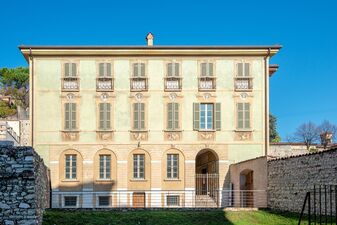 Maggi-Gambara Palace
 -
 Bertolotti Palace
 -
 Beretta Palace
 -
 Martinengo Palace
 -
 Piazza Duomo by night
 -
 The Castle's main entrance
 -
 Street in the old city center
 -
 Roman ruins
 -
 Roman Theatre section
 -
 Corso Zanardelli and Teatro Grande main entrance
 -
 Bruni Conter Palace and Niccolò Tartaglia statue
 -
 Torre d'Ercole
 -
 Steps in the old town
 -
 Arcades


.jpg&filetimestamp=20251116122454&)
.jpg&filetimestamp=20251116122453&)


Fountains
For many years Brescia has been considered a "city of water" due to the presence of many canals and natural waterways, as the French author Paul de Musset (1804–1880) once wrote: "The wide streets and numerous fountains give it an air of a big city. Water gushes in the squares and circulates in private homes almost as abundantly as in Rome".[70]
-
 Medieval fountain
 -
 Tagliaferri fountain
 -
 Neptune fountain
 -
 Minerva fountain
 -
 Pallata fountain
 -
 Armed Brescia fountain
 -
 Private fountain
 -
 Private fountain
 -
 Vescovado fountain
.jpg&filetimestamp=20251116122520&)
.jpg&filetimestamp=20251116122519&)


.JPG&filetimestamp=20251116122509&)


المراجع الثقافية
Astronomy
The 521 Brixia planetoid is named after the city.[71]
See also
References and sources
- References
- ^ "Monthly Demographic Balance". ISTAT.
- ^ Stella, Clara (2003). Brixia. Scoperte e riscoperte (in الإيطالية). Milano: Skira.
- ^ "History of Brescia: the origins and the Roman Brescia". turismobrescia.it. Archived from the original on 2014-02-09. Retrieved 2014-06-20.
- ^ "Storia del Colle Cidneo" [History of the Cidneo Hill]. bresciamusei.com (in الإيطالية). Archived from the original on 2014-10-06. Retrieved 2014-05-14.
- ^ Moore, R. I. (1994). The Origins of European Dissent. London: University of Toronto Press. p. 117. ISBN 0-8020-7566-5.
- ^ Greenway, George William (1931). Arnold of Brescia. Cambridge: Cambridge University Press. pp. 23–25.
- ^ Schmitz-Esser, Romedio (2004). "Arnold of Brescia in Exile: April 1139 to December 1143 – His Role as a Reformer, Reviewed". In Napran, Laura (ed.). Exile in the Middle Ages: Selected proceedings from the International Medieval Congress, University of Leeds 8–11 July 2002. Turnhout: Brepols. p. 216.
- ^ Moore, R. I. (1995). The Birth of Popular Heresy. London: University of Toronto Press. p. 67. ISBN 0-8020-7659-9.
- ^ Johnson, Phillip D. (2016). Arnold of Brescia: Apostle of Liberty in Twelfth-Century Europe. Eugene: Wipf & Stock. pp. 32–42, 68–75, 85–125.
- ^ Baumgartner, Louis XII, 220.
- ^ Baumgartner, Louis XII, 220; Norwich, History of Venice, 421. Baumgartner gives 8,000 as a minimal estimate, while Norwich gives 15,000.
- ^ "Best 5 lakes of Brescia". 24 April 2018. Retrieved 24 April 2018.
- ^ "Valori climatici normali in Italia : Brescia/Ghedi AM". Istituto Superiore per la Protezione e la Ricerca Ambientale. Archived from the original on 17 September 2023. Retrieved 26 November 2024.
- ^ "Brescia/Ghedi (BS)" (PDF). Atlante climatico. Servizio Meteorologico. Retrieved 5 January 2015.
- ^ "STAZIONE 088-BRESCIA GHEDI: medie mensili periodo 61 – 90". Servizio Meteorologico. Retrieved 5 January 2015.
- ^ "Brescia Ghedi: Record mensili dal 1951" (in الإيطالية). Servizio Meteorologico dell'Aeronautica Militare. Retrieved 5 January 2015.
- ^ "Popolazione residente e presente dei comuni. Censimenti dal 1861 al 1971" [Resident and present population of the municipalities. Censuses from 1861 to 1971] (PDF) (in الإيطالية). ISTAT. 1971-10-24.
- ^ "Dashboard Permanent census of population and housing". ISTAT.
- ^ خطأ استشهاد: وسم
<ref>غير صحيح؛ لا نص تم توفيره للمراجع المسماةpopulation3 - ^ "Foreign Citizens. Resident Population by sex and Demographic Balance on 31st December 2018". demo.istat.it. Retrieved 7 August 2019.
- ^ "Demographic Balance for the year 2018 and Resident Population from on 31st December". demo.istat.it. Retrieved 7 August 2019.
- ^ Popham, Peter (20 August 2006). "Murder of Muslim girl 'rebel' by her father shocks all Italy". The Independent. Retrieved 3 December 2019.
- ^ أ ب خطأ استشهاد: وسم
<ref>غير صحيح؛ لا نص تم توفيره للمراجع المسماةbenic - ^ خطأ استشهاد: وسم
<ref>غير صحيح؛ لا نص تم توفيره للمراجع المسماةunesc - ^ أ ب "Brescia: monumental area". italialangobardorum.it. Archived from the original on 17 May 2014. Retrieved 14 May 2014.
- ^ "Brescia: San salvatore-Santa Giulia complex". italialangobardorum.it. Archived from the original on 17 May 2014. Retrieved 14 May 2014.
- ^ "Santa Giulia Museum Complex". bresciamusei.com. Retrieved 14 May 2014.
- ^ Pierluigi De Vecchi; Elda Cerchiari (1991). L'arte nel tempo (in الإيطالية). Milano: Bompiani.
- ^ أ ب ت Stradiotti, Renata (2001). San Salvatore – Santa Giulia a Brescia. Il monastero nella storia (in الإيطالية). Milano: Skira.
- ^ "Brescia: Longobard Monastery". italialangobardorum.it. Archived from the original on 17 May 2014. Retrieved 14 May 2014.
- ^ "Santa Giulia Museum Complex: the choir". bresciamusei.com. Retrieved 14 May 2014.
- ^ Massimiliano Del Barba (26 February 2014). "Brescia ritorna il terzo polo industriale. Ma l'occupazione rischia un nuovo calo" [Brescia becomes again the third largest industrial centre. But for the employment rate is likely a new drop.]. Corriere della Sera (in الإيطالية).
- ^ "AIB-Associazione Industriale Bresciana. La storia" [AIB-Industrial Association of Brescia. The history.]. aib.bs.it (in الإيطالية). Retrieved 14 May 2014.
- ^ "Franciacorta DOCG, disciplinare di produzione" [Franciacorta DOCG, production regulations]. agraria.org (in الإيطالية). Retrieved 14 May 2014.
- ^ "Botticino DOC". agraria.org (in الإيطالية). Retrieved 14 May 2014.
- ^ "Cellatica DOC". agraria.org (in الإيطالية). Retrieved 14 May 2014.
- ^ "Curtefranca DOC". agraria.org (in الإيطالية). Retrieved 14 May 2014.
- ^ "Ronchi di Brescia IGT". agraria.org (in الإيطالية). Retrieved 14 May 2014.
- ^ Bono, Michela (11 September 2012). "Il vigneto Pusterla rinasce e torna alla famiglia Capretti" [The vineyard Pusterla reborn and returns to the family Capretti.]. Bresciaoggi (in الإيطالية). Archived from the original on 26 February 2014. Retrieved 14 May 2014.
- ^ "Un bianco ultracentenario nel cuore di Brescia" [A centuries-old white wine in the heart of Brescia.]. slowfood.it (in الإيطالية). Archived from the original on 25 February 2014. Retrieved 14 May 2014.
- ^ Black, Jane (26 September 2006). "Caviar from farms instead of the seas". The New York Times. Retrieved 31 July 2015.
- ^ "E' Brescia la capitale mondiale del caviale" [Brescia is the world capital of caviar]. quibrescia.it (in الإيطالية). 26 March 2015. Retrieved 31 July 2015.
- ^ "Brescia capitale dell'industria in Europa – BIE".
- ^ "RSY Lombardia-Arrivals and nights spent by guests in accommodation establishments, by type of resort and by type of establishment. Total accommodation establishments. Part III. Tourist resort. Year 2003". asr-lombardia.it. Archived from the original on 15 May 2014. Retrieved 14 May 2014.
- ^ Troncana, Alessandra (27 March 2014). "Turismo, Garda superstar Iseo e Franciacorta in calo". Corriere della Sera (in الإيطالية).
- ^ "Italy, hotel rates: some rise, some drop". italianvenue.com. 9 March 2015. Archived from the original on 22 December 2015. Retrieved 31 July 2015.
- ^ "La notte in albergo più conveniente è a Brescia" [The cheapest overnight stay in a hotel is in Brescia]. Giornale di Brescia (in الإيطالية). 6 March 2014. Retrieved 31 July 2015.
- ^ Trebeschi, Matteo (23 April 2015). "Gli hotel di Brescia sono 3 volte più convenienti di Milano" [Hotels in Brescia are three times cheaper than in Milan]. Corriere della Sera (in الإيطالية). Retrieved 31 July 2015.
- ^ أ ب "La metro di Brescia apre sabato 2 marzo" [The Brescia Metro opens March 2]. CityRailways.it (in الإيطالية). 5 February 2013. Archived from the original on 12 October 2013. Retrieved 15 February 2013.
- ^ أ ب "Mappa della linea metropolitana" (PDF) (in الإيطالية). Brescia Mobilitá. Retrieved 7 November 2013.
- ^ Francesco Di Maio (أبريل 2008). "Automation in a medium-sized city". Railway Gazette International. Archived from the original on مايو 24, 2012. Retrieved أكتوبر 19, 2009.
- ^ "Parte la metro! 2 marzo 2013" [The Metro goes! March 2, 2013] (in الإيطالية). Brescia Mobilitá. 5 February 2013. Archived from the original on 12 October 2013. Retrieved 11 October 2013.
- ^ "Tram arrivato l'ok al finanziamento da 359 milioni". Corriere della Sera - "Brescia" (in الإيطالية). 12 November 2021. p. 5. Davide Bacca (12 November 2021). "Tram, il Governo stanzia 359 milioni. La prima corsa nel marzo del 2029". Giornale di Brescia (in الإيطالية). p. 16. Salvatore Montillo (15 November 2023). "Un assegno di 63 milioni mette il tram sui binari giusti". Giornale di Brescia (in الإيطالية). p. 9.
- ^ Luca Goffi (25 June 2024). "Dal consiglio comunale il sì al tram". Corriere della Sera - "Brescia" (in الإيطالية). p. 4.Nuri Fatolahzadeh (25 June 2024). "Brescia timbra il biglietto del futuro e sale sul tram senza il centrodestra". Giornale di Brescia (in الإيطالية). p. 12.Davide Bacca (7 June 2022). "Il nuovo tram accelera. Il progetto affidato ai francesi di Systra". Giornale di Brescia (in الإيطالية). p. 9.
- ^ Khomenko, S.; Cirach, M.; Pereira-Barboza, E.; Mueller, N.; Barrera-Gómez, J.; Rojas-Rueda, D.; De Hoogh, K.; Hoek, G.; Nieuwenhuijsen, M. (2021). "Premature mortality due to air pollution in European cities: a health impact assessment". The Lancet. Planetary Health. 5 (3): e121–e134. doi:10.1016/S2542-5196(20)30272-2. hdl:10230/53387. PMID 33482109. S2CID 231687871.
- ^ "Brescia Italy's most polluted city". 22 January 2019. Retrieved 10 February 2021.
- ^ "1000 Miglia – La corsa più bella del mondo". 1000 Miglia.
- ^ Bell, Matthew (4 May 2014). "The Mille Miglia: Buckle up for an exhilarating grand tour". The Independent. Retrieved 31 July 2015.
- ^ Preston, Benjamin (19 May 2014). "Mille Miglia Celebrates Cars From Motorsports History". The New York Times. Retrieved 31 July 2015.
- ^ Harvey, Michael (21 May 2014). "Mille Miglia: bruised and blistered". The Telegraph. Archived from the original on 21 May 2014. Retrieved 31 July 2015.
- ^ "Ecco il PalaLeonessa, nuova casa della Germani" [New PalaLeonessa, new home for Germani]. bresciaoggi.it (in الإيطالية). 19 May 2018. Archived from the original on 21 May 2018. Retrieved 5 June 2018.
- ^ "Il PalaLeonessa prende forma: il viaggio nel nuovo palazzetto" [PalaLeonessa is growing: the trip inside the new arena]. giornaledibrescia.it (in الإيطالية). 28 May 2018. Retrieved 5 June 2018.
- ^ Brescia dell'Ateneo Commentari 1882. His obituary is on page 210 as honorary member
- ^ "Gemellaggi". turismobrescia.it (in الإيطالية). Brescia. Archived from the original on 15 December 2019. Retrieved 13 December 2019.
- ^ "Consolato Albanese a Brescia | Italia". www.ambasciata.net.
- ^ "Home | Consolato Onorario della Repubblica del Ghana | Consolato Onorario della Repubblica del Ghana". www.consolatoghana.it.
- ^ "Consolato Onorario di Malta, Easydiplomacy.com".[dead link]
- ^ "Distaccamento Consolato Moldavo presso la sede delle Acli bresciane". www.aclibresciane.it.
- ^ "Consolato Rumena a Brescia | Italia". www.ambasciata.net.
- ^ "Brescia città d'acqua" [Brescia city of water.]. oltreiltondino.it (in الإيطالية). Archived from the original on 26 February 2020. Retrieved 26 February 2020.
- ^ Schmadel, Lutz D. (2003). Dictionary of Minor Planet Names (5th ed.). Berlin, Heidelberg, New York: Springer-Verlag. p. 56. ISBN 3-540-00238-3.
- Sources
- This article incorporates text from a publication now in the public domain: Chisholm, Hugh, ed. (1911). . دائرة المعارف البريطانية (eleventh ed.). Cambridge University Press.
{{cite encyclopedia}}: Cite has empty unknown parameter:|coauthors=(help)  This article incorporates text from a publication now in the public domain: Herbermann, Charles, ed. (1913). "Brescia". Catholic Encyclopedia. New York: Robert Appleton Company.
Bibliography
Brescia 1849 la Compagnia della Stampa Gianluigi Valotti Anno edizione: 2018
وصلات خارجية


- Brescia Tourism official site: useful information, guide destination and hotel, airport
- Tourist Office of the City of Brescia
- Brescia Museums official site
- University of Brescia official site
- Catholic University of Brescia (in إيطالية)
| شمال الغرب |        | |
|---|---|---|
| شمال الشرق | ||
| الوسط | ||
| الجنوب | ||
| الجزر | ||
| الريف |
| |
- Pages using gadget WikiMiniAtlas
- CS1 الإيطالية-language sources (it)
- Articles containing إيطالية-language text
- Articles with dead external links from June 2021
- Short description with empty Wikidata description
- Articles containing Lombard-language text
- Pages using infobox mapframe with missing coordinates
- Coordinates not on Wikidata
- Articles containing إنگليزية-language text
- Pages using infobox settlement with image map1 but not image map
- Pages using infobox settlement with deprecated parameters
- Italian commune articles with missing parameters
- Pages using infobox Italian comune with unknown parameters
- Articles with hatnote templates targeting a nonexistent page
- جميع المقالات الحاوية على عبارات مبهمة
- جميع المقالات الحاوية على عبارات مبهمة from October 2023
- Wikipedia articles needing clarification from October 2023
- مقالات ذات عبارات بحاجة لمصادر
- Pages with empty portal template
- مقالات المعرفة المحتوية على معلومات من دائرة المعارف البريطانية طبعة 1911
- Wikipedia articles incorporating text from the 1911 Encyclopædia Britannica
- Articles incorporating a citation from the 1913 Catholic Encyclopedia with Wikisource reference
- Articles incorporating text from the 1913 Catholic Encyclopedia with Wikisource reference
- Articles with إيطالية-language sources (it)
- Cities and towns in Lombardy
- Municipalities of the Province of Brescia
- بريشا
- قلاع إيطاليا
- World Heritage Sites in Italy
- Domini di Terraferma
- أقاليم جمهورية البندقية
- Populated places established in the 2nd millennium BC
- مدن إيطاليا
- صفحات مع الخرائط