كسوف الشمس في 2 أغسطس 2027
| كسوف الشمس أغسطس 2, 2027 | |
|---|---|
 Map | |
| نوع الكسوف | |
| الطبيعة | Total |
| گاما | 0.1421 |
| القدر | 1.079 |
| أقصى كسوف | |
| المدة | 383 sec (6 m 23 s) |
| الإحداثيات | 25°30′N 33°12′E / 25.5°N 33.2°E |
| أقصى عرض للحزمة | 258 km (160 mi) |
| الأوقات (UTC) | |
| أعظم كسوف | 10:07:50 |
| المراجع | |
| ساروس | 136 (38 of 71) |
| الزيج # (SE5000) | 9568 |
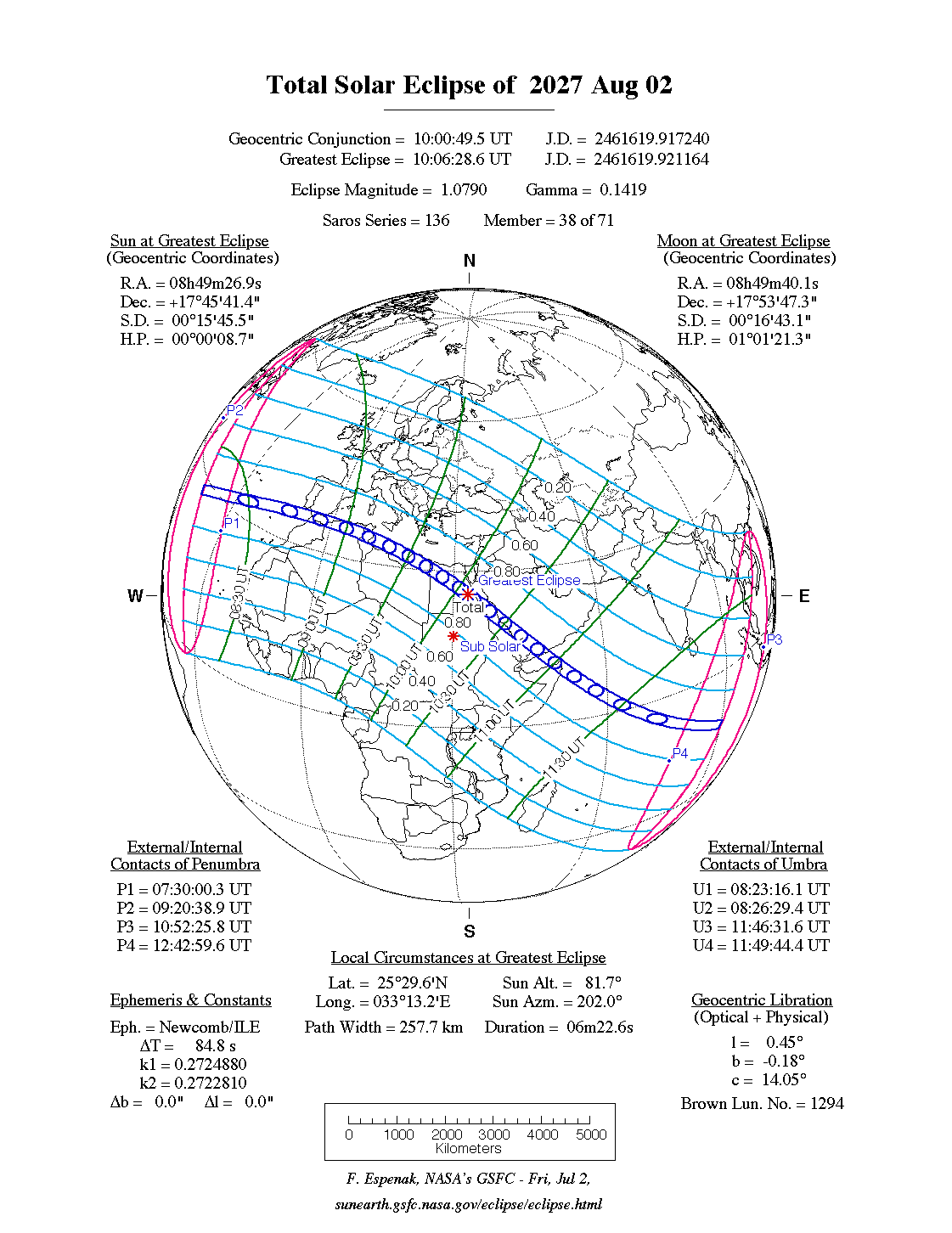
A total solar eclipse, nicknamed the Eclipse of the Century,[1][2][3][4] will occur at the Moon's descending node of orbit on Monday, August 2, 2027,[5] with a magnitude of 1.079. A solar eclipse occurs when the Moon passes between Earth and the Sun, thereby totally or partly obscuring the image of the Sun for a viewer on Earth. A total solar eclipse occurs when the Moon's apparent diameter is larger than the Sun's, blocking all direct sunlight, turning day into darkness. Totality occurs in a narrow path across Earth's surface, with the partial solar eclipse visible over a surrounding region thousands of kilometres wide. Occurring about 2.5 hours before perigee (on August 2, 2027, at 7:25 UTC), the Moon's apparent diameter will be larger.[6]
Path
Totality will commence over the eastern Atlantic Ocean and travel across the Strait of Gibraltar between Spain and Morocco, and continue across parts of North Africa and the Middle East. Major cities and locations under the path of totality will include:[7]
- Cadiz and Málaga, in southern Spain
- Gibraltar
- Tangier, Morocco
- Oran, Algeria
- Sfax, Tunisia
- Benghazi, Libya
- Luxor in central Egypt
- Jeddah and Mecca in southwest Saudi Arabia
- Sana'a in western Yemen
- The tip of the Horn of Africa in extreme northeast Somalia
- Islands in the British Indian Ocean Territory
The maximum duration of totality will be observed in Egypt, approximately 37 ميل (60 km) southeast of Luxor, and will last 6 minutes and 22 seconds.[8]
A partial solar eclipse will be visible from the extreme east tip of Maine, United States, far eastern Quebec and the Atlantic Provinces in Canada, southern Greenland, Iceland, Ireland, Great Britain, nearly the entirety of the European continent, all but the southern quarter of Africa, the Middle East, and from South and Southeast Asia.[7]
It will be the first of three total solar eclipses that are observable in Tunisia in the 21st century, passing over the central part of the country.[9] It will be the second total eclipse in Spain within a year, after August 2026. An annular eclipse will appear in Spain in January 2028. A national eclipse committee has been established to coordinate eclipse-related activities.[10]
Duration
This is the second longest total solar eclipse in the 21st century, the longest being the eclipse prior to this one in Solar Saros 136, that of July 22, 2009. The 2009 eclipse maximum duration of six minutes and 39.5 seconds occurred over the Pacific Ocean, and the longest duration on land was on remote, uninhabited North Iwo Jima, where visiting is not allowed without special permission.[11] The maximum duration of this eclipse is six minutes and 23.2 seconds, occurring in the northeastern part of Egypt's New Valley Governorate. The location of the greatest eclipse is about 250 كيلومتر (160 mi) southeast in Red Sea Governorate, with a slightly shorter duration. This is the longest total solar eclipse on easily accessible land in the 21st century; a longer one will not occur until June 3, 2114.[12]
Images
ملف:SE2027Aug02T.gif
Animated path
Eclipse timing
Places experiencing total eclipse
| Country or territory | City or place | Start of partial eclipse | Start of total eclipse | Maximum eclipse | End of total eclipse | End of partial eclipse | Duration of totality (min:s) | Duration of eclipse (hr:min) | Maximum magnitude |
|---|---|---|---|---|---|---|---|---|---|
 إسپانيا إسپانيا |
Cádiz | 09:40:48 | 10:45:29 | 10:46:57 | 10:48:25 | 11:59:43 | 2:56 | 2:19 | 1.0076 |
 المملكة المغربية المملكة المغربية |
Tangier | 08:40:39 | 09:44:47 | 09:47:12 | 09:49:38 | 11:00:32 | 4:51 | 2:20 | 1.0339 |
| إسپانيا |
Ceuta | 09:41:03 | 10:45:26 | 10:47:50 | 10:50:15 | 12:01:22 | 4:49 | 2:20 | 1.0304 |
 الجبل الأسود الجبل الأسود |
Gibraltar | 09:41:10 | 10:45:39 | 10:47:53 | 10:50:07 | 12:01:18 | 4:28 | 2:20 | 1.0218 |
| إسپانيا |
Marbella | 09:41:42 | 10:46:53 | 10:48:33 | 10:50:14 | 12:02:02 | 3:21 | 2:20 | 1.0099 |
| إسپانيا |
Málaga | 09:42:09 | 10:48:12 | 10:49:10 | 10:50:09 | 12:02:46 | 1:57 | 2:21 | 1.0031 |
| إسپانيا |
Melilla | 09:42:27 | 10:48:19 | 10:50:36 | 10:52:53 | 12:05:31 | 4:34 | 2:23 | 1.0216 |
| المملكة المغربية |
Oujda | 08:43:01 | 09:51:15 | 09:51:49 | 09:52:22 | 11:07:28 | 1:07 | 2:24 | 1.0014 |
 الجزائر الجزائر |
Oran | 08:44:30 | 09:51:10 | 09:53:44 | 09:56:18 | 11:09:33 | 5:08 | 2:25 | 1.0365 |
| الجزائر |
M'sila | 08:48:59 | 09:58:09 | 10:00:50 | 10:03:32 | 11:18:50 | 5:23 | 2:30 | 1.0337 |
 تونس تونس |
Kasserine | 08:54:08 | 10:05:34 | 10:08:18 | 10:11:02 | 11:27:47 | 5:28 | 2:34 | 1.0286 |
| تونس |
Gafsa | 08:53:56 | 10:05:49 | 10:08:23 | 10:10:58 | 11:28:18 | 5:09 | 2:34 | 1.0226 |
| تونس |
Kairouan | 08:55:50 | 10:08:57 | 10:10:20 | 10:11:42 | 11:29:48 | 2:45 | 2:34 | 1.0049 |
| تونس |
Gabès | 08:55:32 | 10:08:47 | 10:10:51 | 10:12:55 | 11:31:22 | 4:08 | 2:36 | 1.0121 |
| تونس |
Sfax | 08:56:29 | 10:08:54 | 10:11:44 | 10:14:35 | 11:31:56 | 5:41 | 2:35 | 1.0323 |
| تونس |
Mahdia | 08:57:02 | 10:10:38 | 10:12:02 | 10:13:27 | 11:31:49 | 2:49 | 2:35 | 1.005 |
| تونس |
Houmt Souk | 08:56:32 | 10:09:52 | 10:12:13 | 10:14:35 | 11:32:55 | 4:43 | 2:36 | 1.0165 |
| تونس |
Zarzis | 08:56:51 | 10:11:21 | 10:12:49 | 10:14:17 | 11:33:46 | 2:56 | 2:37 | 1.0057 |
 إيطاليا إيطاليا |
Lampedusa | 09:59:51 | 11:10:21 | 11:14:49 | 11:17:17 | 13:33:46 | 2:56 | 2:37 | 1.0057 |
.svg&filetimestamp=20120627000614&) ليبيا ليبيا |
Benghazi | 10:10:46 | 11:27:58 | 11:31:03 | 11:34:09 | 12:53:26 | 6:11 | 2:43 | 1.0385 |
 مصر مصر |
Siwa Oasis | 11:22:18 | 12:42:42 | 12:45:28 | 12:48:15 | 14:08:17 | 5:33 | 2:46 | 1.0206 |
| مصر |
Asyut | 11:35:37 | 12:57:03 | 13:00:06 | 13:03:10 | 14:21:41 | 6:07 | 2:46 | 1.028 |
| مصر |
Luxor | 11:40:21 | 13:02:14 | 13:05:26 | 13:08:36 | 14:26:44 | 6:22 | 2:46 | 1.0361 |
 السعودية السعودية |
Jeddah | 12:00:23 | 13:22:21 | 13:25:18 | 13:28:14 | 14:43:47 | 5:53 | 2:43 | 1.0262 |
| السعودية |
Mecca | 12:01:58 | 13:24:06 | 13:26:41 | 13:29:16 | 14:44:49 | 5:10 | 2:43 | 1.0176 |
| السعودية |
Taif | 12:03:36 | 13:26:59 | 13:28:01 | 13:29:03 | 14:45:43 | 2:04 | 2:42 | 1.0023 |
| السعودية |
Khamis Mushait | 12:13:38 | 13:34:41 | 13:37:41 | 13:40:41 | 14:54:05 | 6:00 | 2:40 | 1.0333 |
 اليمن اليمن |
Sanaa | 12:22:05 | 13:44:15 | 13:45:35 | 13:46:54 | 15:00:50 | 2:39 | 2:39 | 1.0046 |
 الصومال الصومال |
Bosaso | 12:39:49 | 13:58:18 | 14:00:22 | 14:02:26 | 15:12:09 | 4:08 | 2:32 | 1.013 |
| References: [5] | |||||||||
Places experiencing partial eclipse
| Country or territory | City or place | Start of partial eclipse | Maximum eclipse | End of partial eclipse | Duration of eclipse (hr:min) | Maximum coverage | |||
|---|---|---|---|---|---|---|---|---|---|
| المملكة المغربية |
Casablanca | 08:38:29 | 09:44:25 | 10:57:29 | 2:19 | 97.21% | |||
 البرتغال البرتغال |
Lisbon | 08:40:51 | 09:44:57 | 10:55:12 | 2:14 | 92.54% | |||
| إسپانيا |
Madrid | 09:45:32 | 10:51:21 | 12:02:53 | 2:17 | 86.38% | |||
| الجزائر |
Algiers | 08:48:23 | 09:59:05 | 11:15:48 | 2:27 | 99.83% | |||
 المملكة المتحدة المملكة المتحدة |
London | 09:03:40 | 10:00:15 | 10:59:38 | 1:56 | 41.92% | |||
 فرنسا فرنسا |
Paris | 10:00:46 | 11:01:19 | 12:05:10 | 2:04 | 51.31% | |||
| تونس |
Tunis | 08:56:18 | 10:10:12 | 11:28:54 | 2:33 | 97.14% | |||
 الڤاتيكان الڤاتيكان |
Vatican City | 10:02:14 | 11:12:50 | 12:26:55 | 2:25 | 74.57% | |||
| إيطاليا |
Rome | 10:02:15 | 11:12:53 | 12:26:58 | 2:25 | 74.58% | |||
| ليبيا |
Tripoli | 09:59:46 | 11:16:57 | 12:38:36 | 2:39 | 100.00% | |||
 مالطا مالطا |
Valletta | 10:01:49 | 11:17:58 | 12:37:54 | 2:36 | 97.31% | |||
 بلغاريا بلغاريا |
Sofia | 11:18:28 | 12:29:07 | 13:40:52 | 2:22 | 60.79% | |||
 اليونان اليونان |
Athens | 11:16:52 | 12:33:02 | 13:50:12 | 2:33 | 78.30% | |||
 قبرص قبرص |
Nicosia | 11:35:25 | 12:53:04 | 14:08:45 | 2:33 | 72.47% | |||
| مصر |
Cairo | 11:33:15 | 12:56:00 | 14:16:24 | 2:43 | 94.79% | |||
 لبنان لبنان |
Beirut | 11:40:20 | 12:58:32 | 14:14:00 | 2:34 | 72.69% | |||
 سوريا سوريا |
Damascus | 11:42:17 | 13:00:30 | 14:15:45 | 2:33 | 72.27% | |||
 إسرائيل إسرائيل |
Jerusalem | 11:40:44 | 13:01:04 | 14:18:17 | 2:38 | 80.48% | |||
 الأردن الأردن |
Amman | 11:42:11 | 13:02:05 | 14:18:45 | 2:37 | 78.39% | |||
| السعودية |
Medina | 11:57:24 | 13:21:00 | 14:38:45 | 2:41 | 94.43% | |||
 السودان السودان |
Khartoum | 10:57:20 | 12:22:46 | 13:42:26 | 2:45 | 71.27% | |||
| السعودية |
Riyadh | 12:13:49 | 13:32:45 | 14:45:10 | 2:31 | 75.94% | |||
 إرتريا إرتريا |
Asmara | 12:11:01 | 13:36:19 | 14:54:05 | 2:43 | 87.69% | |||
 جيبوتي جيبوتي |
Djibouti | 12:27:22 | 13:50:37 | 15:05:23 | 2:38 | 87.49% | |||
| اليمن |
Aden | 12:28:40 | 13:51:32 | 15:05:50 | 2:37 | 96.26% | |||
| الصومال |
Berbera | 12:33:24 | 13:55:40 | 15:09:14 | 2:36 | 89.11% | |||
| الصومال |
Garowe | 12:44:04 | 14:04:17 | 15:15:39 | 2:32 | 92.38% | |||
 ملديڤ ملديڤ |
Malé | 15:29:54 | 16:32:47 | 17:29:28 | 2:00 | 72.85% | |||
| ملديڤ |
Addu City | 15:33:59 | 16:37:58 | 17:35:30 | 2:02 | 89.97% | |||
 أراضي المحيط الهندي البريطانية أراضي المحيط الهندي البريطانية |
Diego Garcia | 16:40:07 | 17:43:43 | 18:40:59 | 2:01 | 96.56% | |||
| References: [5] | |||||||||
Eclipse details
Shown below are two tables displaying details about this particular solar eclipse. The first table outlines times at which the Moon's penumbra or umbra attains the specific parameter, and the second table describes various other parameters pertaining to this eclipse.[13]
| Event | Time (UTC) |
|---|---|
| First penumbral external contact | 2027 August 2 at 07:31:21.9 UTC |
| First umbral external contact | 2027 August 2 at 08:24:37.8 UTC |
| First central line | 2027 August 2 at 08:26:14.5 UTC |
| First umbral internal contact | 2027 August 2 at 08:27:51.1 UTC |
| First penumbral internal contact | 2027 August 2 at 09:22:00.9 UTC |
| Greatest duration | 2027 August 2 at 10:01:33.8 UTC |
| Equatorial conjunction | 2027 August 2 at 10:02:10.7 UTC |
| Ecliptic conjunction | 2027 August 2 at 10:06:23.6 UTC |
| Greatest eclipse | 2027 August 2 at 10:07:50.2 UTC |
| Last penumbral internal contact | 2027 August 2 at 10:53:47.0 UTC |
| Last umbral internal contact | 2027 August 2 at 11:47:53.1 UTC |
| Last central line | 2027 August 2 at 11:49:29.5 UTC |
| Last umbral external contact | 2027 August 2 at 11:51:05.9 UTC |
| Last penumbral external contact | 2027 August 2 at 12:44:21.3 UTC |
| Parameter | Value |
|---|---|
| Eclipse magnitude | 1.07903 |
| Eclipse obscuration | 1.16430 |
| Gamma | 0.14209 |
| Sun right ascension | 08h49m26.9s |
| Sun declination | +17°45'41.3" |
| Sun semi-diameter | 15'45.5" |
| Sun equatorial horizontal parallax | 08.7" |
| Moon right ascension | 08h49m40.1s |
| Moon declination | +17°53'47.8" |
| Moon semi-diameter | 16'43.1" |
| Moon equatorial horizontal parallax | 1°01'21.4" |
| ΔT | 72.8 s |
Characteristics
Bright stars and planets visible during totality
 |
The eclipsed Sun will be in mid-Cancer, a few degrees southeast of the Beehive Cluster (which will not be visible to the naked eye) and Venus (which will most definitely be seen if the sky is at all transparent). Mercury will be well past greatest western elongation and nearing superior conjunction (therefore showing most of its sunlit side to bright effect -- magnitude -1.2[14]) several degrees west of Venus. Jupiter will be near Regulus about 20 degrees east of the Sun. Mars will be many degrees farther east in Virgo. Saturn will be many degrees west of the Sun. Over most of the continental areas in the path of totality, the Winter Hexagon will be visible, although on the Arabian Peninsula its westernmost stars -- Aldebaran and Rigel—will be low. In the British Indian Ocean Territory the Winter Hexagon stars will either have disappeared below the western horizon or will be very low, but Alpha Centauri, Beta Centauri and the Southern Cross will be well up in the south.[15]
Eclipse path intersections
The path of the August 2, 2027 eclipse will be crossed by the path of another solar eclipse less than 7 years later, on March 20, 2034, at a location on the southeastern coast of Egypt.[16] This is similar to the intersection in the paths of the August 2017 and April 2024 total solar eclipses in the United States, over southern Illinois, and in Turkey during the August 1999 and March 2006 solar eclipses; the intersections within these pairs of total eclipses also occurred about 7 years apart.[17][18] This phenomenon is considered to be unusual, since the average interval for any given spot on Earth to observe a total solar eclipse is about once every 375 years. The intersection patterns are caused by the dynamics of the Saros cycle.[17]
Impact
Economy and tourism
The August 2027 total solar eclipse is expected to draw large numbers of tourists and become the most photographed astronomical event in history.[1][2][4] In December 2025, about a year and a half before the eclipse, regions in southern Spain and Morocco were already reporting early hotel sell-outs, and travel operators predicted a multi-million-euro surge in tourism.[4] An estimated 89 million people live in the path of totality,[1] at least double the 44 million people who lived within the path of totality of the April 2024 solar eclipse in North America.[19] One source estimated that over 200 million people could attempt to watch the August 2027 solar eclipse.[20]
Eclipse season
This eclipse is part of an eclipse season, a period, roughly every six months, when eclipses occur. Only two (or occasionally three) eclipse seasons occur each year, and each season lasts about 35 days and repeats just short of six months (173 days) later; thus two full eclipse seasons always occur each year. Either two or three eclipses happen each eclipse season. In the sequence below, each eclipse is separated by a fortnight. The first and last eclipse in this sequence is separated by one synodic month.
| July 18 Ascending node (full moon) |
August 2 Descending node (new moon) |
August 17 Ascending node (full moon) |
|---|---|---|
 |
|

|
| Penumbral lunar eclipse Lunar Saros 110 |
Total solar eclipse Solar Saros 136 |
Penumbral lunar eclipse Lunar Saros 148 |
Related eclipses
Eclipses in 2027
- An annular solar eclipse on February 6.
- A penumbral lunar eclipse on February 20.
- A penumbral lunar eclipse on July 18.
- A total solar eclipse on August 2.
- A penumbral lunar eclipse on August 17.
Metonic
- Preceded by: Solar eclipse of October 14, 2023
- Followed by: Solar eclipse of May 21, 2031
Tzolkinex
- Preceded by: Solar eclipse of June 21, 2020
- Followed by: Solar eclipse of September 12, 2034
Half-Saros
- Preceded by: Lunar eclipse of July 27, 2018
- Followed by: Lunar eclipse of August 7, 2036
Tritos
- Preceded by: Solar eclipse of September 1, 2016
- Followed by: Solar eclipse of July 2, 2038
Solar Saros 136
- Preceded by: Solar eclipse of July 22, 2009
- Followed by: Solar eclipse of August 12, 2045
Inex
- Preceded by: Solar eclipse of August 22, 1998
- Followed by: Solar eclipse of July 12, 2056
Triad
- Preceded by: Solar eclipse of October 1, 1940
- Followed by: Solar eclipse of June 3, 2114
Solar eclipses of 2026–2029
قالب:Solar eclipse set 2026–2029
Saros 136
Metonic series
قالب:Solar Metonic series 1993–2069
Tritos series
قالب:Solar Tritos series 2005 October 3
Inex series
قالب:Solar Inex series 2027 August 2
See also


.svg&filetimestamp=20140724211543&)


- List of solar eclipses in the 21st century
- Solar eclipse of August 11, 1999
- Solar eclipse of July 22, 2009
- Solar eclipse of April 8, 2024
- Solar eclipse of July 22, 2028
- Solar eclipse of March 20, 2034
References
- ^ أ ب ت Jamie Carter (5 November 2024). "The 'Eclipse Of The Century' Is 1,000 Days Away — What To Know And Where To Go". Forbes. Archived from the original on 10 January 2025. Retrieved 2 December 2025.
- ^ أ ب Jamie Carter (11 May 2024). "Total solar eclipse 2027: A complete guide to the 'eclipse of the century'". Space.com. Future US, Inc. Retrieved 2 December 2025.
- ^ Chris Littlechild (1 December 2025). "The 'Eclipse Of The Century' Is Coming – Here's What Makes It So Special". SlashGear. Retrieved 2 December 2025.
- ^ أ ب ت Melvin Gascon (1 December 2025). "The 'Eclipse of the Century' Is Coming: How Europe, North Africa and the Middle East Will Go Dark for 6 Minutes in 2027". International Business Times. Retrieved 2 December 2025.
- ^ أ ب ت "August 2, 2027 Total Solar Eclipse". timeanddate. Retrieved 13 August 2024.
- ^ "Moon Distances for London, United Kingdom, England". timeanddate. Retrieved 13 August 2024.
- ^ أ ب "Total Solar Eclipse on August 2, 2027: Path Map and Times". www.timeanddate.com (in الإنجليزية). Retrieved 2024-03-23.
- ^ "Longest Duration of Total Solar Eclipse of 2027 Aug 02". NASA Goddard Space Flight Center. NASA. Retrieved 7 September 2017.
- ^ "Map of Solar Eclipse of August 2, 2027" (Map). "Solar Eclipse Maps". NASA. Retrieved October 21, 2017.
- ^ "Eclipses at Spain - [2026-2027-2028]".
- ^ Fred Espenak. "Total Solar Eclipse of 2009 Jul 22 - Google Maps and Solar Eclipse Paths". NASA Eclipse Web Site. Archived from the original on 22 July 2009.
- ^ Fred Espenak. "Total Solar Eclipses with Durations Exceeding 06m 00s: 2001 to 3000". NASA Eclipse Web Site. Archived from the original on 10 March 2014.
- ^ "Total Solar Eclipse of 2027 Aug 02". EclipseWise.com. Retrieved 13 August 2024.
- ^ https://in-the-sky.org/news.php?id=20270716_11_101 In-The-Sky.org, Mercury at greatest elongation west 15 July 2027
- ^ https://skyandtelescope.org/interactive-sky-chart/ Sky & Telescope Sky Chart
- ^ Michael E. Bakich (24 June 2024). "How to see the next 20 years of eclipses, including the eclipse of a lifetime". Astronomy. Retrieved 7 December 2025.
- ^ أ ب Gordon Telepun (7 April 2020). "2024 total solar eclipse: The novelty of "the cross"". AccuWeather. Retrieved 7 December 2025.
- ^ "Total Solar Eclipse 2017 – Path Overlap with the 2024 Eclipse". eclipse2017.org. Archived from the original on September 3, 2017. Retrieved September 1, 2017.
- ^ Jamie Carter (27 March 2024). "Will the total solar eclipse on April 8 be the most watched ever?". Space.com. Retrieved 27 December 2025.
- ^ Earth Pulse Now, Editorial Team (19 June 2026). "Day Will Slowly Fade Into Night as the Longest Total Solar Eclipse Over Land This Century Crosses Three Continents". earthpulsenow. Retrieved 19 March 2026.
External links
- NASA eclipse plot
- Jay Anderson (1 August 2025). "Total Solar Eclipse 2027 August 2". Eclipsophile. Archived from the original on 2 December 2025. Retrieved 2 December 2025.
| قائمة الكسوفات | الأزمنة العتيقة · القرن 19 · القرن 20 · القرن 21 · Eclipses seen from: China / the United Kingdom |  |
|---|---|---|
| Individual eclipses | Mursili's eclipse · Assyrian eclipse · Battle of Halys · Crucifixion darkness and eclipse · July 11, 1991 · August 11, 1999 · June 21, 2001 · December 4, 2002 · November 23, 2003 · April 19, 2004 · April 8, 2005 · October 3, 2005 · March 29, 2006 · August 1, 2008 · 22 يوليو 2009 · July 22, 2009 · January 15, 2010 · 11 يوليو، 2010 · November 13, 2012 · November 3, 2013 · April 29, 2014 · March 20, 2015 · March 9, 2016 · August 21, 2017 · July 2, 2019 · December 14, 2020 · December 4, 2021 · April 20, 2023 · April 8, 2024 · August 12, 2026 · August 2, 2027 · July 22, 2028 | |
| في كواكب أخرى | ||
| موضوعات متعلقة | ||
- Short description is different from Wikidata
- Pages using gadget WikiMiniAtlas
- المقالات needing additional references from April 2026
- كل المقالات needing additional references
- Articles with hatnote templates targeting a nonexistent page
- 2027 in science
- 21st-century solar eclipses
- Future solar eclipses
- Total solar eclipses