كسوف الشمس في 12 أغسطس 2026
| كسوف الشمس أغسطس 12, 2026 | |
|---|---|
 Map | |
| نوع الكسوف | |
| الطبيعة | Total |
| گاما | 0.8977 |
| القدر | 1.0386 |
| أقصى كسوف | |
| المدة | 138 sec (2 m 18 s) |
| الإحداثيات | 65°12′N 25°12′W / 65.2°N 25.2°W |
| أقصى عرض للحزمة | 294 km (183 mi) |
| الأوقات (UTC) | |
| أعظم كسوف | 17:47:06 |
| المراجع | |
| ساروس | 126 (48 of 72) |
| الزيج # (SE5000) | 9566 |
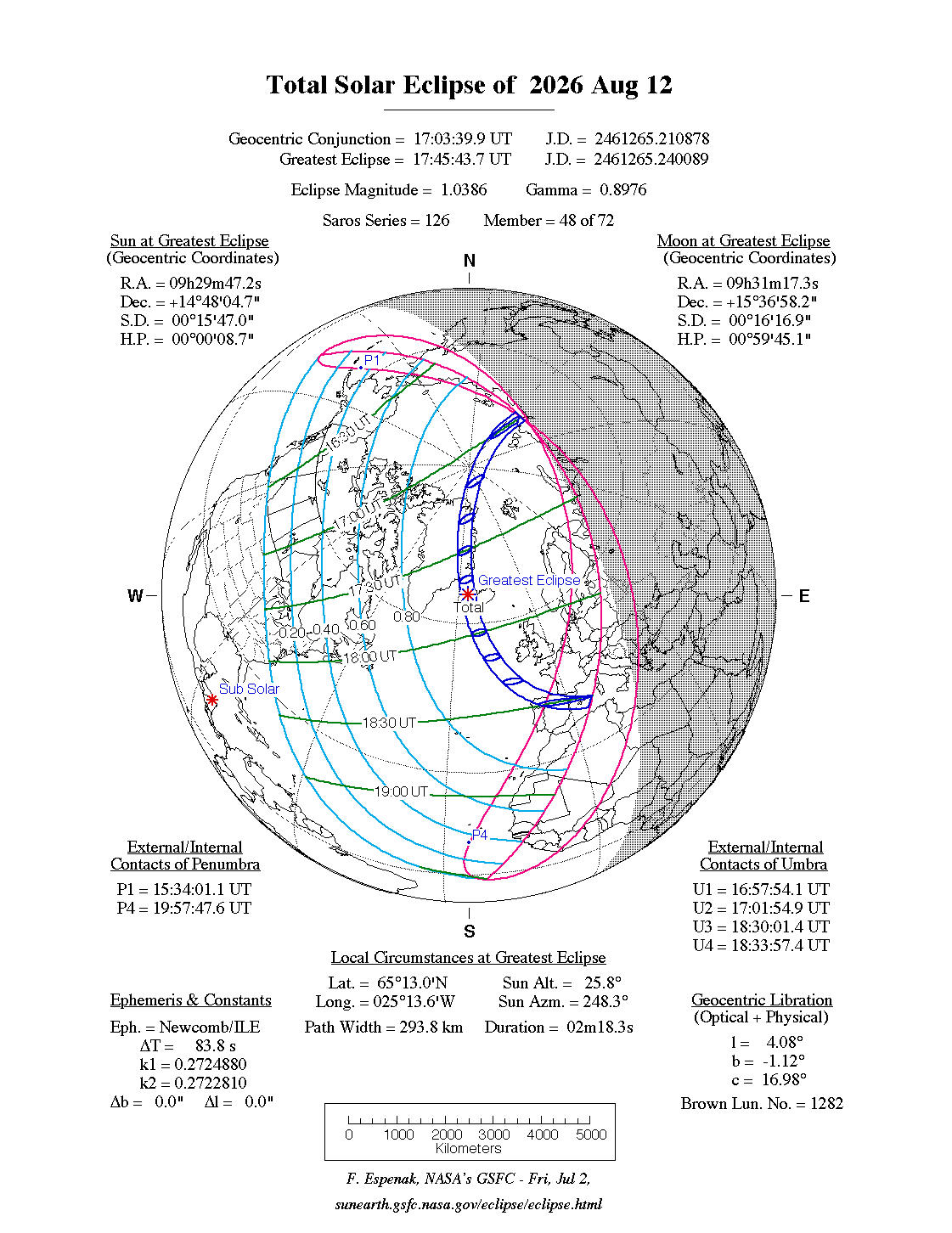
A total solar eclipse will occur at the Moon's descending node of orbit on Wednesday, August 12, 2026,[1] with a magnitude of 1.0386. A solar eclipse occurs when the Moon passes between the Earth and the Sun, and totally or partly obscures the view of the Sun for a viewer on Earth. A total solar eclipse occurs when the Moon's apparent diameter is larger than the Sun's, blocking all direct sunlight. Totality occurs in a narrow path across Earth's surface, with the partial solar eclipse visible over a surrounding region thousands of kilometres wide. Because the eclipse will occur about 2.2 days after perigee (on August 10, 2026, at 12:15 UTC), the Moon's apparent diameter will be larger.[2]
The total eclipse will pass over the Arctic, Greenland, Iceland, the Atlantic Ocean, northern Spain and the extreme northeastern part of Portugal.[3] The points of greatest duration and greatest eclipse will be just 45 km (28 mi) off the western coast of Iceland by 65°10.3' N and 25°12.3' W, where the totality will last 2m 18.21s.[citation needed] The first part of the total eclipse path will, unusually, pass from east to west from Russia to Greenland, just avoiding the North Pole. A partial eclipse will cover more than 90% of the Sun in Ireland, Great Britain, Portugal, France, Italy, the Balkans and North Africa and to a lesser extent in most of Europe, West Africa and northern North America.
The total eclipse will pass over northern Spain from the Atlantic coast to the Mediterranean coast as well as the Balearic Islands. The total eclipse will be visible from the cities of A Coruña, Valencia, Zaragoza, Palma and Bilbao, but both Madrid and Barcelona will be just outside the path of totality.[4]
The last total eclipse in continental Europe occurred on March 29, 2006[5] and in the continental part of European Union it occurred on August 11, 1999. It will be the first total solar eclipse visible in Iceland since June 30, 1954, also Solar Saros series 126 (descending node), and the only one to occur in the 21st century: the next one visible over Iceland will be in 2196. The last total solar eclipse in Spain happened on August 30, 1905 and followed a similar path across the country. The next total eclipse visible in Spain will happen less than a year later on August 2, 2027.[6]
Tourism
The longest the eclipse will last on land will be Látrabjarg in Iceland. It is therefore expected that many people will make their way there that day. Plans are being made to ensure safety in the area, but many of the roads to Látrabjarg are very narrow and dangerous. There has been talk of closing the area to car traffic and ferrying people by bus.[7] Work has started on repairing parts of the road to Látrabjarg, partly as routine maintenance but also because of the eclipse.[8]
Circumstances
The eclipse path proceeds from North Siberia throughout the Arctic Region, Iceland, eastern Atlantic to Spain and the Mediterranean.
Solar eclipse and the aurora borealis
In the North Russia area where totality will begin at sunrise, the aurora borealis could also be visible up to the beginning of the nautical twilight, depending on the intensity of the auroral activity at that date. If an extremely high intensity geomagnetic storm takes place simultaneously, there might be chances of seeing the aurora simultaneously with the eclipsed Sun. In the east of Taymyr Peninsula (north-east of Krasnoyarsk Krai) the maximum of total phase will occur on August 13 at 0:00 local time during midnight sun.[9]
Solar eclipse below the horizon
Due to the considerable eclipse gamma (more than 0.8), observers, where the totally eclipsed Sun is just below the horizon will have the chance to observe the lunar shadow in the high atmosphere, as well as shortened civil twilight and extended nautical twilight. The darkening of the twilight sky could improve the chances of observing the inner Zodiacal light.[10]
Bright planets and stars visible during totality
Far northern Russia will be treated to a dawn eclipse. Mercury and Jupiter will be very low above the rising eclipsed Sun, but Mercury will be showing most of its sunlit side and Jupiter will have its usual brightness. Mars and Saturn will be more advantageously placed in the northeast and southeast respectively. Of the bright asterisms, the Big Dipper will be very high in the north-northwest and the Summer Triangle will be high in the southwest. Aldebaran, Arcturus, Capella and Pollux are other first-magnitude stars which may be seen, although they will be low.
In Iceland the eclipse will be a mid-afternoon event occurring about 4 hours before sunset, it will start in Reykjavik at around 4:47 PM, with the total eclipse occurring at 5:48 PM.[11] Mars may be a challenge to find, because it will be low in the west. Mercury and Jupiter will be well positioned west of the Sun and Venus will be many degrees to its east. Of 1st-magnitude stars from west to east, Capella and Pollux will be at decent elevations west of the Sun; Regulus, Spica (due south), Arcturus, Vega and Deneb are candidates for easy sighting to the Sun's east. Procyon will be about to set, while Altair will be low on the opposite side.
In Spain the eclipse will occur about 1 hour before sunset. Mercury and Jupiter, west of the eclipsed Sun, will therefore be very low below it. Venus will be brilliant well up in the southwest, with Spica to its east. Arcturus will be high in the south, and the Summer Triangle will be well up in the east. Lower in the south, Antares will be minutes away from transit.[12]
Images
ملف:SE2026Aug12T.gif
Animated path
Eclipse timing
Places experiencing total eclipse
| Country or territory | City or place | Start of partial eclipse | Start of total eclipse | Maximum eclipse | End of total eclipse | End of partial eclipse | Duration of totality (min:s) | Duration of eclipse (hr:min) | Maximum magnitude |
|---|---|---|---|---|---|---|---|---|---|
 گرينلاند گرينلاند |
Station Nord | 16:19:51 | 17:18:08 | 17:18:16 | 17:18:24 | 18:15:53 | 0:16 | 1:56 | 1.0005 |
 آيسلندا آيسلندا |
Ísafjörður | 16:43:17 | 17:44:08 | 17:44:53 | 17:45:39 | 18:43:59 | 1:31 | 2:01 | 1.0052 |
| آيسلندا |
Látrabjarg | 16:43:39 | 17:44:28 | 17:45:34 | 17:46:41 | 18:44:55 | 2:13 | 2:01 | 1.014 |
| آيسلندا |
Borgarnes | 16:46:28 | 17:47:41 | 17:48:00 | 17:48:21 | 18:46:53 | 0:40 | 2:00 | 1.0012 |
| آيسلندا |
Reykjavík | 16:47:11 | 17:48:16 | 17:48:47 | 17:49:17 | 18:47:40 | 1:01 | 2:00 | 1.0024 |
| آيسلندا |
Keflavík | 16:47:11 | 17:48:05 | 17:48:54 | 17:49:44 | 18:47:54 | 1:39 | 2:01 | 1.0064 |
 البرتغال البرتغال |
Guadramil / Rio de Onor | 18:33:49 | 19:30:20 | 19:30:29 | 19:30:37 | 20:23:31 (sunset) | 0:17 | 1:49 | 1.0006 |
 إسپانيا إسپانيا |
Santander | 19:31:22 | 20:26:57 | 20:27:29 | 20:28:01 | 21:20:09 | 1:04 | 1:52 | 1.0036 |
| إسپانيا |
Bilbao | 19:31:47 | 20:27:23 | 20:27:38 | 20:27:54 | 21:19:07 (sunset) | 0:31 | 1:47 | 1.0011 |
| إسپانيا |
Gijón | 19:31:02 | 20:26:48 | 20:27:40 | 20:28:33 | 21:20:46 | 1:45 | 1:50 | 1.0127 |
| إسپانيا |
Oviedo | 19:31:19 | 20:27:05 | 20:28:00 | 20:28:54 | 21:21:06 | 1:49 | 1:50 | 1.0155 |
| إسپانيا |
Vitoria-Gasteiz | 19:32:31 | 20:27:43 | 20:28:15 | 20:28:47 | 21:17:12 (sunset) | 1:04 | 1:45 | 1.0038 |
| إسپانيا |
A Coruña | 19:30:56 | 20:27:40 | 20:28:19 | 20:28:57 | 21:22:01 | 1:17 | 1:51 | 1.005 |
| إسپانيا |
Lugo | 19:31:43 | 20:28:07 | 20:28:50 | 20:29:31 | 21:22:16 | 1:24 | 1:51 | 1.0063 |
| إسپانيا |
Logroño | 19:33:13 | 20:28:09 | 20:28:50 | 20:29:31 | 21:15:33 (sunset) | 1:22 | 1:42 | 1.0067 |
| إسپانيا |
Burgos | 19:33:21 | 20:28:24 | 20:29:17 | 20:30:08 | 21:20:12 (sunset) | 1:44 | 1:47 | 1.0139 |
| إسپانيا |
Ponferrada | 19:32:42 | 20:28:44 | 20:29:28 | 20:30:11 | 21:22:36 | 1:27 | 1:50 | 1.0069 |
| إسپانيا |
Zaragoza | 19:34:40 | 20:29:02 | 20:29:44 | 20:30:27 | 21:07:33 (sunset) | 1:25 | 1:33 | 1.0074 |
| إسپانيا |
Palencia | 19:33:53 | 20:29:08 | 20:29:59 | 20:30:51 | 21:22:35 | 1:43 | 1:49 | 1.0123 |
| إسپانيا |
Salou | 19:35:38 | 20:29:31 | 20:30:05 | 20:30:39 | 20:58:21 (sunset) | 1:08 | 1:23 | 1.0046 |
| إسپانيا |
Valladolid | 19:34:30 | 20:29:53 | 20:30:37 | 20:31:20 | 21:22:54 (sunset) | 1:27 | 1:48 | 1.0076 |
| إسپانيا |
Mahón | 19:37:22 | 20:30:16 | 20:30:51 | 20:31:26 | 20:43:31 (sunset) | 1:10 | 1:06 | 1.0055 |
| إسپانيا |
Port de Pollença | 19:37:27 | 20:30:30 | 20:31:14 | 20:31:58 | 20:48:16 (sunset) | 1:28 | 1:11 | 1.0097 |
| إسپانيا |
Alcúdia | 19:37:33 | 20:30:34 | 20:31:19 | 20:32:03 | 20:48:01 (sunset) | 1:29 | 1:10 | 1.0102 |
| إسپانيا |
Segovia | 19:35:47 | 20:31:09 | 20:31:37 | 20:32:06 | 21:19:04 (sunset) | 0:57 | 1:43 | 1.003 |
| إسپانيا |
Teruel | 19:36:55 | 20:31:04 | 20:31:51 | 20:32:38 | 21:05:52 | 1:34 | 1:29 | 1.0105 |
| إسپانيا |
Palma | 19:38:03 | 20:31:05 | 20:31:53 | 20:32:41 | 20:49:22 (sunset) | 1:36 | 1:11 | 1.0152 |
| إسپانيا |
Guadalajara | 19:36:23 | 20:31:21 | 20:31:55 | 20:32:28 | 21:14:38 (sunset) | 1:07 | 1:38 | 1.0042 |
| إسپانيا |
Cuenca | 19:37:23 | 20:32:06 | 20:32:33 | 20:32:59 | 21:09:27 (sunset) | 0:53 | 1:32 | 1.0027 |
| إسپانيا |
Valencia | 19:38:24 | 20:32:30 | 20:33:00 | 20:33:30 | 21:01:16 (sunset) | 1:00 | 1:23 | 1.0036 |
| إسپانيا |
Sant Antoni de Portmany | 19:39:08 | 20:32:40 | 20:33:13 | 20:33:46 | 20:53:39 (sunset) | 1:06 | 1:15 | 1.0047 |
| إسپانيا |
Ibiza | 19:39:15 | 20:32:45 | 20:33:18 | 20:33:49 | 20:53:00 (sunset) | 1:04 | 1:14 | 1.0043 |
| References: [1] | |||||||||
Places experiencing partial eclipse
| Country or territory | City or place | Start of partial eclipse | Maximum eclipse | End of partial eclipse | Duration of eclipse (hr:min) | Maximum coverage | |||
|---|---|---|---|---|---|---|---|---|---|
 كندا كندا |
Alert | 12:09:49 | 13:09:31 | 14:08:56 | 1:59 | 93.42% | |||
 سڤالبارد ويان ماين سڤالبارد ويان ماين |
Longyearbyen | 18:28:51 | 19:24:53 | 20:19:53 | 1:51 | 90.74% | |||
| گرينلاند |
Danmarkshavn | 16:26:59 | 17:26:23 | 18:24:29 | 1:58 | 99.12% | |||
| گرينلاند |
Ittoqqortoormiit | 15:36:14 | 16:37:02 | 17:35:50 | 2:00 | 99.67% | |||
| آيسلندا |
Vestmannaeyjar | 16:49:11 | 17:50:30 | 18:49:02 | 2:00 | 99.63% | |||
 جزر فارو جزر فارو |
Tórshavn | 17:56:29 | 18:54:51 | 19:50:34 | 1:54 | 91.22% | |||
 السويد السويد |
Stockholm | 19:03:17 | 19:56:12 | 20:46:01 (sunset) | 1:43 | 81.02% | |||
 نرويج نرويج |
Oslo | 19:02:40 | 19:57:03 | 20:49:13 | 1:47 | 83.07% | |||
 بولندا بولندا |
Warsaw | 19:14:37 | 20:02:54 | 20:06:41 (sunset) | 0:52 | 81.72% | |||
 الدنمارك الدنمارك |
Copenhagen | 19:10:08 | 20:03:37 | 20:52:19 (sunset) | 1:42 | 83.54% | |||
 ألمانيا ألمانيا |
Berlin | 19:15:28 | 20:08:25 | 20:38:04 (sunset) | 1:23 | 84.89% | |||
 جزيرة مان جزيرة مان |
Douglas | 18:11:47 | 19:09:10 | 20:03:29 | 1:52 | 92.39% | |||
 نمسا نمسا |
Vienna | 19:22:03 | 20:10:14 | 20:13:39 (sunset) | 0:52 | 84.89% | |||
 أيرلندا أيرلندا |
Dublin | 18:12:54 | 19:10:42 | 20:05:19 | 1:52 | 94.02% | |||
 هولندا هولندا |
Amsterdam | 19:16:05 | 20:10:56 | 21:03:03 | 1:47 | 88.26% | |||
 إيطاليا إيطاليا |
Rome | 19:32:47 | 20:11:38 | 20:14:38 (sunset) | 0:42 | 69.17% | |||
 التشيك التشيك |
Prague | 19:19:22 | 20:11:48 | 20:26:34 (sunset) | 1:07 | 86.29% | |||
 سلوفينيا سلوفينيا |
Ljubljana | 19:25:51 | 20:12:28 | 20:15:44 (sunset) | 0:50 | 84.25% | |||
 المملكة المتحدة المملكة المتحدة |
London | 18:17:19 | 19:13:19 | 20:06:21 | 1:49 | 91.42% | |||
 بلجيكا بلجيكا |
Brussels | 19:18:46 | 20:13:35 | 21:05:36 | 1:50 | 89.55% | |||
 لوكسمبورگ لوكسمبورگ |
Luxembourg | 19:20:56 | 20:15:11 | 20:58:21 (sunset) | 1:37 | 89.68% | |||
 فرنسا فرنسا |
Paris | 19:22:13 | 20:17:19 | 21:09:28 | 1:49 | 92.12% | |||
 سويسرا سويسرا |
Zurich | 19:24:36 | 20:18:01 | 20:42:48 (sunset) | 1:18 | 90.66% | |||
 موناكو موناكو |
Monaco | 19:30:44 | 20:23:58 | 20:38:45 (sunset) | 1:08 | 95.01% | |||
 أندورا أندورا |
Andorra la Vella | 19:33:12 | 20:27:45 | 20:59:43 (sunset) | 1:27 | 99.03% | |||
| إسپانيا |
Madrid | 19:36:45 | 20:32:23 | 21:16:22 (sunset) | 1:40 | 99.98% | |||
 الجزائر الجزائر |
Algiers | 18:42:36 | 19:33:45 | 19:42:40 (sunset) | 1:00 | 96.09% | |||
| البرتغال |
Lisbon | 18:39:17 | 19:36:07 | 20:29:08 | 1:50 | 94.52% | |||
 الجبل الأسود الجبل الأسود |
Gibraltar | 19:44:09 | 20:39:27 | 21:15:11 (sunset) | 1:31 | 93.03% | |||
 المملكة المغربية المملكة المغربية |
Casablanca | 18:48:35 | 19:43:52 | 20:20:01 (sunset) | 1:31 | 86.97% | |||
| References: [1] | |||||||||
Eclipse details
Shown below are two tables displaying details about this particular solar eclipse. The first table outlines times at which the Moon's penumbra or umbra attains the specific parameter, and the second table describes various other parameters pertaining to this eclipse.[13]
| Event | Time (UTC) |
|---|---|
| First Penumbral External Contact | 2026 August 12 at 15:35:23.9 UTC |
| First Umbral External Contact | 2026 August 12 at 16:59:18.1 UTC |
| First Central Line | 2026 August 12 at 17:01:16.5 UTC |
| First Umbral Internal Contact | 2026 August 12 at 17:03:19.0 UTC |
| Equatorial Conjunction | 2026 August 12 at 17:05:01.6 UTC |
| Ecliptic Conjunction | 2026 August 12 at 17:37:53.9 UTC |
| Greatest Duration | 2026 August 12 at 17:45:53.9 UTC |
| Greatest Eclipse | 2026 August 12 at 17:47:05.8 UTC |
| Last Umbral Internal Contact | 2026 August 12 at 18:31:21.6 UTC |
| Last Central Line | 2026 August 12 at 18:33:21.7 UTC |
| Last Umbral External Contact | 2026 August 12 at 18:35:17.7 UTC |
| Last Penumbral External Contact | 2026 August 12 at 19:59:09.2 UTC |
| Parameter | Value |
|---|---|
| Eclipse Magnitude | 1.03863 |
| Eclipse Obscuration | 1.07876 |
| Gamma | 0.89774 |
| Sun Right Ascension | 09h29m47.3s |
| Sun Declination | +14°48'04.5" |
| Sun Semi-Diameter | 15'47.0" |
| Sun Equatorial Horizontal Parallax | 08.7" |
| Moon Right Ascension | 09h31m17.3s |
| Moon Declination | +15°36'58.5" |
| Moon Semi-Diameter | 16'16.9" |
| Moon Equatorial Horizontal Parallax | 0°59'45.1" |
| ΔT | 72.4 s |
Eclipse season
This eclipse is part of an eclipse season, a period, roughly every six months, when eclipses occur. Only two (or occasionally three) eclipse seasons occur each year, and each season lasts about 35 days and repeats just short of six months (173 days) later; thus two full eclipse seasons always occur each year. Either two or three eclipses happen each eclipse season. In the sequence below, each eclipse is separated by a fortnight.
| August 12 Descending node (new moon) |
August 28 Ascending node (full moon) |
|---|---|
|

|
| Total solar eclipse Solar Saros 126 |
Partial lunar eclipse Lunar Saros 138 |
Related eclipses
Eclipses in 2026
- An annular solar eclipse on February 17.
- A total lunar eclipse on March 3.
- A total solar eclipse on August 12.
- A partial lunar eclipse on August 28.
Metonic
- Preceded by: Solar eclipse of October 25, 2022
- Followed by: Solar eclipse of June 1, 2030
Tzolkinex
- Preceded by: Solar eclipse of July 2, 2019
- Followed by: Solar eclipse of September 23, 2033
Half-Saros
- Preceded by: Lunar eclipse of 7 August 2017
- Followed by: Lunar eclipse of 19 August 2035
Tritos
- Preceded by: Solar eclipse of September 13, 2015
- Followed by: Solar eclipse of July 13, 2037
Solar Saros 126
- Preceded by: Solar eclipse of August 1, 2008
- Followed by: Solar eclipse of August 23, 2044
Inex
- Preceded by: Solar eclipse of September 2, 1997
- Followed by: Solar eclipse of July 24, 2055
Triad
- Preceded by: Solar eclipse of October 12, 1939
- Followed by: Solar eclipse of June 13, 2113
Solar eclipses of 2026–2029
قالب:Solar eclipse set 2026–2029
Saros 126
Metonic series
قالب:Solar Metonic series 2011–2098
Tritos series
قالب:Solar Tritos series 2004 October 14
Inex series
قالب:Solar Inex series 2026 August 12
References
- ^ أ ب ت "August 12, 2026 Total Solar Eclipse". timeanddate. Retrieved 13 August 2024.
- ^ "Moon Distances for London, United Kingdom, England". timeanddate. Retrieved 13 August 2024.
- ^ Jamie Carter (2024-08-25). "Where can I see the total solar eclipse on Aug. 12, 2026?". Space.com (in الإنجليزية). Retrieved 2024-09-18.
- ^ "Eclipse solar abril 2024 en directo: mapa, trayectoria en España y horarios del eclipse de sol, hoy en vivo". Diario AS (in الإسبانية). 2024-04-09. Retrieved 2024-09-18.
- ^ see f.e. Eclipse in Astrakhan, which is located in European Russia
- ^ Lagatta, Eric (April 10, 2024). "Total solar eclipses are becoming more rare. Here's why 'it's all downhill from here.'". USA TODAY (in الإنجليزية الأمريكية). Retrieved 2024-09-18.
- ^ "Umferðarstýring og gæsla við Látrabjarg í undirbúningi vegna sólmyrkva á næsta ári - RÚV.is". www.ruv.is. 21 June 2025. Retrieved 2025-07-24.
- ^ "Tveir kaflar að Látrabjargi lagfærðir fyrir almyrkvann - Vísir". www.visir.is. Retrieved 2025-07-24.
- ^ 12–13 August, 2026. — Total Solar Eclipse — Mys Izbovoy, Russia. timeanddate.com
- ^ Guliaev, R. A. (1992). "On a possible use of total solar eclipse below the horizon for observations of the inner zodiacal light (as applied to the eclipse of 30 June, 1992)". Solar Physics. 138 (1): 209–211. Bibcode:1992SoPh..138..209G. doi:10.1007/BF00146206. S2CID 122443822.
- ^ Freyr, Aron (2024-09-02). "2026 Solar Eclipse in Iceland: Facts, Best Spots, Tips, etc". www.gocarrental.is (in الإنجليزية). Retrieved 2024-09-18.
- ^ https://skyandtelescope.org/interactive-sky-chart/ Sky & Telescope Interactive Sky Chart
- ^ "Total Solar Eclipse of 2026 Aug 12". EclipseWise.com. Retrieved 13 August 2024.
External links
- "Total Solar Eclipse of 2026 Aug 12". Archived from the original on 17 September 2008.
- "Path of Total Solar Eclipse of 2026 Aug 12". eclipse.gsfc.nasa.gov. Retrieved 24 July 2025.
- "Total Solar Eclipse on August 12, 2026". www.timeanddate.com. Retrieved 24 July 2025.
- "2026 Total Solar Eclipse Maps for Iceland and Spain". nationaleclipse.com. Retrieved 24 July 2025.
- Jay Anderson (1 February 2023). "Total Solar Eclipse: 2026 August 12". Eclipsophile. Archived from the original on 11 August 2025. Retrieved 7 December 2025.
- "Total Solar Eclipse August 12, 2026 – Iceland". eclipse2026.is. Retrieved 2026-05-14.
- "Partial Solar Eclipse August 12, 2026 – UK". ukeclipse.com. Retrieved 2026-06-08.
| قائمة الكسوفات | الأزمنة العتيقة · القرن 19 · القرن 20 · القرن 21 · Eclipses seen from: China / the United Kingdom |  |
|---|---|---|
| Individual eclipses | Mursili's eclipse · Assyrian eclipse · Battle of Halys · Crucifixion darkness and eclipse · July 11, 1991 · August 11, 1999 · June 21, 2001 · December 4, 2002 · November 23, 2003 · April 19, 2004 · April 8, 2005 · October 3, 2005 · March 29, 2006 · August 1, 2008 · 22 يوليو 2009 · July 22, 2009 · January 15, 2010 · 11 يوليو، 2010 · November 13, 2012 · November 3, 2013 · April 29, 2014 · March 20, 2015 · March 9, 2016 · August 21, 2017 · July 2, 2019 · December 14, 2020 · December 4, 2021 · April 20, 2023 · April 8, 2024 · August 12, 2026 · August 2, 2027 · July 22, 2028 | |
| في كواكب أخرى | ||
| موضوعات متعلقة | ||


- CS1 الإسبانية-language sources (es)
- CS1 الإنجليزية الأمريكية-language sources (en-us)
- Short description is different from Wikidata
- Pages using gadget WikiMiniAtlas
- Articles with unsourced statements from December 2025
- Articles with hatnote templates targeting a nonexistent page
- 2026 in science
- 21st-century solar eclipses
- Future solar eclipses
- Total solar eclipses
- August 2026