مادة مظلمة

| جزء من سلسلة عن |
| علم الكون الطبيعي |
|---|
 |


في علم الفلك وعلم الكون، المادة المظلمة (dark matter)، هي شكل افتراضي وغير مرئي من المادة لا يتفاعل مع الضوء أو الأشعة الكهرومغناطيسي. وتُستدل على وجود المادة المظلمة من خلال تأثيرات الجاذبية التي لا يمكن تفسيرها بنظرية النسبية العامة إلا إذا كانت كمية المادة الموجودة أكبر مما يمكن رصده. وتحدث هذه التأثيرات في سياق تشكل المجرات وتطورها،[1] عدسة الجاذبية،[2] البنية الحالية للكون المرصود، وموقع الكتلة في تصادمات المجرات،[3] حركة المجرات داخل عناقيد المجرات، وإشعاع الخلفية الصغروي الكوني. يُعتقد أن المادة المظلمة تعمل كدعامات جاذبية للبُنى الكونية.[4] بعد الانفجار العظيم، تجمعت المادة المظلمة في كتل على امتداد خيوط ضيقة، وشكلت عناقيد المجرات العملاقة شبكة كونية على نطاقات تبدو فيها المجرات بأكملها كجسيمات صغيرة.[5][6]
في نموذج لامبدا-سيديإم المعياري، فإن محتوى الكتلة-الطاقة للكون هو 5% مادة عادية، و26.8% مادة مظلمة، و68.2% شكل من أشكال الطاقة يُعرف باسم الطاقة المظلمة.[7][8][9][10] وبالتالي، تشكل المادة المظلمة 85% من الكتلة الإجمالية، بينما تشكل الطاقة المظلمة والمادة المظلمة 95% من إجمالي محتوى الكتلة-الطاقة.[11][12][13][14] على الرغم من أن كثافة المادة المظلمة كبيرة في الهالة المحيطة بالمجرة، إلا أن كثافتها المحلية في المجموعة الشمسية أقل بكثير من كثافة المادة العادية. ويبلغ مجموع كتلة المادة المظلمة حتى مدار نپتون حوالي 1017 كجم، أي ما يعادل كتلة كويكب كبير.[15]
لا يُعرف أن المادة المظلمة تتفاعل مع المادة الباريونية العادية والإشعاع إلا من خلال الجاذبية، مما يجعل اكتشافها في المعمل صعباً. التفسير الأكثر شيوعاً هو أن المادة المظلمة عبارة عن جسيم دون ذري لم يُكتشف بعد، مثل الجسيمات الضخمة ضعيفة التفاعل (WIMPs) أو الأكسيونات.[16] الاحتمال الرئيسي الآخر هو أن المادة المظلمة تتكون من ثقوب سوداء بدائية.[17][18][19]
تُصنّف المادة المظلمة إلى "باردة" أو "دافئة" أو "ساخنة" وفقاً لسرعتها (أو تحديداً، طول مسارها الحر). وقد رجّحت النماذج الحديثة سيناريو المادة المظلمة الباردة، حيث تنشأ البُنى من خلال التراكم التدريجي للجسيمات.
على الرغم من أن مجتمع الفيزياء الفلكية يقبل عموماً وجود المادة المظلمة،[20] يدعو عدد قليل من علماء الفيزياء الفلكية، الذين أثارت اهتمامهم ملاحظات محددة لا يُفسرها مفهوم المادة المظلمة التقليدية تفسيراً وافياً، إلى تعديلات مختلفة على قوانين النسبية العامة. تشمل هذه التعديلات الديناميكا النيوتونية المعدلة، والجاذبية الموترية-المتجهية-القياسية، والجاذبية الإنتروپية. حتى الآن، لا تستطيع أي من نظريات الجاذبية المعدلة المقترحة تفسير جميع الأدلة الرصدية في آن واحد، مما يشير إلى أنه حتى في حال تعديل الجاذبية، سيظل وجود شكل من أشكال المادة المظلمة ضرورياً.[21]
التاريخ
التاريخ المبكر
تتمتع فرضية المادة المظلمة بتاريخ مفصل.[22][23] ناقش وليام طومسون، لورد كلڤن، العدد المحتمل للنجوم حول الشمس في ملاحق كتاب استند إلى سلسلة من المحاضرات التي ألقاها عام 1884 في بالتيمور.[24][22] استنتج كلڤن كثافتها باستخدام تشتت السرعة المرصود للنجوم القريبة من الشمس، بافتراض أن عمر الشمس يتراوح بين 20 و100 مليون سنة. وتساءل عما سيحدث لو كان هناك ألف مليون نجم ضمن مسافة 1 كيلو فرسخ فلكي من الشمس (حيث يكون اختلاف المنظر عند هذه المسافة 1 [[دقيقة وثانية القوس|ملي-ثانية قوس). وخلص كلڤن إلى أن:
قد تكون العديد من نجومنا المفترضة التي يبلغ عددها آلاف الملايين - وربما غالبيتها العظمى - أجراماً مظلمة.[24][25]
عام 1906، استخدم هنري پوانكاريه[26] المصطلح الفرنسي [matière obscure] ("المادة المظلمة") في نقاشه لعمل كلڤن.[26][25] لقد وجد أن كمية المادة المظلمة يجب أن تكون أقل من كمية المادة المرئية، لكن اتضح أن هذا الاكتشاف خاطئ.[25][22]
ثاني من اقترح وجود المادة المظلمة باستخدام سرعات النجوم كان الفلكي الهولندي ياكوبوس كاپتين عام 1922.[27][28]
تشير إحدى منشورات عالم الفلك السويدي نوت لوندمارك عام 1930 إلى أنه كان أول من أدرك أن الكون يجب أن يحتوي على كتلة أكبر بكثير مما يمكن رصده.[29] افترض رائد علم الفلك الراديوي الهولندي يان أورت أيضاً وجود المادة المظلمة عام 1932.[28][30][31] كان أورت يدرس حركات النجوم في الجوار المجري ووجد أن الكتلة في مستوى المجرة يجب أن تكون أكبر مما رُصد، لكن تبين لاحقاً أن هذا القياس غير صحيح.[32]
عام 1933، درس عالم الفيزياء الفلكية السويسري فريتس تسڤيكي عناقيد المجرات أثناء عمله في معهد كاليفورنيا للتكنولوجيا وتوصل إلى استنتاج مماثل.[33][أ][34] طبّق تسڤيكي نظرية ڤيريال على عنقود الذؤابة، وحصل على دليل على وجود كتلة غير مرئية أطلق عليها اسم dunkle Materie ('المادة المظلمة'). قدّر تسڤيكي كتلة العنقود بناءً على حركة المجرات القريبة من حافته، وقارن ذلك بتقدير آخر مبني على سطوعه وعدد مجراته. وقدّر أن كتلة العنقود تزيد بنحو 400 ضعف عن الكتلة المرئية. كان تأثير جاذبية المجرات المرئية ضئيلاً للغاية بالنسبة لهذه المدارات السريعة، مما يعني أن الكتلة مخفية عن الأنظار. بناءً على هذه الاستنتاجات، استنتج تسڤيكي أن بعض المادة غير المرئية هي التي وفرت الكتلة وقوة الجذب المرتبطة بها للحفاظ على تماسك العنقود.[35] كانت تقديرات تسڤيكي خاطئة بأكثر من قيمة أسية، ويرجع ذلك أساساً إلى قيمة ثابت هبل المهملة؛[36] تُظهر الحسابات نفسها اليوم نسبةً أقل، باستخدام قيم أكبر للكتلة اللامعة. ومع ذلك، فقد استنتج تسڤيكي بشكل صحيح من حساباته أن معظم المادة الجاذبية الموجودة كانت مظلمة.[25] لكن على عكس النظريات الحديثة، اعتبر تسڤيكي "المادة المظلمة" مادة عادية غير لامعة.[22]
ظهرت مؤشرات إضافية على وجود شذوذ في نسبة الكتلة إلى الضوء من خلال قياسات منحنيات دوران المجرات. عام 1939، نشر هوراس بابكوك منحنى دوران مجرة المرأة المسلسلة، والذي أشار إلى أن نسبة الكتلة إلى اللمعان تزداد شعاعياً.[37] عزا ذلك إما إلى امتصاص الضوء داخل المجرة أو إلى تغيرات في ديناميكيات الأجزاء الخارجية من المجرة الحلزونية، بدلاً من وجود مادة غير مرئية. بعد تقرير بابكوك عام 1939 عن دوران سريع غير متوقع في أطراف مجرة المرأة المسلسلة ونسبة الكتلة إلى الضوء تبلغ 50؛ عام 1940، اكتشف أورت وكتب عن الهالة الكبيرة غير المرئية لمجرة NGC 3115.[38]
السبعينيات
ترسخت فرضية المادة المظلمة بشكل كبير في السبعينيات. جُمعت عدة ملاحظات مختلفة للتأكيد على أن المجرات يجب أن تكون محاطة بهالات من مادة غير مرئية. في ورقتين بحثيتين نُشرتا عام 1974، توصلت مجموعتان بحثيتان مستقلتان إلى هذا الاستنتاج: الأولى في پرنستون، نيوجرزي، بواسطة جرميا أوسترايكر، جيم پيبلز، وعاموس ياهيل، والثانية في تارتو، إستونيا، بواسطة يان إيناستو، إن ساريت، وأنتس كاسيك.[39]
كان شكل منحنيات دوران المجرة أحد الملاحظات التي قدمت دليلاً على وجود هالات مجرية من المادة المظلمة. أُجريت هذه الملاحظات في علم الفلك البصري والراديو. في علم الفلك البصري، عملت ڤيرا روبن وكنت فورد باستخدام مطياف جديد لقياس منحنى سرعة المجرات الحلزونية التي تُرى من جانبها بدقة أكبر.[40][41][42]
في الوقت نفسه، كان علماء الفلك الراديوي يستخدمون تلسكوبات راديوية جديدة لرسم خريطة الخط 21 سم للهيدروجين الذري في المجرات القريبة. غالباً ما يمتد التوزيع القطري للهيدروجين الذري بين النجوم (المنطقة H I) إلى مسافات مجرية أكبر بكثير مما يمكن رصده كضوء نجمي جماعي، مما يوسع نطاق المسافات التي يمكن أخذ عينات منها لمنحنيات الدوران - وبالتالي توزيع الكتلة الكلية - إلى نظام ديناميكي جديد. رُسمت خريطة مبكرة لمجرة المرأة المسلسلة باستخدام تلسكوب يبلغ قطره 91 متراً في گرين بانك[43] وطبق يبلغ قطره 76 متراً في جودرل بانك[44] وظهر بالفعل أن منحنى دوران HI لم يتتبع الانخفاض المتوقع من المدارات الكپلرية.
مع توفر أجهزة استقبال أكثر حساسية، Roberts & Whitehurst (1975)[45] تمكن الباحثون من تحديد سرعة دوران مجرة المرأة المسلسلة حتى مسافة 30 ك.ف.ف.، وهو ما يتجاوز بكثير نطاق القياسات البصرية. وهذا يوضح ميزة تتبع قرص الغاز عند أنصاف أقطار كبيرة؛ كما هو موضح في "الشكل 16" من تلك الورقة البحثية[45] يجمع البيانات البصرية[42] (مجموعة النقاط عند أنصاف أقطار أقل من 15 كيلوبارسيك مع نقطة واحدة أبعد) مع بيانات HI بين 20 و30 ك.ف.ف، مما يُظهر استواء منحنى دوران المجرة الخارجية؛ المنحنى المتصل الذي يبلغ ذروته في المركز هو كثافة السطح البصرية، بينما يُظهر المنحنى الآخر الكتلة التراكمية، التي لا تزال ترتفع خطيًا عند القياس الأبعد. بالتوازي مع ذلك، كان يجري تطوير استخدام مصفوفات التداخل الطيفي لـ HI خارج المجرة. نشر شوستاك وروجستاد[46] منحنيات دوران HI لخمسة حلزونات رُسمت باستخدام مقياس التداخل في وادي أوينز؛ وكانت منحنيات دوران جميعها مسطحة للغاية، مما يشير إلى قيم كبيرة جداً لنسبة الكتلة إلى الضوء في الأجزاء الخارجية من أقراص HI.[46]
عام 1978، قدم ألبرت بوسما مزيداً من الأدلة على منحنيات الدوران المسطحة باستخدام بيانات من تلسكوب وستربورك الراديوي التخليقي.[47]
عام 1978، قدم ستيگمان وزملائه[48] دراسة وسّعت حسابات الكثافة المتبقية الكونية السابقة لتشمل أي لپتون افتراضي مستقر، متعادل كهربائياً، وذو طاقة ضعيفة، موضحة كيف ستتلاشى وفرة هذا الجسيم في الكون المبكر، ومقدمةً تعابير تحليلية تربط كتلته ومقطع التفاعل الضعيف بكثافة المادة الحالية. ومن خلال فصل التحليل عن خصائص النيوترينو المحددة ومعالجة المرشح بشكل عام، وضع المؤلفون إطاراً أصبح فيما بعد النموذج القياسي للجسيمات الضخمة ضعيفة التفاعل (WIMPs)[49] ولمقارنة نماذج فيزياء الجسيمات بالقيود الكونية. على الرغم من أن الأعمال اللاحقة قد حسّنت المنهجية واستكشفت العديد من المرشحين البديلين، إلا أن هذه الورقة البحثية مثّلت أول معالجة صريحة ومنهجية للمادة المظلمة كنوع جديد من الجسيمات يتجاوز النموذج المعياري.[50]
بحلول أواخر السبعينيات، أصبح وجود هالات المادة المظلمة حول المجرات حقيقة معترف بها على نطاق واسع، وأصبح مشكلة رئيسية لم تُحل في علم الفلك.[39]
1980–التسعينيات
دعمت سلسلة من الملاحظات في فترة 1980-التسعينيات وجود المادة المظلمة. Persic, Salucci & Stel (1996) وتشتهير تلك الملاحظات بالتحقيق في 967 حلزوناً.[51] وتضمنت الأدلة على وجود المادة المظلمة أيضاً ظاهرة عدسة الجاذبية للأجسام الخلفية بواسطة عناقيد المجرات،[52] توزيع درجة حرارة الغاز الساخن في المجرات والعناقيد، ونمط التباينات في إشعاع الخلفية الصغروي الكوني.
وفقاً للإجماع الحالي بين علماء الكون، تتكون المادة المظلمة بشكل أساسي من نوع من الجسيمات دون الذرية التي لم يتم تحديد خصائصها بعد.[53][54] يُعد البحث عن هذه الجسيمات، من خلال وسائل متنوعة، أحد الجهود الرئيسية في فيزياء الجسيمات.[55]
التعريف التقني
في الحسابات الكونية القياسية، تعني كلمة "المادة" أي مكون من مكونات الكون تتناسب كثافة طاقته مع مكعب عامل المقياس العكسي، أي ρ ∝ a−3 . وهذا على النقيض من "الإشعاع"، الذي يتناسب عكسياً مع القوة الرابعة لعامل المقياس ρ ∝ a−4 , وثابت كوني لا يتغير بالنسبة إلى a (ρ ∝ a0).[56] تُعدّ عوامل القياس المختلفة للمادة والإشعاع نتيجةً للإشعاع الإزاحة الحمراء. على سبيل المثال، بعد مضاعفة قطر الكون المرصود عبر تمدد الكون، فإن المقياس، a، قد تضاعف. انخفضت طاقة إشعاع الخلفية الصغروي الكوني إلى النصف (لأن طول موجة كل فوتون قد تضاعف)؛[57] وبالمثل، تنخفض طاقة الجسيمات فائقة الجاذبية، مثل نيوترينوات النموذج القياسي في الحقبة المبكرة، إلى النصف.[ب] الثابت الكوني، باعتباره خاصية جوهرية للفضاء، له كثافة طاقة ثابتة بغض النظر عن الحجم قيد الدراسة.[56]
من حيث المبدأ، تعني "المادة المظلمة" جميع مكونات الكون غير المرئية لكنها تخضع لقوانين الكون ρ ∝ a−3 . من الناحية العملية، غالباً ما يُستخدم مصطلح "المادة المظلمة" ليعني فقط المكون غير الباريوني للمادة المظلمة، أي استبعاد "الباريونات المفقودة".[58] عادةً ما يشير السياق إلى المعنى المقصود.
دور المادة المظلمة
لعبت المادة المظلمة دوراً أساسياً في تخليق النجوم في البدايات الأولى من الكون، إذا كانت المادة المظلمة على هذه الحالة، على أية حال، يجب أن يشتمل المادة المظلمة على الجزيئات المعروفة بـ"النيوترونات العقيمة". قام بيتر بيرمان من معهد ماكس بلانك لعلوم الفلك الإشعاعي في بون، وألكسندر كوسينكو، من جامعة كاليفورنيا في لوس أنجليس، باظهار أنه عندما تضمحل النيوترونات العقيمة، فإنها تسرّع عملية خلق جزيئات الهيدروجين، هذه العملية ساعدت على إضاءة النجوم الأولى فقط منذ حوالي 20 إلى 100 مليار سنة بعد الانفجار الكبير، كل هذه المعطيات تعطينا تفسيراً بسيطاً لبعض الملاحظات المحيرة الأخرى التي تتعلق بالمادة المظلمة، النيوترونات العقيمة، والمادة المضادة.
اكتشف العلماء بأن تلك النيوترونات لها كتلة خلال تجارب قياس ذبذبة النيوترونات. هذا قاد إلى افتراضات بإن النيوترونات العقيمة الموجودة - هي كذلك معروفة أيضا بالنيوترونات اليمينية، وبأنها لا تشارك في التفاعلات الضعيفة مباشرة، ولكنها تتفاعل من خلال خلطها مع النيوترونات العادية.إن العدد الكلي للنيوترونات العقيمة غير واضح، إذا كانت كتلة المادة المظلمة نعادل بضعة كيلو إلكترونوفولتز (1 KeV تعادل مليون كتلة ذرة الهيدروجين)، فإنها توضح ضخامة الكتلة المفقودة في الكون، أحيانا، تسمى المادة المظلمة، ودعمت ملاحظات الفلكيين الفيزيائيين وجهة نظر باحتمال بأن المادة المظلمة تشتمل على النيوترونات العقيمة.
نظرية بيرمان وكوسينكو
.

تسلط نظرية بيرمان وكوسينكو الضوء على عدد من الألغاز الفلكية الغير مفسرة، أولا، وأثناء الانفجار الكبير، كانت كتلة النيوترونات المخلوقة في الانفجار الكبير تساوي ما نحتاجه لتفسير المادة المظلمة، ثانياً، هذه الجسيمات يمكن أن تكون الحل لمشكلة كبيرة حول لماذا تتحرك البولسرات بسرعة كبيرة.
البولسرات هي نجوم نيوترونية تدور بسرعة عالية جداً، ونشأت نتيجة لانفجار مستعر فائق (سوبرنوفا) وتكون عادة مقذوفة في اتجاه واحد. الانفجار أعطاها " دفعاً قويا"، مثل محرك صاروخ. مما يجعل البولسرات تسير بسرعات كبيرة تصل إلى مئات الكيلومترات في الثانية - وأحياناً إلى الآلاف. مصدر هذه السرعات تبقى مجهولة، لكن إشعاع النيوترونات العقيمة توضح تحركات البولسرات.
يحتوي سديم القيثارة على بولسرات سريعة جداً، إذا كانت المادة المظلمة صنعت جزيئات مؤينة في الكون - كما يقترح بيرمان وكوسينكو- بأن حركة البولسرات هي التي أنشأت سديم القيثارة.
كما ان النيوترونات العقيمة يمكن أن تساعد على توضيح انعدام المادة المضادة في الكون. في بدايات الكون الأولى، كانت النيوترونات العقيمة "تسرق" ما يعرف بــ" ترقيمات ليبتون" من البلازما. وفي وقت لاحق، أدت قلة ترقيمات ليبتون إلى تحويلها إلى عدد غير صفري من الترقيمات البريونية. اللاتناظر الناتج بين البريونات (مثل البروتون) والبريونات المضادة (مثل البروتون المضاد) يمكن أن يكون السبب حول عدم وجود مادة مضادة في الكون.
فتشكيلة الثقوب السوداء المركزية في المجرة، بالإضافة إلى التركيب القياسي للمجرات الفرعية، تعطي تفسيراً مفضلا حول النيوترونات العقيمة في المادة المظلمة. والإجماع على آراء متعددة معقدة يقود إلى اتجاه واحد باعتقاد أن المادة المظلمة، في الحقيقة، هي نيوترونات عقيمة[59].
أدلة رصدية
منحنيات دوران المجرة
تدور أذرع المجرات الحلزونية حول مركزها المجري. تتناقص كثافة الكتلة المضيئة للمجرة الحلزونية كلما اتجهنا من المركز إلى الأطراف. إذا كانت الكتلة المضيئة هي كل المادة، فيمكن نمذجة المجرة على أنها كتلة نقطية في المركز وكتل اختبارية تدور حولها، على غرار المجموعة الشمسية.[ت] من المتوقع، وفقاً لقانون كپلر الثالث، أن تتناقص سرعات الدوران مع زيادة المسافة عن المركز، على غرار المجموعة الشمسية. إلا أن هذا لم يُلاحظ.[61] بدلاً من ذلك، يظل منحنى دوران المجرة مسطحاً أو حتى يزداد مع زيادة المسافة من المركز.
إذا كانت قوانين كپلر صحيحة، فإن الطريقة الواضحة لحل هذا التناقض هي استنتاج أن توزيع الكتلة في المجرات الحلزونية لا يشبه توزيعها في المجموعة الشمسية. وعلى وجه الخصوص، قد توجد كميات كبيرة من المادة غير اللامعة (المادة المظلمة) في أطراف المجرة.
تبدد سرعة المجرات
تخضع النجوم في الأنظمة المرتبطة بحسب نظرية ڤيريال. يمكن استخدام هذه النظرية، إلى جانب توزيع السرعة المقاس، لقياس توزيع الكتلة في نظام مرتبط، مثل المجرات الإهليلجية أو العناقيد الكروية. باستثناءات قليلة، تُقدَّر تشتتات سرعة المجرات الإهليلجية[62] لا تتطابق مع تشتت السرعة المتوقع من توزيع الكتلة المرصود، حتى مع افتراض التوزيعات المعقدة للمدارات النجمية.[63]
كما هو الحال مع منحنيات دوران المجرات، فإن الطريقة الواضحة لحل هذا التناقض هي افتراض وجود مادة غير مضيئة.
عناقيد المجرات
تُعد عناقيد المجرات ذات أهمية خاصة لدراسات المادة المظلمة حيث يمكن تقدير كتلها بثلاث طرق مستقلة:
- من تشتت السرعات الشعاعية للمجرات داخل العناقيد.
- من الأشعة السينية المنبعثة من الغاز الساخن في العناقيد. من طيف طاقة الأشعة السينية وتدفقها، يمكن تقدير درجة حرارة الغاز وكثافته، ومن ثم تحديد الضغط؛ بافتراض أن توازن الضغط والجاذبية يحدد توزيع كتلة العنقود.
- يمكن لعدسة الجاذبية (عادةً للمجرات البعيدة) قياس كتل العناقيد دون الاعتماد على ملاحظات الديناميكيات (مثل السرعة).
بشكل عام، تتفق هذه الطرق الثلاث بشكل معقول على أن المادة المظلمة تفوق المادة المرئية بنسبة 5 إلى 1 تقريباً.[64]

عنقود الطلقة
تشكل عنقود الرصاصة نتيجة اصطدام حديث بين عنقودين مجريين. وتكتسب أهمية خاصة لأن موقع مركز كتلتها، كما يُقاس بواسطة عدسة الجاذبية، يختلف عن موقع مركز كتلة المادة المرئية. وهذا ما يصعب على نظريات الجاذبية المعدلة، التي تتنبأ عمومًا بحدوث عدسة جاذبية حول المادة المرئية، تفسيره.[65][66][67][68] لكن نظرية المادة المظلمة القياسية لا تواجه أي مشكلة: فالغاز الساخن المرئي في كل عنقود يبرد ويتباطأ بفعل التفاعلات الكهرومغناطيسية، بينما المادة المظلمة (التي لا تتفاعل كهرومغناطيسياً) لا تتأثر. وهذا يؤدي إلى انفصال المادة المظلمة عن الغاز المرئي، مما ينتج عنه ذروة عدسية منفصلة كما هو مرصود.[69]
عدسة الجاذبية
من نتائج نظرية النسبية العامة ظاهرة عدسة الجاذبية. تحدث عدسة الجاذبية عندما تعمل الأجسام الضخمة الواقعة بين مصدر الضوء والمراقب كعدسة لثني الضوء الصادر من هذا المصدر. لا تعتمد هذه الظاهرة على خصائص الكتلة، بل يكفي وجود كتلة. كلما زادت كتلة الجسم، زادت وضوح ظاهرة عدسة الجاذبية. مثال على ذلك عناقيد مجرات يقع بين مصدر بعيد كالكويزر والمراقب. في هذه الحالة، سيؤثر عنقود المجرات على الكويزر كعدسة جاذبية.
تُعرف ظاهرة العدسة الجاذبية القوية بأنها تشوه المجرات الخلفية إلى شكل أقواس عندما يمر ضوؤها عبر عدسة جاذبية. وقد لوحظت هذه الظاهرة حول العديد من التجمعات المجرية البعيدة، بما في ذلك آبل 1689.[70] من خلال قياس هندسة التشوه، يمكن الحصول على كتلة العنقود المتداخل. في نظام ضعيف، لا تُشوه العدسة المجرات الخلفية إلى أقواس، بل تُسبب تشوهات طفيفة. من خلال فحص التشوه القصي الظاهري للمجرات الخلفية المجاورة، يمكن تحديد التوزيع المتوسط للمادة المظلمة. تتوافق نسب الكتلة إلى الضوء المقاسة مع كثافات المادة المظلمة المتوقعة من قياسات أخرى للبنية واسعة النطاق.[71][72]
قياسات المسافة بين المستعرات العظمى من النوع Ia
يمكن استخدام المستعرات العظمى من النوع Ia كشموع معيارية لقياس المسافات بين المجرات، والتي بدورها يمكن استخدامها لقياس مدى سرعة تمدد الكون في الماضي.[73] تشير البيانات إلى أن الكون يتمدد بمعدل متسارع، ويعزى سبب ذلك عادةً إلى الطاقة المظلمة.[74] بما أن الملاحظات تشير إلى أن الكون مسطح تقريباً،[75][76][77] ومن المتوقع أن يكون مجموع كثافة الطاقة الكلية لكل شيء في الكون يساوي 1 (Ωtot ≈ 1). تبلغ كثافة الطاقة المظلمة المقاسة ΩΛ ≈ 0.690، بينما تبلغ كثافة طاقة المادة العادية (الباريونية) المرصودة Ωb ≈ 0.0482، وكثافة طاقة الإشعاع ضئيلة. يتبقى بذلك عنصر مفقود Ωdm ≈ 0.258، والذي مع ذلك يتصرف كالمادة (انظر قسم التعريف التقني أعلاه)، أي المادة المظلمة.[78]
تشوهات الإزاحة الحمراء-الفضاء
يمكن استخدام مسوحات الإزاحة الحمراء للمجرات الكبيرة لإنشاء خريطة ثلاثية الأبعاد لتوزيع المجرات. هذه الخرائط مشوهة قليلاً لأن المسافات تُقدّر من الإزاحات الحمراء المرصودة؛ إذ تحتوي الإزاحة الحمراء على مساهمة من ما يُسمى بالسرعة الخاصة للمجرة بالإضافة إلى حد تمدد هبل السائد. في المتوسط، تتمدد التجمعات المجرية العملاقة ببطء أكبر من المتوسط الكوني بسبب جاذبيتها، بينما تتمدد الفراغات المجرية بسرعة أكبر من المتوسط. في خريطة الإزاحة الحمراء، تمتلك المجرات الواقعة أمام التجمع المجري العملاق سرعات شعاعية زائدة باتجاهه، ويكون إزاحتها الحمراء أعلى قليلاً مما يُفترض أن تكون عليه المسافة، بينما تكون إزاحة المجرات الواقعة خلف التجمع المجري العملاق أقل قليلاً بالنسبة للمسافة. يتسبب هذا التأثير في ظهور التجمعات المجرية العملاقة مضغوطة في الاتجاه الشعاعي، وبالمثل، تظهر الفراغات المجرية ممتدة. أما مواقعها الزاوية فلا تتأثر. لا يمكن رصد هذا التأثير في أي بنية منفردة لعدم معرفة شكلها الحقيقي، ولكن يمكن قياسه عن طريق حساب المتوسط عبر العديد من البنى. وقد تنبأ به نيك كايزر كمياً عام 1987، وقيس لأول مرة بشكل قاطع عام 2001 بواسطة مسح الإزاحة الحمراء 2dF.[79] تتفق النتائج مع نموذج لامبدا-سيديإم.
غابة لايمان-ألفا
في المطيافية افلكية، تُعرف غابة لايمان-ألفا بأنها مجموع خطوط الامتصاص الناتجة عن انتقال خط الهيدروجين المتعادل في أطياف المجرات البعيدة والكويزرات. كما يمكن أن تُسهم رصدات غابة لايمان-ألفا في تقييد النماذج الكونية.[80] تتفق هذه القيود مع تلك التي تم الحصول عليها من بيانات مسبار ولكنسون.
إشعاع الخلفية الصغروي الكوني
على الرغم من أن المادة المظلمة والمادة العادية كلاهما مادة، إلا أنهما لا يتصرفان بالطريقة نفسها. ففي الكون المبكر، كانت المادة العادية متأينة وتتفاعل بقوة مع الإشعاع عبر تشتت طومسون. أما المادة المظلمة فلا تتفاعل مباشرة مع الإشعاع، لكنها تؤثر على إشعاع الخلفية الصغروي الكوني من خلال جهد جاذبيتها (بشكل رئيسي على نطاقات واسعة) وتأثيراتها على كثافة وسرعة المادة العادية. ولذلك، تتطور اضطرابات المادة العادية والمادة المظلمة بشكل مختلف مع مرور الوقت، وتترك بصمات مختلفة على إشعاع الخلفية الصغروي الكوني.
يُعدّ إشعاع الخلفية الصغروي الكوني قريباً جداً من إشعاع الجسم الأسود المثالي، لكنه يحتوي على تباينات حرارية ضئيلة للغاية، لا تتجاوز بضعة أجزاء من المئة ألف. ويمكن تحليل خريطة السماء لهذه التباينات إلى طيف قدرة زاوي، والذي يُلاحظ أنه يحتوي على سلسلة من القمم الصوتية متقاربة المسافات لكنها مختلفة الارتفاع. وتعتمد مواقع هذه القمم على المعايير الكونية. وبالتالي، فإن مطابقة النظرية مع البيانات تُقيّد المعايير الكونية.[81]
اكتُشف تباين إشعاع الخلفية الصغروي الكوني لأول مرة بواسطة مستكشف الخلفية الكونية عام 1992، إلا أن دقة الرصد لم تكن كافية لرصد الذروات الصوتية. بعد اكتشاف أول ذروة صوتية بواسطة تجربة BOOMERanG المحمولة بالمنطاد عام 2000، رُصد طيف القدرة بدقة بواسطة مسبار ولكنسون في الفترة 2003-2012، وبدقة أكبر بواسطة مركبة الفضاء پلانك في الفترة 2013-2015. وتدعم هذه النتائج نموذج لامبدا-سيديإم.[82][83]
يوفر طيف القدرة الزاوي لإشعاع الخلفية الصغروي الكوني المرصود دليلاً قوياً يدعم وجود المادة المظلمة، حيث أن بنيته الدقيقة تتناسب بشكل جيد مع نموذج لامبدا-سيديإم،[83] لكن من الصعب إعادة إنتاجها باستخدام أي نموذج منافس مثل ديناميكا نيوتن المعدلة (MOND).[84]
تشكل البنية

.jpg&filetimestamp=20260101140732&)
يشير تشكل البنية إلى الفترة التي تلت الانفجار العظيم، حين انهارت اضطرابات الكثافة لتشكيل النجوم والمجرات والتجمعات النجمية. قبل تكوين البنية، كانت حلول فريدمان للنسبية العامة تصف كوناً متجانساً. لاحقاً، نمت التباينات الصغيرة تدريجياً وكثفت الكون المتجانس إلى نجوم ومجرات وبنى أكبر. تتأثر المادة العادية بالإشعاع، الذي كان العنصر المهيمن في الكون في مراحله المبكرة جداً. ونتيجة لذلك، تتلاشى اضطرابات كثافتها ولا تستطيع التكثف لتشكل البنية.[87] لو كانت المادة في الكون عادية فقط، لما كان هناك وقت كافي لتطور اضطرابات الكثافة إلى المجرات والتجمعات التي نراها حالياً.
تُقدّم المادة المظلمة حلاً لهذه المشكلة لأنها لا تتأثر بالإشعاع. لذا، يمكن لاضطرابات كثافتها أن تنمو أولاً. ويعمل جهد الجاذبية الناتج كوهدة جهد جاذب للمادة العادية التي تنهار لاحقاً، مما يُسرّع عملية تشكل البنية.[87][88]
العملاق اللطيف

في 12 مايو 2022، قدم العلماء أول نظرة على ما أسموه "العملاق اللطيف" المتربص في مركز درب التبانة، وكشفوا عن صورة لثقب أسود فائق الكتلة يلتهم أي مادة تتجول داخل جاذبيتها العملاقة.
الثقب الأسود - المسمى الرامي A* * - هو ثاني ثقب يتم تصويره على الإطلاق. تم إنجاز هذا العمل الفذ من خلال نفس التعاون الدولي ل"تلسكوب إڤنت هورايزون" الذي كشف في عام 2019 عن الصورة الأولى لثقب أسود - تلك الصورة الموجودة في قلب مجرة مختلفة.
في مؤتمر صحفي في واشنطن، أشادت فريال أوزيل، عالمة الفلك بجامعة أريزونا، ب"أول صورة مباشرة للعملاق اللطيف في وسط مجرتنا"، والتي تظهر حلقة متوهجة من الأحمر والأصفر والأبيض تحيط مركز أغمق.[89]
المسوحات السماوية وتذبذبات الباريون الصوتية
تُعرف تذبذبات الباريون الصوتية (BAO) بأنها تقلبات في كثافة المادة الباريونية المرئية (المادة العادية) في الكون على نطاقات واسعة. يُتوقع أن تنشأ هذه التذبذبات في نموذج لامبدا-سيديإم نتيجةً للتذبذبات الصوتية في سائل الفوتون-باريون في الكون المبكر، ويمكن رصدها في طيف القدرة الزاوية لإشعاع الخلفية الصغروي الكوني. تُحدد تذبذبات الباريون الصوتية مقياس طول مفضل للباريونات. ونظرًا لتكتل المادة المظلمة والباريونات معاً بعد إعادة التركيب، فإن هذا التأثير يكون أضعف بكثير في توزيع المجرات في الكون القريب، لكنه قابل للكشف كتفضيل طفيف (حوالي 1%) لأزواج المجرات التي تفصل بينها مسافة 147 م.ف.ف، مقارنةً بتلك التي تفصل بينها مسافة 130-160 م.ف.ف. تم التنبؤ بهذه السمة نظرياً في التسعينيات ثم تم اكتشافها عام 2005، في مسحين كبيرين للإزاحة الحمراء للمجرات، وهما مسح سلون السماوي الرقمي ومسح الإزاحة الحمراء للمجرات 2dF.[90] إن الجمع بين ملاحظات CMB وقياسات BAO من مسح الإزاحة الحمراء للمجرات يوفر تقديراً دقيقاً لثابت هبل متوسط كثافة المادة في الكون.[91] تدعم النتائج نموذج لامبدا-سيديإم.
التصنيفات النظرية
يمكن تقسيم المادة المظلمة إلى ثلاث تصنيفات باردة ودافئة وساخنة.[92] تشير هذه التصنيفات إلى السرعة لا إلى درجة الحرارة الفعلية، وتوضح المسافة التي قطعتها الأجسام المقابلة نتيجةً للحركات العشوائية في الكون المبكر، قبل أن تتباطأ بسبب تمدد الكون. تُسمى هذه المسافة طول التدفق الحر. تُحدد فئات المادة المظلمة بناءً على حجم كتلة المادة قبل تشكل البنية الكونية، والتي تنهار لاحقًا لتكوين مجرة قزمة. تُسمى هذه الكتلة أحياناً المجرة الأولية. تُصنف جسيمات المادة المظلمة إلى باردة أو دافئة أو ساخنة إذا كان طول تدفقها الحر أصغر بكثير (باردة)، أو مشابهاً (دافئة)، أو أكبر بكثير (ساخنة) من طول تدفق المجرة الأولية للمجرة القزمة.[93][94][95] من الممكن أيضاً وجود مزيج مما سبق: كانت نظرية المادة المظلمة المختلطة شائعة في منتصف التسعينيات، لكن النظرية رُفضت بعد اكتشاف الطاقة المظلمة.[citation needed]
تكمن أهمية طول التدفق الحر في أن الكون بدأ بتقلبات بدائية في الكثافة ناتجة عن الانفجار العظيم (والتي بدورها نشأت من تقلبات كمومية على المستوى المجهري). تنتشر الجسيمات من المناطق ذات الكثافة العالية بشكل طبيعي إلى المناطق ذات الكثافة المنخفضة، لكن نظراً لتسارع تمدد الكون، فإن هناك حداً زمنياً لانتشارها. تستطيع الجسيمات الأسرع (المادة المظلمة الساخنة) تجاوز هذا الحد الزمني، بينما لا تستطيع الجسيمات الأبطأ ذلك. تقطع الجسيمات مسافة تعادل طول التدفق الحر ضمن هذا الحد الزمني؛ لذا يحدد هذا الطول الحد الأدنى لتشكل البنية لاحقاً. ولأن تقلبات الكثافة بحجم المجرات تتلاشى بفعل التدفق الحر، فإن المادة المظلمة الساخنة تشير إلى أن الأجسام الأولى التي يمكن أن تتشكل هي كتل ضخمة بحجم عناقيد المجرات، والتي تتفتت بدورها إلى مجرات، بينما يكون العكس صحيحاً بالنسبة للمادة المظلمة الباردة.
تُظهر عمليات رصد الحقول العميقة أن المجرات تشكلت أولاً، تلتها العناقيد والعناقيد العملاقة مع تجمع المجرات معاً،[55] وبالتالي فإن معظم المادة المظلمة باردة. وهذا أيضاً هو السبب في أن النيوترينوات، التي تتحرك بسرعة تقارب سرعة الضوء، وبالتالي تندرج ضمن المادة المظلمة الساخنة، لا يمكن أن تشكل الجزء الأكبر من المادة المظلمة.[87]
التركيب
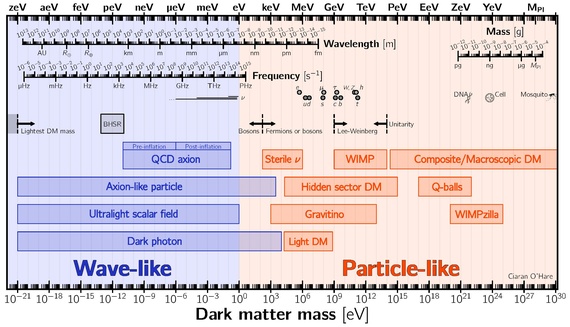
هوية المادة المظلمة غير معروفة، لكن هناك العديد من الفرضيات حول ما يمكن أن تتكون منه المادة المظلمة، كما هو موضح في الجدول أدناه.
| البوزونات الخفيفة | أكسيونات الديناميكا اللونية الكمية |
| الجسيمات الشبيهة بالأكسيون | |
| المادة المظلمة الباردة الضبابية | |
| النيوترينوات | النموذج المعياري[ث] |
| النيوترينوات العقيمة | |
| جسيمات أخرى | الجسيم فائق التنظار الأخف |
| الجسيم الضخم ضعيف التفاعل | |
| المادة المظلمة المتفاعلة ذاتياً | |
| المادة المظلمة الذرية[97][98][99][100] | |
| strangelet[101] | |
| المادة المظلمة الديناميكية[102] | |
| العينانية | الثقب الأسود البدائيs[17][18][103][19][104][105][106][107][108][109] |
| الأجرام الهالية المضغوطة الثقيلة (MACHOs) | |
| المادة المظلمة العيانية (Macros) |
المادة الباريونية
يمكن أن تشير المادة المظلمة إلى أي مادة تتفاعل بشكل أساسي مع المادة المرئية (مثل النجوم والكواكب) عبر الجاذبية. وبالتالي، من حيث المبدأ، لا يشترط أن تتكون من نوع جديد من الجسيمات الأساسية، بل يمكن أن تتكون، جزئياً على الأقل، من المادة الباريونية المعيارية، مثل الپروتونات أو النيوترونات. وتندرج معظم المادة العادية المألوفة لدى علماء الفلك، بما في ذلك الكواكب والأقزام البنية والأقزام الحمراء والنجوم المرئية والأقزام البيضاء والنجوم النيوترونية والثقوب السوداء، ضمن هذ التصنيف.[22][110] سيقوم الثقب الأسود بابتلاع كل من المادة الباريونية وغير الباريونية التي تقترب بدرجة كافية من أفق الحدث الخاص به؛ بعد ذلك، يختفي التمييز بين الاثنين.[111]
تُعرف هذه الأجرام الضخمة التي يصعب رصدها مجتمعةً باسم الأجرام الهالية المضغوطة الثقيلة (MACHO). وقد أمل بعض العلماء في البداية أن تُفسر هذه الأجرام الهالية المضغوطة الثقيلة الباريونية وجود المادة المظلمة بأكملها.[52][112]
مع ذلك، تشير أدلة متعددة إلى أن غالبية المادة المظلمة غير باريونية:
- يمكن رؤية كميات كافية من الغاز أو الغبار الباريوني المنتشر عند إضاءته من الخلف بواسطة النجوم.
- تتنبأ نظرية تخليق الانفجار العظيم النووي بوفرة العناصر الكيميائية الملحوظة. فإذا كان هناك المزيد من الباريونات، فمن المفترض أن يكون هناك أيضًا المزيد من الهيليوم والليثيوم والعناصر الأثقل التي خُلقت أثناء الانفجار العظيم.[113][114]
يتطلب التوافق مع الوفرة المرصودة أن تشكل المادة الباريونية ما بين 4-5% من الكثافة الحرجة للكون. في المقابل، تشير البنية واسعة النطاق وغيرها من عمليات الرصد إلى أن كثافة المادة الكلية تبلغ حوالي 30% من الكثافة الحرجة.[78]
- أظهرت عمليات البحث الفلكية عن عدسة الجاذبية الصغرية في درب التبانة أن جزءاً صغيراً فقط من المادة المظلمة قد يكون موجوداً في أجرام مظلمة ومضغوطة وتقليدية (MACHOs، وما إلى ذلك)؛ ويتراوح نطاق كتل الأجرام المستبعدة من نصف كتلة الأرض إلى 30 كتلة شمسية، وهو ما يغطي جميع المرشحين المحتملين تقريباً.[115][116][117][118][119][120]
- يشير التحليل المفصل للاختلافات الصغيرة (التباينات) في إشعاع الخلفية الصغروي الكوني بواسطة مسبار ولكنسون وپلانك إلى أن حوالي خمسة أسداس المادة الكلية موجودة في شكل لا يتفاعل بشكل كبير مع المادة العادية أو الفوتونات إلا من خلال التأثيرات الجاذبية.[121]
المادة غير الباريونية
هناك مرشحان رئيسيان للمادة المظلمة غير الباريونية: الجسيمات الجديدة والثقوب السوداء البدائية.
على عكس المادة الباريونية، فإن الجسيمات غير الباريونية لا تساهم في تكوين العناصر في الكون المبكر (تخليق الانفجار العظيم النووي)[122][123][53] وبالتالي، لا يُشعر بوجودها إلا من خلال تأثيرات جاذبيتها (مثل عدسة الجاذبية الضعيفة). إضافةً إلى ذلك، يمكن لبعض الجسيمات المرشحة للمادة المظلمة أن تتفاعل مع نفسها (المادة المظلمة ذاتية التفاعل) أو مع الجسيمات العادية (مثل الجسيمات الضخمة ضعيفة التفاعل)، مما قد ينتج عنه نواتج ثانوية قابلة للرصد مثل أشعة گاما والنيوترينوات (الكشف غير المباشر).[96] يوجد العديد من المرشحين (انظر الجدول أعلاه)، ولكل منهم نقاط قوته وضعفه.
الجسيمات الضخمة الغير مكتشفة
لا يوجد تعريف رسمي للجسيمات الضخمة ضعيفة التفاعل، لكن بشكل عام، هي جسيمات أولية تتفاعل عبر الجاذبية وأي قوة (أو قوى) أخرى مساوية أو أضعف من القوة النووية الضعيفة، لكنها لا تنعدم. من المتوقع أن العديد من الجسيمات المرشحة للجسيمات الضخمة ضعيفة التفاعل قد أُنتجت حرارياً في الكون المبكر، على غرار جسيمات النموذج المعياري[124] وفقاً لنظرية الانفجار العظيم، وعادةً ما تُشكّل المادة المظلمة الباردة. يتطلب الحصول على الوفرة الصحيحة من المادة المظلمة اليوم عبر الإنتاج الحراري مقطع تصادم [[يفنى ذاتياً ≃ 3×10⁻²⁶ cm3⋅s−1، وهو ما يُتوقع تقريبًا بالنسبة لجسيم جديد في نطاق 100 ج.إ.ڤ، /c2 نطاق الكتلة الذي يتفاعل عبر القوة الكهروضعيفة.
لأن امتدادات التناظر الفائق للنموذج المعياري لفيزياء الجسيمات تتنبأ بسهولة بجسيم جديد بهذه الخصائص، فإن هذا التزامن الظاهري يُعرف باسم "معجزة WIMP"، وكان الشريك المتناظر الفائق المستقر لفترة طويلة تفسيراً رئيسياً للمادة المظلمة.[125] تشمل الجهود التجريبية للكشف عن الجسيمات الضخمة ضعيفة التفاعل (WIMPs) البحث عن نواتج إفناء هذه الجسيمات، بما في ذلك آشعة گاما، النيوترينوات، والأشعة الكونية في المجرات القريبة وتجمعات المجرات؛ وتجارب الكشف المباشر المصممة لقياس تصادم الجسيمات الضخمة ضعيفة التفاعل مع النوى في المعمل، بالإضافة إلى محاولات إنتاج تصادم الجسيمات الضخمة ضعيفة التفاعل مباشرة في المصادمات، مثل مصادم الهدرونات الكبير في سرن.
في أوائل عقد 2010، أدت نتائج تجارب الكشف المباشر، إلى جانب عدم وجود دليل على التناظر الفائق في تجربة مصادم الهدرونات الكبير، إلى نتائج هامة[126][127] إلى إثارة شكوكاً حول أبسط فرضية للجسيمات الضخمة ضعيفة التفاعل.[128]
الجسيمات فائقة الخفة الغير مكتشفة
الأكسيونات هي جسيمات أولية افتراضية، نُظِّر لها لأول مرة عام 1978 بشكل مستقل من قِبَل فرانك ويلتشك وستيڤن واينبرگ باعتبارها بوزون گولدستون لنظرية پيتشي-كوين، التي طُرحت عام 1977 لحل مشكلة التناظر القوي في الديناميكا اللونية الكمية (QCD). تُنتج تأثيرات الديناميكا اللونية الكمية جهداً دورياً فعالاً يتحرك فيه مجال الأكسيون.[129] بتوسيع نطاق الجهد حول إحدى نقاطه الدنيا، نجد أن حاصل ضرب كتلة الأكسيون في ثابت اضمحلال الأكسيون يتحدد بالحساسية الطوبولوجية لفراغ الديناميكا اللونية الكمية. الأكسيون ذو الكتلة الأقل بكثير من 60 كيلو إلكترون ڤولت/ثانية2 يكون طويل العمر وضعيف التفاعل: مرشح مثالي للمادة المظلمة.
تُولد تذبذبات مجال الأكسيون حول الحد الأدنى للجهد الفعال، وهي ما يُسمى بآلية عدم المحاذاة، مجموعة كونية من الأكسيونات الباردة بوفرة تعتمد على كتلة الأكسيون.[130][131][132] بكتلة تزيد عن 5 ميكرو إلكترون ڤولت (أي 10⁻¹¹ ضعف كتلة الإلكترون)، يمكن أن تُفسر الأكسيونات المادة المظلمة، وبالتالي تُعتبر مرشحاً محتملاً للمادة المظلمة وحلاً لمشكلة التناظر القوي. إذا حدث التضخم على نطاق صغير واستمر لفترة كافية، فقد تنخفض كتلة الأكسيون إلى 1 پيكو إلكترون ڤولت.[133][134][135]
نظراً لأن الأكسيونات ذات كتلة منخفضة للغاية، فإن الطول الموجي لدي برولي الخاصة بها كبير جداً، مما يعني بدوره أن التأثيرات الكمومية قد تساعد في حل مشكلات النطاق الصغير لنموذج لامبدا-سيديإم. يوفر أكسيون واحد فائق الخفة ذو ثابت اضمحلال على نطاق نظرية الموحدة العظمى الكثافة المتبقية الصحيحة دون الحاجة إلى ضبط دقيق.[136]
اكتسبت الأكسيونات كمرشح للمادة المظلمة شعبية في السنوات الأخيرة، بسبب عدم اكتشاف الجسيمات الضخمة ضعيفة التفاعل.[137]
الثقوب السوداء البدائية
الثقوب السوداء البدائية هي ثقوب سوداء افتراضية تشكلت بعد الانفجار العظيم بفترة وجيزة. في حقبة التضخم الكوني وبداية حقبة سيطرة الإشعاع، ربما كانت جيوب كثيفة للغاية من الجسيمات دون الذرية متراصة بإحكام لدرجة انهيار الجاذبية، مما أدى إلى تكوين ثقوب سوداء بدائية دون ضغط المستعر الأعظم اللازم عادةً لتشكل الثقوب السوداء اليوم. وقد طُرحت فكرة إمكانية تشكل الثقوب السوداء في الكون المبكر لأول مرة من قبل ياكوڤ زيلدوڤيتش وإيگور ديميترييڤيتش نوڤيكوڤ عام 1967، وبشكل مستقل من قبل ستيفن هوكنگ عام 1971. سرعان ما اتضح أن هذه الثقوب السوداء قد تُفسر جزءاً على الأقل من المادة المظلمة. ولأن تشكل الثقوب السوداء البدائية يسبق تشكل النجوم الأولى، فإنها لا تقتصر على نطاق الكتلة الضيق للثقوب السوداء النجمية، كما أنها لا تُصنف ضمن المادة المظلمة الباريونية.
تتمتع الثقوب السوداء البدائية، باعتبارها مرشحاً للمادة المظلمة، بميزة رئيسية تتمثل في أنها تستند إلى نظرية مفهومة جيداً (النسبية العامة) وأجرام (الثقوب السوداء) معروفة الوجود بالفعل. ومع ذلك، فإن تشكل الثقوب السوداء البدائية يتطلب تضخماً كونياً غريباً أو فيزياء تتجاوز النموذج المعياري لفيزياء الجسيمات،[138] وقد يتطلب الأمر أيضاً ضبطاً دقيقاً.[139] قد تمتد الثقوب السوداء البدائية أيضاً على كامل نطاق الكتلة الممكن تقريباً، من حجم الذرة إلى الكتلة الهائلة.
اكتسبت فكرة أن الثقوب السوداء البدائية تشكل المادة المظلمة أهمية كبيرة عام 2015[140] في أعقاب نتائج قياسات الأمواج الثقالية التي رصدت اندماج ثقوب سوداء متوسطة الكتلة، تبين أن الثقوب السوداء التي تبلغ كتلتها حوالي 30 ضعف كتلة الشمس لا يُتوقع تشكلها عن طريق انهيار النجوم (عادةً ما تكون كتلتها أقل من 15 ضعف كتلة الشمس) أو عن طريق اندماج الثقوب السوداء في مراكز المجرات (بملايين أو بلايين الكتل الشمسية)، مما يشير إلى أن الثقوب السوداء المرصودة قد تكون بدائية. وفي مسح لاحق لحوالي ألف مستعر أعظم، لم يُرصد أي حدث عدسة جاذبية، في حين كان من المتوقع حدوث حوالي ثمانية أحداث إذا شكلت الثقوب السوداء البدائية متوسطة الكتلة، التي تتجاوز نطاق كتلة معين، أكثر من 60% من المادة المظلمة.[141] ومع ذلك، افترضت تلك الدراسة أن جميع الثقوب السوداء لها نفس الكتلة أو كتلة مماثلة لنطاق كتلة لايگو/العذراء، وهو ما قد لا يكون هو الحال (كما أشارت إليه أرصاد تلسكوپ جيمس وب الفضائي).[142][103]
استُبعدت إمكانية أن تُشكّل الثقوب السوداء البدائية بحجم الذرة نسبةً كبيرةً من المادة المظلمة، وذلك من خلال قياسات تدفقات الپوزيترونات والإلكترونات خارج الغلاف الشمسي بواسطة المركبة الفضائية ڤويدجر-1. ويُفترض نظرياً أن الثقوب السوداء الصغيرة تُصدر إشعاع هوكنگ. إلا أن التدفقات المُكتشفة كانت منخفضةً للغاية، ولم يكن لها طيف الطاقة المتوقع، مما يُشير إلى أن الثقوب السوداء البدائية الصغيرة ليست منتشرةً على نطاقٍ واسعٍ بما يكفي لتفسير المادة المظلمة.[143] ومع ذلك، لا تزال الأبحاث والنظريات التي تقترح تفسيرات للمادة المظلمة الكثيفة مستمرة حتى عام 2018، بما في ذلك مناهج تبريد المادة المظلمة،[144][145] ولا يزال السؤال بلا إجابة. ففي عام 2019، يشير غياب تأثيرات العدسات الدقيقة في رصد مجرة المرأة المسلسلة إلى عدم وجود ثقوب سوداء صغيرة.[146] ومع ذلك، لا يزال هناك نطاق كتلة غير مقيد إلى حد كبير أصغر من ذلك الذي يمكن تحديده من خلال ملاحظات العدسات الدقيقة البصرية، حيث قد تفسر الثقوب السوداء البدائية كل المادة المظلمة.[147][148]
الجاذبية المعدلة
الاحتمال الرئيسي الأخير هو أن النسبية العامة، النظرية التي يقوم عليها علم الكون الحديث، غير صحيحة. لقد خضعت النسبية العامة لاختبارات مكثفة على نطاق المجموعة الشمسية، لكن صحتها على نطاق المجرات أو علم الكون لم تثبت بشكل قاطع.[149] من الممكن نظرياً أن يؤدي تعديل مناسب للنسبية العامة إلى إلغاء الحاجة إلى المادة المظلمة. ومن أشهر النظريات في هذا المجال نظرية ديناميكا نيوتن المعدلة (MOND) وتعميمها النسبي نظرية الجاذبية الموترية-المتجهية-القياسية (TeVeS)،[150] f(R) الجاذبية،[151] الكتلة السالبة، المائع المظلم،[152][153][154] والجاذبية الإنتروپية.[155] هناك نظريات بديلة كثيرة.[156][157]
تكمن إحدى مشكلات تعديل الجاذبية في أن الأدلة الرصدية على وجود المادة المظلمة - ناهيك عن النسبية العامة - تأتي من العديد من المناهج المستقلة (انظر قسم "الأدلة الرصدية" أعلاه). يُمكن تفسير أي رصد منفرد، لكن تفسيرها جميعًا في غياب المادة المظلمة أمرٌ بالغ الصعوبة. ومع ذلك، فقد تحققت بعض النجاحات المتفرقة لفرضيات بديلة، مثل اختبار عدسة الجاذبية في الجاذبية الإنتروپية الذي أُجري عام 2016[158][159][160] وقياس عام 2020 لتأثير موند.[161][162]
الرأي السائد بين معظم علماء الفيزياء الفلكية هو أنه في حين أن التعديلات على النسبية العامة يمكن أن تفسر جزءاً من الأدلة الرصدية، فمن المحتمل أن تكون هناك بيانات كافية للاستنتاج بأنه لا بد من وجود شكل من أشكال المادة المظلمة في الكون.[21]
تجمعات المادة المظلمة وأجرام المادة المظلمة الكثيفة
إذا كانت المادة المظلمة تتكون من جسيمات ضعيفة التفاعل، فإن السؤال البديهي هو ما إذا كان بإمكانها تكوين أجرام مكافئة للكواكب أو النجوم أو الثقوب السوداء. تاريخياً، كانت الإجابة هي لا.
من المعتقدات الشائعة حول المادة المظلمة أنها لا تبرد عن طريق إشعاع الطاقة. فلو كان ذلك ممكناً، لربما تجمعت معاً وشكّلت أجراماً متراصة، كما هو الحال في تشكل الكواكب والنجوم والمجرات بواسطة المادة الباريونية. تشير الملاحظات حتى الآن إلى أن المادة المظلمة لا تفعل ذلك، فهي موجودة فقط في هالات منتشرة... ونتيجة لذلك، من المستبعد جداً وجود أجرام شديدة الكثافة، كالنجوم، مصنوعة بالكامل (أو حتى في معظمها) من المادة المظلمة. المادة المظلمة." — بكلي وديفرانزو (2018)[163] }}[163][164][165]
ويرجع ذلك إلى عاملين:
- إفتقارها إلى وسيلة فعالة لفقدان الطاقة [163]
- تتشكل الأجسام الكثيفة من المادة العادية لأنها تمتلك طرقاً عديدة لفقدان الطاقة. يُعدّ فقدان الطاقة ضرورياً لتكوين الأجرام، لأن الجسيم الذي يكتسب طاقة أثناء الانضغاط أو السقوط "للداخل" تحت تأثير الجاذبية، ولا يستطيع فقدانها بأي طريقة أخرى، سيسخن ويزداد كل من سرعته وزخمه. أما المادة المظلمة، فيبدو أنها تفتقر إلى وسيلة لفقدان الطاقة، ببساطة لأنها غير قادرة على التفاعل بقوة إلا من خلال الجاذبية. تشير نظرية ڤيريال إلى أن مثل هذا الجسيم لن يبقى مرتبطاً بالجرم المتشكل تدريجياً - فمع بدء تشكل الجرم وانضغاطه، ستتسارع جسيمات المادة المظلمة الموجودة بداخله وتميل إلى الهروب.
- إفتقارها إلى تنوع التفاعلات اللازمة لتكون البنى.[165]
- تتفاعل المادة العادية بطرقٍ عديدة ومختلفة، مما يسمح لها بتكوين بنى أكثر تعقيداً. على سبيل المثال، تتشكل النجوم بفعل الجاذبية، لكن الجسيمات داخلها تتفاعل وتُصدر طاقةً على شكل نيوترينوات وإشعاع كهرومغناطيسي من خلال الاندماج النووي عندما تبلغ طاقةً كافية. يمكن للپروتونات والنيوترونات أن ترتبط عبر التفاعل القوي، ثم تُكوّن ذرات مع الإلكترونات، وذلك بشكل رئيسي من خلال التفاعل الكهرومغناطيسي. لا يوجد دليل على قدرة المادة المظلمة على مثل هذا التنوع الواسع من التفاعلات، إذ يبدو أنها تتفاعل فقط من خلال الجاذبية (وربما من خلال وسيلةٍ لا تقل قوةً عن التفاعل الضعيف، مع العلم أن هذا يبقى مجرد تكهنات إلى حين فهم المادة المظلمة بشكل أفضل).
الكشف عن جسيمات المادة المظلمة
إذا كانت المادة المظلمة تتكون من جسيمات دون ذرية، فلا بد أن تمر ملايين، وربما بلايين، من هذه الجسيمات عبر كل سنتيمتر مربع من الأرض كل ثانية.[166][167] تهدف العديد من التجارب إلى اختبار هذه الفرضية. على الرغم من أن الجسيمات المتفاعلة ضعيفة التفاعل (WIMPs) كانت المرشح الرئيسي للبحث،[55] حظيت الأكسيونات باهتمام متجدد، مع أبحاث تجربة أكسيون المادة المظلمة (ADMX) والعديد من المشاريع الأخرى المخطط لها في المستقبل.[168] ومن المرشحين الآخرين جسيمات القطاع المخفي الثقيلة التي تتفاعل فقط مع المادة العادية عن طريق الجاذبية.
يمكن تقسيم هذه التجارب إلى فئتين: تجارب الكشف المباشر، التي تبحث عن تشتت جسيمات المادة المظلمة عن نوى الذرات داخل جهاز الكشف؛ وتجارب الكشف غير المباشر، التي تبحث عن نواتج إفناء أو اضمحلال جسيمات المادة المظلمة.[96]
الكشف المباشر
تهدف تجارب الكشف المباشر إلى رصد ارتدادات النوى منخفضة الطاقة (عادةً بضعة كيلو إلكترون ڤولت) الناتجة عن تفاعلاتها مع جسيمات المادة المظلمة، التي تمر (نظرياً) عبر الأرض. بعد هذا الارتداد، تُصدر النواة طاقةً على شكل ضوء وميضي أو فونونات أثناء مرورها عبر أجهزة الكشف الحساسة. ولتحقيق ذلك بفعالية، من الضروري الحفاظ على مستوى منخفض للغاية من التشويش الخلفي، ولهذا السبب تُجرى هذه التجارب عادةً في أعماق الأرض، حيث يكون التداخل الناتج عن الأشعة الكونية في حده الأدنى. تشمل أمثلة المعامل تحت الأرض التي تجري فيها تجارب الكشف المباشر ما يلي: منجم ستاوِل، منجم سودان، معمل سنولاب في سدبري، معمل گران ساسو ، معمل كانفرانك، معمل بولبي، معمل العلوم والهندسة ومعمل جينپينگ.
تستخدم هذه التجارب في الغالب تقنيات الكشف المبردة أو تقنيات الكشف باستخدام السوائل النبيلة. تكشف الكواشف المبردة، التي تعمل عند درجات حرارة أقل من 100 ملي كلڤن، الحرارة الناتجة عن اصطدام جسيم بذرة في مادة ماصة بلورية مثل الجرمانيوم. أما كواشف السوائل النبيلة، فتكشف الوميض الناجم عن تصادم جسيم في الزينون أو الأرگون السائل. تشمل تجارب الكشف المبردة مشاريع مثل مشروع البحث عن المادة المظلمة المبردة (CDMS)، ومشروع البحث عن الأحداث النادرة المبردة باستخدام مقاييس حرارة فائقة التوصيل (CRESST)، ومشروع إيديلويس (EDELWEISS)، والمصفوفة الأوروپية تحت الأرض لمقياس السعرات الحرارية للأحداث النادرة (EURECA). أما تجارب السوائل النبيلة فتشمل تجربة LZ، زينون (XENON)، DEAP، ArDM، WARP، داركسايد، PandaX، LUX، وتجربة الزينون الكبرى. وتركز كلتا التقنيتين بشكل كبير على قدرتهما على التمييز بين جسيمات الخلفية (التي تتشتت في الغالب بفعل الإلكترونات) وجسيمات المادة المظلمة (التي تتشتت بفعل النوى). وتشمل التجارب الأخرى سيمپل و پيكاسو، والتي تستخدم أساليب بديلة في محاولاتها للكشف عن المادة المظلمة.
حتى الآن، لم يتم التوصل إلى أي ادعاء راسخ بالكشف عن المادة المظلمة من خلال تجربة كشف مباشرة، مما أدى بدلاً من ذلك إلى وضع حدود عليا قوية على كتلة ومقطع التفاعل مع النيوكليونات لجسيمات المادة المظلمة هذه.[169] رصدت التجارب التعاونية الأحدث، DAMA/NaI وDAMA/LIBRA تغيراً سنوياً في معدل الأحداث في أجهزة الكشف الخاصة بها،[170][171] ويزعمون أن ذلك يعود إلى المادة المظلمة. وينتج هذا عن توقع أن سرعة الكاشف بالنسبة لهالة المادة المظلمة ستتغير بمقدار ضئيل أثناء دوران الأرض حول الشمس. هذا الادعاء غير مؤكد حتى الآن، ويتناقض مع نتائج سلبية من تجارب أخرى مثل LUX وSuperCDMS[172] وXENON100.[173]
تُعدّ التجارب ذات الحساسية الاتجاهية حالة خاصة من تجارب الكشف المباشر. وتعتمد هذه الاستراتيجية البحثية على حركة المجموعة الشمسية حول مركز المجرة.[174][175][176][177] تتيح غرفة إسقاط الزمن ذات الضغط المنخفض الوصول إلى معلومات حول مسارات الارتداد وتقييد حركية جسيمات المادة المظلمة المتفاعلة ضعيفة التفاعل مع النواة. وبذلك، يمكن فصل جسيمات المادة المظلمة المتفاعلة ضعيفة التفاعل القادمة من اتجاه حركة الشمس (تقريباً باتجاه كوكبة الدجاجة) عن الخلفية، التي يفترض أن تكون متجانسة الخواص. تشمل تجارب المادة المظلمة الاتجاهية غرفة إسقاط الزمن للمادة المظلمة (DMTPC)، وتحديد الارتداد الاتجاهي من المسارات (DRIFT)، ونيو إيج، وميماك.
الكشف غير المباشر

تبحث تجارب الكشف غير المباشر عن نواتج الفناء الذاتي أو تحلل جسيمات المادة المظلمة في الفضاء الخارجي. على سبيل المثال، في مناطق ذات كثافة عالية من المادة المظلمة (مثل مركز مجرة درب التبانة)، يمكن لجسيمين من المادة المظلمة أن يفنيا بعضهما البعض لإنتاج آشعة گاما أو أزواج من جسيمات ومضادات جسيمات النموذج المعياري.[179] بدلاً من ذلك، إذا كانت جسيمات المادة المظلمة غير مستقرة، فقد تتحلل إلى جسيمات النموذج المعياري (أو غيرها). ويمكن رصد هذه العمليات بشكل غير مباشر من خلال زيادة أشعة گاما، أو الپروتونات المضادة، أو الپوزيترونات المنبعثة من مناطق عالية الكثافة في مجرة درب التبانة والمجرات الأخرى.[180] تتمثل إحدى الصعوبات الرئيسية الكامنة في عمليات البحث هذه في أن مصادر الفيزياء الفلكية المختلفة يمكن أن تحاكي الإشارة المتوقعة من المادة المظلمة، وبالتالي فمن المحتمل أن تكون هناك حاجة إلى إشارات متعددة للتوصل إلى اكتشاف حاسم.[55][96]
قد تتشتت بعض جسيمات المادة المظلمة التي تمر عبر الشمس أو الأرض عن الذرات وتفقد طاقتها. وبالتالي، قد تتراكم المادة المظلمة في مركز هذه الأجرام، مما يزيد من احتمالية التصادم/الفناء. وقد ينتج عن ذلك إشارة مميزة على شكل نيوترينوات عالية الطاقة.[181] ستكون هذه الإشارة دليلاً غير مباشر قوياً على وجود المادة المظلمة المكونة من الجسيمات الضخمة ضعيفة التفاعل.[55] تقوم تلسكوبات النيوترينو عالية الطاقة مثل أماندا، آيس كيوب وأنتاريس بالبحث عن هذه الإشارة.[52] إن اكتشاف موجات الجاذبية بواسطة مرصد لايگو في سبتمبر 2015 يفتح المجال أمام رصد المادة المظلمة بطريقة جديدة، لا سيما إذا كانت على شكل ثقوب سوداء بدائية.[182][183][184]
أُجريت العديد من عمليات البحث التجريبية للبحث عن مثل هذا الانبعاث الناتج عن فناء المادة المظلمة أو تحللها، وفيما يلي أمثلة على ذلك.
رصد تلسكوب تجربة آشعة گاما النشطة آشعة گاما أكثر عام 2008 مما كان متوقعاً من مجرة درب التبانة، لكن العلماء خلصوا إلى أن هذا يرجع على الأرجح إلى تقدير غير صحيح لحساسية التلسكوب.[185]
يبحث تلسكوب فرمي الفضائي لآشعة گاما عن آشعة گاما مماثلة.[186] عام 2009، رُصد فائض غير مُفسّر حتى الآن من آشعة گاما من مركز مجرة درب التبانة في بيانات مرصد فرمي. قد يُعزى هذا الفائض من آشعة گاما من فائض طاقة مركز المجرة إلى فناء المادة المظلمة أو إلى وجود مجموعة من النجوم النابضة.[187] في أبريل 2012، أظهر تحليل البيانات المتاحة سابقاً من تلسكوب المنطقة الكبرى بمرصد فرمي أدلة إحصائية على وجود إشارة 130 گ.إ.ڤ. في آشعة گاما القادمة من مركز مجرة درب التبانة.[188] كان يُنظر إلى فناء الجسيمات الضخمة ضعيفة التفاعل على أنه التفسير الأكثر ترجيحاً.[189]
عند الطاقات الأعلى، وضعت تلسكوبات آشعة گاما الأرضية حدودًا على فناء المادة المظلمة في المجرات القزمة الكروية[190] وفي عناقيد المجرات.[191]
رصدت تجربة PAMELA (التي أُطلقت عام 2006) فائضاً من الپوزيترونات. قد يكون مصدرها فناء المادة المظلمة أو النجوم النابضة. ولم يُرصد أي فائض من الپروتونات المضادة.[192]
عام 2013، أشارت نتائج مطياف ألفا المغناطيسي الموجود على متن المحطة الفضائية الدولية إلى وجود فائض من الأشعة الكونية عالية الطاقة، والتي قد تكون ناجمة عن فناء المادة المظلمة.[193][194][195][196][197][198]
أبحاث المصادم حول المادة السوداء
يُعدّ إنتاج جسيمات المادة المظلمة في المعمل نهجاً بديلاً للكشف عنها في الطبيعة. وقد تتمكن التجارب التي تُجرى باستخدام مصادم الهدرونات الكبير من رصد جسيمات المادة المظلمة الناتجة عن تصادمات حزم الپروتونات في المصادم. ولأن تفاعل جسيم المادة المظلمة مع المادة المرئية العادية ضئيل للغاية، فإنه يُمكن رصده بشكل غير مباشر على هيئة كميات كبيرة من الطاقة والزخم المفقودين اللذين يفلتان من أجهزة الكشف، شريطة رصد نواتج تصادم أخرى (غير ضئيلة).[199] توجد أيضاً قيود على المادة المظلمة من تجربة مصادم الإلكترون-الپوزيتون باستخدام مبدأ مماثل، ولكن عن طريق فحص تفاعل جسيمات المادة المظلمة مع الإلكترونات بدلاً من الكواركات.[200] يجب تأكيد أي اكتشاف من عمليات البحث في المصادمات من خلال اكتشافات في قطاعات الكشف غير المباشر أو المباشر لإثبات أن الجسيم المكتشف هو في الواقع مادة مظلمة.
في الثقافة العامة
تظهر المادة المظلمة بانتظام كموضوع في الدوريات الهجينة التي تغطي كلاً من المواضيع العلمية الواقعية والخيال العلمي،[201] وقد أشير إلى المادة المظلمة نفسها بأنها "مادة الخيال العلمي".[202]
يُذكر مفهوم المادة المظلمة في الأعمال الأدبية. وفي هذه الحالات، تُنسب إليها عادةً خصائص فيزيائية أو سحرية غير عادية، مما يتعارض مع الخصائص المفترضة للمادة المظلمة في الفيزياء وعلم الكون. على سبيل المثال:
- تُستخدم المادة المظلمة كأداة حبكة في حلقة "الضوء الخافت" من مسلسل ملفات-إكس عام 1995.[203]
- تظهر مادة مستوحاة من المادة المظلمة تُعرف "بالغبار" بشكل بارز في ثلاثية مواده المظلمة لفليپ پولمان.[204]
- الكيانات المصنوعة من المادة المظلمة هي الخصوم في تسلسل إكسيلي لستيفن باكستر.[205]
وبشكل أوسع، تُستخدم عبارة "المادة المظلمة" مجازياً في الأدب الخيالي لاستحضار ما هو غير مرئي أو غير مرئي.[206]
معرض الصور
-
![خريطة المادة المظلمة بواسطة مسح التطور الكوني (كوزموس) باستخدام تلسكوب فضاء هبل (2007).[207][208]](/w/images/thumb/3/37/COSMOSDMmap2007.jpg/180px-COSMOSDMmap2007.jpg)
-
![خريطة المادة المظلمة بواسطة مسح العدسات CFHT (CFHTLenS) باستخدام تلكسوب كندا-فرنسا-هاواي (2012).[209][210] (خريطة كوزموس في الوسط)](/w/images/thumb/7/76/CFHTLenSDMmap2012.jpg/180px-CFHTLenSDMmap2012.jpg) خريطة المادة المظلمة بواسطة مسح العدسات CFHT (CFHTLenS) باستخدام تلكسوب كندا-فرنسا-هاواي (2012).[209][210] (خريطة كوزموس في الوسط)
خريطة المادة المظلمة بواسطة مسح العدسات CFHT (CFHTLenS) باستخدام تلكسوب كندا-فرنسا-هاواي (2012).[209][210] (خريطة كوزموس في الوسط) -
![خريطة المادة المظلمة بواسطة مسح كيلو-درجة (KiDS) باستخدام تلكسوب مسح ڤي إل تي (2015).[211][212]](/w/images/b/bb/KiDSDMmap2015.gif)
-
![خريطة المادة المظلمة بواسطة مسح هايپر سوپرايم-كام (HSCS) باستخدام تلكسوب سوبارو (2018).[213][214]](/w/images/thumb/9/9e/HSCSDMmap2018.gif/180px-HSCSDMmap2018.gif)
-
![خريطة المادة المظلمة بواسطة مسح الطاقة المظلمة (DES) باستخدام تلسكوب ڤيكتور م. بلانكو (2021).[215][216]](/w/images/thumb/a/ae/DESDMmap2021.png/180px-DESDMmap2021.png) خريطة المادة المظلمة بواسطة مسح الطاقة المظلمة (DES) باستخدام تلسكوب ڤيكتور م. بلانكو (2021).[215][216]
خريطة المادة المظلمة بواسطة مسح الطاقة المظلمة (DES) باستخدام تلسكوب ڤيكتور م. بلانكو (2021).[215][216]
![خريطة المادة المظلمة بواسطة مسح التطور الكوني (كوزموس) باستخدام تلسكوب فضاء هبل (2007).[207][208]](/w/index.php?title=%D9%85%D9%84%D9%81:COSMOSDMmap2007.jpg&filetimestamp=20260101140713&)
![خريطة المادة المظلمة بواسطة مسح العدسات CFHT (CFHTLenS) باستخدام تلكسوب كندا-فرنسا-هاواي (2012).[209][210] (خريطة كوزموس في الوسط)](/w/index.php?title=%D9%85%D9%84%D9%81:CFHTLenSDMmap2012.jpg&filetimestamp=20231209000220&)
![خريطة المادة المظلمة بواسطة مسح كيلو-درجة (KiDS) باستخدام تلكسوب مسح ڤي إل تي (2015).[211][212]](/w/index.php?title=%D9%85%D9%84%D9%81:KiDSDMmap2015.gif&filetimestamp=20260101140709&)
![خريطة المادة المظلمة بواسطة مسح هايپر سوپرايم-كام (HSCS) باستخدام تلكسوب سوبارو (2018).[213][214]](/w/index.php?title=%D9%85%D9%84%D9%81:HSCSDMmap2018.gif&filetimestamp=20260101140709&)
![خريطة المادة المظلمة بواسطة مسح الطاقة المظلمة (DES) باستخدام تلسكوب ڤيكتور م. بلانكو (2021).[215][216]](/w/index.php?title=%D9%85%D9%84%D9%81:DESDMmap2021.png&filetimestamp=20260101140707&)
انظر أيضاً
- نظريات متعلقة
- الطاقة المظلمة
- الجاذبية المطابقة
- نظرية موجة الكثافة – نظرية تفترض أن موجات الغاز المضغوط، التي تتحرك أبطأ من المجرة، تحافظ على بنية المجرة
- الجاذبية الإنتروپية
- الإشعاع المظلم
- الجاذبية الهائلة
- الفيزياء الغير جسيمية
- تجارب
- DEAP، جهاز بحث
- تجربة LZ، كاشف المادة المظلمة الكبير تحت الأرض
- مسكتشف جسيمات المادة المظلمة (DAMPE)، مهمة فضائية
- مطياف الجسيمات المضادة العام
- ملتيدارك، برنامج بحثي
- مشروع إلوستريس، عمليات محاكاة فيزيائية فلكية
- المصادم الدائري المستقبلي، بنية تحتية لأبحاث مسرعات الجسيمات
- المرشحون للمادة المظلمة
- الجسيم ضعيف التفاعل
- المادة المظلمة الخفيفة
- المادة العاكسة
- المادة الغريبة
- النيوترالينو
- المجرة المظلمة
- المادة المظلمة في المجال القياسي
- المادة المظلمة ذاتية التفاعل
- الجسيم الضخم ضعيف التفاعل
- الجسيم النحيل ضعيف التفاعل (WISP) – النظير منخفض الكتلة للجسيم الضخم ضعيف التفاعل
- الجسيم الضخم قوي التفاعل
- جسيم الحرباء
- أخرى
- Galactic Center GeV excess
- الأثير الناقل للضوء – مادة غير مرئية ولا نهائية كان يُعتقد أنها لا تتفاعل مع الأجسام المادية، وكانت تُستخدم لتفسير كيفية انتقال الضوء عبر الفراغ (وهو أمر تم دحضه الآن).
الهوامش
- ^
"Um, wie beobachtet, einen mittleren Dopplereffekt von 1000 km/sek oder mehr zu erhalten, müsste also die mittlere Dichte im Comasystem mindestens 400 mal grösser sein als die auf Grund von Beobachtungen an leuchtender Materie abgeleitete. Falls sich dies bewahrheiten sollte, würde sich also das überraschende Resultat ergeben, dass dunkle Materie in sehr viel grösserer Dichte vorhanden ist als leuchtende Materie."[33]
- [In order to obtain an average Doppler effect of 1000 km/s or more, as observed, the average density in the Coma system would thus have to be at least 400 times greater than that derived on the basis of observations of luminous matter. If this were to be confirmed, the surprising result would then follow that dark matter is present in very much greater density than luminous matter.]
- ^ However, in the modern cosmic era, this neutrino field has cooled and started to behave more like matter and less like radiation.
- ^ This is a consequence of the shell theorem and the observation that spiral galaxies are spherically symmetric to a large extent (in 2D).
- ^ The three neutrino types already observed are indeed abundant, and dark, and matter, but their individual masses are almost certainly too tiny to account for more than a small fraction of dark matter, due to limits derived from large-scale structure and high-redshift galaxies.[96]
المصادر
- ^ Siegfried, T. (5 July 1999). "Hidden space dimensions may permit parallel universes, explain cosmic mysteries". The Dallas Morning News. Archived from the original on 21 February 2015. Retrieved 24 October 2009.
- ^ Trimble, V. (1987). "Existence and nature of dark matter in the universe" (PDF). Annual Review of Astronomy and Astrophysics. 25: 425–472. Bibcode:1987ARA&A..25..425T. doi:10.1146/annurev.aa.25.090187.002233. ISSN 0066-4146. S2CID 123199266. Archived (PDF) from the original on 2018-07-18.
- ^ "A history of dark matter". 2017.
- ^ "The Milky Way May Be Missing a Trillion Suns' Worth of Mass". Scientific American. 10 October 2023.
- ^ Schilling, Govert (23 May 2001). "Filaments of the Early Universe". Science.
- ^ Stapelberg, Sebastian (5 December 2022). "The Cosmic Web of Galaxies, Dark Matter and How It Emerged". Structures Blog.
- ^ "Planck Mission Brings Universe into Sharp Focus". NASA Mission Pages. 21 March 2013. Archived from the original on 12 November 2020. Retrieved 1 May 2016.
- ^ "Dark Energy, Dark Matter". NASA Science: Astrophysics. 5 June 2015.
- ^ Ade, P. A. R.; Aghanim, N.; Armitage-Caplan, C.; et al. (Planck Collaboration) (22 March 2013). "Planck 2013 results. I. Overview of products and scientific results – Table 9". Astronomy and Astrophysics. 1303: 5062. arXiv:1303.5062. Bibcode:2014A&A...571A...1P. doi:10.1051/0004-6361/201321529. S2CID 218716838.
- ^ Francis, Matthew (22 March 2013). "First Planck results: the Universe is still weird and interesting". Ars Technica.
- ^ "Planck captures portrait of the young Universe, revealing earliest light". University of Cambridge. 21 March 2013. Retrieved 21 March 2013.
- ^ Carroll, Sean (2007). Dark Matter, Dark Energy: The dark side of the universe. The Teaching Company. Guidebook Part 2 p. 46.
... dark matter: An invisible, essentially collisionless component of matter that makes up about 25 percent of the energy density of the universe ... it's a different kind of particle... something not yet observed in the laboratory ...
- ^ Ferris, Timothy (January 2015). "Dark matter". Hidden cosmos. National Geographic Magazine. Archived from the original on 25 December 2014. Retrieved 10 June 2015.
- ^ Jarosik, N.; et al. (2011). "Seven-year Wilson microwave anisotropy probe (WMAP) observations: Sky maps, systematic errors, and basic results". Astrophysical Journal Supplement. 192 (2): 14. arXiv:1001.4744. Bibcode:2011ApJS..192...14J. doi:10.1088/0067-0049/192/2/14. S2CID 46171526.
- ^ Siegel, Ethan (3 July 2018). "This Is How Much Dark Matter Passes Through Your Body Every Second". Forbes.
- ^ Timmer, John (21 April 2023). "No WIMPS! Heavy particles don't explain gravitational lensing oddities". Ars Technica (in الإنجليزية الأمريكية). Retrieved 21 June 2023.
- ^ أ ب Carr, B. J.; Clesse, S.; García-Bellido, J.; Hawkins, M. R. S.; Kühnel, F. (26 February 2024). "Observational evidence for primordial black holes: A positivist perspective". Physics Reports. 1054: 1–68. arXiv:2306.03903. Bibcode:2024PhR..1054....1C. doi:10.1016/j.physrep.2023.11.005. ISSN 0370-1573. See Figure 39.
- ^ أ ب Bird, Simeon; Albert, Andrea; Dawson, Will; Ali-Haïmoud, Yacine; Coogan, Adam; Drlica-Wagner, Alex; Feng, Qi; Inman, Derek; Inomata, Keisuke; Kovetz, Ely; Kusenko, Alexander; Lehmann, Benjamin V.; Muñoz, Julian B.; Singh, Rajeev; Takhistov, Volodymyr; Tsai, Yu-Dai (1 August 2023). "Primordial black hole dark matter". Physics of the Dark Universe. 41 101231. arXiv:2203.08967. Bibcode:2023PDU....4101231B. doi:10.1016/j.dark.2023.101231. ISSN 2212-6864. S2CID 247518939.
- ^ أ ب Carr, Bernard; Kühnel, Florian (2 May 2022). "Primordial black holes as dark matter candidates". SciPost Physics Lecture Notes 48. arXiv:2110.02821. doi:10.21468/SciPostPhysLectNotes.48. S2CID 238407875. Retrieved 13 February 2023. (See also the accompanying slide presentation.
- ^ Hossenfelder, Sabine; McGaugh, Stacy S. (August 2018). "Is dark matter real?". Scientific American. 319 (2): 36–43. Bibcode:2018SciAm.319b..36H. doi:10.1038/scientificamerican0818-36. PMID 30020902. S2CID 51697421.
Right now a few dozens of scientists are studying modified gravity, whereas several thousand are looking for particle dark matter.
- ^ أ ب Carroll, Sean (9 May 2012). "Dark matter vs. modified gravity: A trialogue". Retrieved 14 February 2017.
- ^ أ ب ت ث ج Bertone, Gianfranco; Hooper, Dan (15 October 2018). "History of dark matter". Reviews of Modern Physics. 90 (4) 045002. arXiv:1605.04909. Bibcode:2018RvMP...90d5002B. doi:10.1103/RevModPhys.90.045002. S2CID 18596513.
- ^ de Swart, J.G.; Bertone, G.; van Dongen, J. (2017). "How dark matter came to matter". Nature Astronomy. 1 (59): 59. arXiv:1703.00013. Bibcode:2017NatAs...1E..59D. doi:10.1038/s41550-017-0059. S2CID 119092226.
- ^ أ ب Thompson, W., Lord Kelvin (1904). Baltimore Lectures on Molecular Dynamics and the Wave Theory of Light. London, UK: C.J. Clay and Sons. p. 274 – via hathitrust.org.
- ^ أ ب ت ث "A history of dark matter". Ars Technica (in الإنجليزية الأمريكية). 2017-02-03. Retrieved 8 February 2017.
- ^ أ ب Poincaré, H. (1906). "La Voie lactée et la théorie des gaz" [The Milky Way and the theory of gases]. Bulletin de la Société astronomique de France (in الفرنسية). 20: 153–165.
- ^ Kapteyn, J.C. (1922). "First attempt at a theory of the arrangement and motion of the sidereal system". Astrophysical Journal. 55: 302–327. Bibcode:1922ApJ....55..302K. doi:10.1086/142670.
It is incidentally suggested when the theory is perfected it may be possible to determine the amount of dark matter from its gravitational effect. [emphasis in original]
- ^ أ ب Rosenberg, Leslie J. (30 June 2014). "Status of the Axion Dark-Matter Experiment (ADMX)" in 10th PATRAS Workshop on Axions, WIMPs and WISPs..
- ^ Lundmark, K. (1930-01-01). "Über die Bestimmung der Entfernungen, Dimensionen, Massen, und Dichtigkeit fur die nächstgelegenen anagalacktischen Sternsysteme" [On determination of distances, dimensions, masses, and densities for the nearest non-galactic star systems]. Meddelanden Fran Lunds Astronomiska Observatorium (in الألمانية). 125: 1–13. Bibcode:1930MeLuF.125....1L.
- ^ Oort, J.H. (1932). "The force exerted by the stellar system in the direction perpendicular to the galactic plane and some related problems". Bulletin of the Astronomical Institutes of the Netherlands. 6: 249–287. Bibcode:1932BAN.....6..249O.
- ^ "The hidden lives of galaxies: Hidden mass". Imagine the Universe. Greenbelt, MD: NASA / GSFC.
- ^ Kuijken, K.; Gilmore, G. (July 1989). "The Mass Distribution in the Galactic Disc – Part III – the Local Volume Mass Density". Monthly Notices of the Royal Astronomical Society. 239 (2): 651–664. Bibcode:1989MNRAS.239..651K. doi:10.1093/mnras/239.2.651.
- ^ أ ب Zwicky, F. (1933). "Die Rotverschiebung von extragalaktischen Nebeln" [The red shift of extragalactic nebulae]. Helvetica Physica Acta. 6: 110–127. Bibcode:1933AcHPh...6..110Z.
- ^ Zwicky, Fritz (1937). "On the Masses of Nebulae and of Clusters of Nebulae". The Astrophysical Journal. 86: 217–246. Bibcode:1937ApJ....86..217Z. doi:10.1086/143864.
- ^ Some details of Zwicky's calculation and of more modern values are given in Richmond, M. (c. 1999). Using the virial theorem: The mass of a cluster of galaxies. Physics 440. Rochester, NY: Rochester Institute of Technology. Archived from the original. You must specify the date the archive was made using the
|archivedate=parameter. http://spiff.rit.edu/classes/phys440/lectures/gal_clus/gal_clus.html. Retrieved on 10 July 2007. - ^ Freese, Katherine (2014). The Cosmic Cocktail: Three parts dark matter. Princeton University Press. ISBN 978-1-4008-5007-5.
- ^ Babcock, H.W. (1939). "The rotation of the Andromeda Nebula". Lick Observatory Bulletin. 19: 41–51. Bibcode:1939LicOB..19...41B. doi:10.5479/ADS/bib/1939LicOB.19.41B.
- ^ Oort, J.H. (April 1940). "Some problems concerning the structure and dynamics of the galactic system and the elliptical nebulae NGC 3115 and 4494" (PDF). The Astrophysical Journal. 91 (3): 273–306. Bibcode:1940ApJ....91..273O. doi:10.1086/144167. hdl:1887/8533 – via leidenuniv.nl.
- ^ أ ب de Swart, Jaco (1 August 2024). "Five decades of missing mass". Physics Today. 77: 34–43. doi:10.1063/pt.ozhk.lfeb.
- ^ Overbye, D. (27 December 2016). "Vera Rubin, 88, dies; opened doors in astronomy, and for women". The New York Times (obituary). Retrieved 27 December 2016.
- ^ "First observational evidence of dark matter". Darkmatterphysics.com. Archived from the original on 25 June 2013. Retrieved 6 August 2013.
- ^ أ ب Rubin, V.C.; Ford, W.K. Jr. (February 1970). "Rotation of the Andromeda nebula from a spectroscopic survey of emission regions". The Astrophysical Journal. 159: 379–403. Bibcode:1970ApJ...159..379R. doi:10.1086/150317. S2CID 122756867.
- ^ Roberts, Morton S. (May 1966). "A high-resolution 21 cm hydrogen-line survey of the Andromeda nebula". The Astrophysical Journal. 159: 639–656. Bibcode:1966ApJ...144..639R. doi:10.1086/148645.
- ^ Gottesman, S. T.; Davies, Rod D.; Reddish, Vincent Cartledge (1966). "A neutral hydrogen survey of the southern regions of the Andromeda nebula". Monthly Notices of the Royal Astronomical Society. 133 (4): 359–387. Bibcode:1966MNRAS.133..359G. doi:10.1093/mnras/133.4.359.
- ^ أ ب Roberts, Morton S. (October 1975). "The rotation curve and geometry of M 31 at large galactocentric distances". The Astrophysical Journal. 201: 327–346. Bibcode:1975ApJ...201..327R. doi:10.1086/153889.
- ^ أ ب Rogstad, David H.; Shostak, G. Seth (September 1972). "Gross properties of five Scd galaxies as determined from 21 centimeter observations". The Astrophysical Journal. 176: 315–321. Bibcode:1972ApJ...176..315R. doi:10.1086/151636.
- ^ Bosma, A. (1978). The distribution and kinematics of neutral hydrogen in spiral galaxies of various morphological types (Ph.D. thesis). Rijksuniversiteit Groningen.
- ^ Gunn, J. E.; Lee, B. W.; Lerche, I.; Schramm, D. N.; Steigman, G. (Aug 1978). "Some astrophysical consequences of the existence of a heavy stable neutral lepton". The Astrophysical Journal (in الإنجليزية). 223: 1015–1031. Bibcode:1978ApJ...223.1015G. doi:10.1086/156335. ISSN 0004-637X.
- ^ Tan, Chung-i; Jevicki, Antal (1989-05-01). Particles, Strings And Supernovae - Proceedings Of Theoretical Advanced Study Institute In Elementary Particle Physics (In 2 Volumes) (in الإنجليزية). World Scientific. p. 191. ISBN 978-981-4590-77-8.
- ^ Mambrini, Yann (2021), Mambrini, Yann, ed. (in en), Introduction, Cham: Springer International Publishing, pp. 1–22, doi:, ISBN 978-3-030-78139-2, https://link.springer.com/chapter/10.1007/978-3-030-78139-2_1, retrieved on 2025-04-26
- ^ Persic, Massimo; Salucci, Paolo; Stel, Fulvio (1996). "The universal rotation curve of spiral galaxies — I. The dark matter connection". Monthly Notices of the Royal Astronomical Society. 281 (1): 27–47. arXiv:astro-ph/9506004. Bibcode:1996MNRAS.281...27P. doi:10.1093/mnras/278.1.27.
- ^ أ ب ت Randall, Lisa (2015). Dark Matter and the Dinosaurs: The astounding interconnectedness of the Universe. New York, NY: Ecco / HarperCollins Publishers. ISBN 978-0-06-232847-2.
- ^ أ ب Copi, C.J.; Schramm, D.N.; Turner, M.S. (1995). "Big-Bang nucleosynthesis and the baryon density of the universe". Science. 267 (5195): 192–199. arXiv:astro-ph/9407006. Bibcode:1995Sci...267..192C. doi:10.1126/science.7809624. PMID 7809624. S2CID 15613185.
- ^ Bergstrom, L. (2000). "Non-baryonic dark matter: Observational evidence and detection methods". Reports on Progress in Physics. 63 (5): 793–841. arXiv:hep-ph/0002126. Bibcode:2000RPPh...63..793B. doi:10.1088/0034-4885/63/5/2r3. S2CID 119349858.
- ^ أ ب ت ث ج Bertone, G.; Hooper, D.; Silk, J. (2005). "Particle dark matter: Evidence, candidates, and constraints". Physics Reports. 405 (5–6): 279–390. arXiv:hep-ph/0404175. Bibcode:2005PhR...405..279B. doi:10.1016/j.physrep.2004.08.031. S2CID 118979310.
- ^ أ ب Baumann, Daniel. "Cosmology: Part III" (PDF). Mathematical Tripos. Cambridge University. pp. 21–22. Archived from the original (PDF) on 2 February 2017. Retrieved 24 January 2017.
- ^ Siegel, Ethan (2019). "Is energy conserved when photons redshift in our expanding universe?". Starts With a Bang (in الإنجليزية). Retrieved 5 November 2022.
- ^ Peter, Annika H. G. (18 Jan 2012). "Dark Matter: A Brief Review". arXiv:1201.3942 [astro-ph.CO].
- ^ THE NATURE OF LIGHT DARK MATTER
- ^
European Southern Observatory (18 April 2012). "Serious Blow to Dark Matter Theories?". Press release. Archived from the original. You must specify the date the archive was made using the
|archivedate=parameter. http://www.eso.org/public/news/eso1217/. - ^ Salucci, P. (2019). "The distribution of dark matter in galaxies". The Astronomy and Astrophysics Review. 27 (1) 2. arXiv:1811.08843. Bibcode:2019A&ARv..27....2S. doi:10.1007/s00159-018-0113-1.
- ^ Faber, S. M.; Jackson, R. E. (1976). "Velocity dispersions and mass-to-light ratios for elliptical galaxies". The Astrophysical Journal. 204: 668–683. Bibcode:1976ApJ...204..668F. doi:10.1086/154215.
- ^ Binny, James; Merrifield, Michael (1998). Galactic Astronomy. Princeton University Press. pp. 712–713.
- ^ Allen, Steven W.; Evrard, August E.; Mantz, Adam B. (2011). "Cosmological Parameters from Clusters of Galaxies". Annual Review of Astronomy and Astrophysics. 49 (1): 409–470. arXiv:1103.4829. Bibcode:2011ARA&A..49..409A. doi:10.1146/annurev-astro-081710-102514. S2CID 54922695.
- ^ (16–23 July 2006) "Dark matter and the Bullet Cluster" in 36th COSPAR Scientific Assembly.. Abstract only
- ^ Clowe, Douglas; et al. (2006). "A Direct Empirical Proof of the Existence of Dark Matter". The Astrophysical Journal Letters. 648 (2): L109–L113. arXiv:astro-ph/0608407. Bibcode:2006ApJ...648L.109C. doi:10.1086/508162. S2CID 2897407.
- ^ Lee, Chris (21 September 2017). "Science-in-progress: Did the Bullet Cluster withstand scrutiny?". Ars Technica.
- ^ Siegel, Ethan (9 November 2017). "The Bullet Cluster proves dark matter exists, but not for the reason most physicists think". Forbes.
- ^ "Bullet Cluster: Direct Proof of Dark Matter" (PDF). NASA.
- ^ Taylor, A. N.; et al. (1998). "Gravitational lens magnification and the mass of Abell 1689". The Astrophysical Journal. 501 (2): 539–553. arXiv:astro-ph/9801158. Bibcode:1998ApJ...501..539T. doi:10.1086/305827. S2CID 14446661.
- ^ Refregier, A. (2003). "Weak gravitational lensing by large-scale structure". Annual Review of Astronomy and Astrophysics. 41 (1): 645–668. arXiv:astro-ph/0307212. Bibcode:2003ARA&A..41..645R. doi:10.1146/annurev.astro.41.111302.102207. S2CID 34450722.
- ^ Wu, X.; Chiueh, T.; Fang, L.; Xue, Y. (1998). "A comparison of different cluster mass estimates: consistency or discrepancy?". Monthly Notices of the Royal Astronomical Society. 301 (3): 861–871. arXiv:astro-ph/9808179. Bibcode:1998MNRAS.301..861W. CiteSeerX 10.1.1.256.8523. doi:10.1046/j.1365-8711.1998.02055.x. S2CID 1291475.
- ^ Planck Collaboration; Aghanim, N.; Akrami, Y.; Ashdown, M.; Aumont, J.; Baccigalupi, C.; Ballardini, M.; Banday, A. J.; Barreiro, R. B.; Bartolo, N.; Basak, S. (2020). "Planck 2018 results. VI. Cosmological parameters". Astronomy & Astrophysics. 641: A6. arXiv:1807.06209. Bibcode:2020A&A...641A...6P. doi:10.1051/0004-6361/201833910. S2CID 119335614.
- ^ Kowalski, M.; et al. (2008). "Improved Cosmological Constraints from New, Old, and Combined Supernova Data Sets". The Astrophysical Journal. 686 (2): 749–778. arXiv:0804.4142. Bibcode:2008ApJ...686..749K. doi:10.1086/589937. S2CID 119197696.
- ^ "Will the Universe expand forever?". NASA. 24 January 2014. Retrieved 2021-03-28.
- ^ "Our flat universe". FermiLab/SLAC. 7 April 2015. Retrieved 2021-03-28.
- ^ Yoo, Marcus Y. (2011). "Unexpected connections". Engineering & Science. 74 (1): 30.
- ^ أ ب "Planck Publications: Planck 2015 Results". European Space Agency. February 2015. Retrieved 9 February 2015.
- ^ Peacock, J.; et al. (2001). "A measurement of the cosmological mass density from clustering in the 2dF Galaxy Redshift Survey". Nature. 410 (6825): 169–173. arXiv:astro-ph/0103143. Bibcode:2001Natur.410..169P. doi:10.1038/35065528. PMID 11242069. S2CID 1546652.
- ^ Viel, M.; Bolton, J. S.; Haehnelt, M. G. (2009). "Cosmological and astrophysical constraints from the Lyman α forest flux probability distribution function". Monthly Notices of the Royal Astronomical Society. 399 (1): L39–L43. arXiv:0907.2927. Bibcode:2009MNRAS.399L..39V. doi:10.1111/j.1745-3933.2009.00720.x. S2CID 12470622.
- ^ The details are technical. For an intermediate-level introduction, see Hu, Wayne (2001). "Intermediate Guide to the Acoustic Peaks and Polarization".
- ^ Hinshaw, G.; et al. (2009). "Five-year Wilkinson microwave anisotropy probe (WMAP) observations: Data processing, sky maps, and basic results". The Astrophysical Journal Supplement. 180 (2): 225–245. arXiv:0803.0732. Bibcode:2009ApJS..180..225H. doi:10.1088/0067-0049/180/2/225. S2CID 3629998.
- ^ أ ب Ade, P.A.R.; et al. (2016). "Planck 2015 results. XIII. Cosmological parameters". Astron. Astrophys. 594 (13): A13. arXiv:1502.01589. Bibcode:2016A&A...594A..13P. doi:10.1051/0004-6361/201525830. S2CID 119262962.
- ^ Skordis, C.; et al. (2006). "Large scale structure in Bekenstein's theory of relativistic modified Newtonian dynamics". Phys. Rev. Lett. 96 (1) 011301. arXiv:astro-ph/0505519. Bibcode:2006PhRvL..96a1301S. doi:10.1103/PhysRevLett.96.011301. PMID 16486433. S2CID 46508316.
- ^ NASA (7 January 2007). "Hubble Maps the Cosmic Web of "Clumpy" Dark Matter in 3-D". Press release. Archived from the original. You must specify the date the archive was made using the
|archivedate=parameter. http://hubblesite.org/newscenter/archive/releases/2007/01/image/a/grav. - ^ "Dark matter may be smoother than expected – Careful study of large area of sky imaged by VST reveals intriguing result". www.eso.org. Retrieved 8 December 2016.
- ^ أ ب ت Jaffe, A. H. "Cosmology 2012: Lecture Notes" (PDF). Archived from the original (PDF) on July 17, 2016.
- ^ Low, L. F. (12 October 2016). "Constraints on the composite photon theory". Modern Physics Letters A. 31 (36): 1675002. Bibcode:2016MPLA...3175002L. doi:10.1142/S021773231675002X.
- ^ "First image of the 'gentle giant' supermassive black hole at centre of the Milky Way revealed". إيورو نيوز. 2022-05-13. Retrieved 2022-02-14.
- ^ Percival, W. J.; et al. (2007). "Measuring the Baryon Acoustic Oscillation scale using the Sloan Digital Sky Survey and 2dF Galaxy Redshift Survey". Monthly Notices of the Royal Astronomical Society. 381 (3): 1053–1066. arXiv:0705.3323. Bibcode:2007MNRAS.381.1053P. doi:10.1111/j.1365-2966.2007.12268.x.
- ^ Komatsu, E.; et al. (2009). "Five-Year Wilkinson Microwave Anisotropy Probe Observations: Cosmological Interpretation". The Astrophysical Journal Supplement. 180 (2): 330–376. arXiv:0803.0547. Bibcode:2009ApJS..180..330K. doi:10.1088/0067-0049/180/2/330. S2CID 119290314.
- ^ Silk, Joseph (2000). "IX". The Big Bang: Third Edition. Henry Holt and Company. ISBN 978-0-8050-7256-3.
- ^ Bambi, Cosimo; D. Dolgov, Alexandre (2016). Introduction to Particle Cosmology. UNITEXT for Physics (in English). Springer Berlin, Heidelberg. p. 178. doi:10.1007/978-3-662-48078-6. ISBN 978-3-662-48078-6.
{{cite book}}: CS1 maint: unrecognized language (link) - ^ Vittorio, N.; J. Silk (1984). "Fine-scale anisotropy of the cosmic microwave background in a universe dominated by cold dark matter". Astrophysical Journal Letters. 285: L39–L43. Bibcode:1984ApJ...285L..39V. doi:10.1086/184361.
- ^ Umemura, Masayuki; Satoru Ikeuchi (1985). "Formation of Subgalactic Objects within Two-Component Dark Matter". Astrophysical Journal. 299: 583–592. Bibcode:1985ApJ...299..583U. doi:10.1086/163726.
- ^ أ ب ت ث Bertone, G.; Merritt, D. (2005). "Dark Matter Dynamics and Indirect Detection". Modern Physics Letters A. 20 (14): 1021–1036. arXiv:astro-ph/0504422. Bibcode:2005MPLA...20.1021B. doi:10.1142/S0217732305017391. S2CID 119405319.
- ^ Bansal, Saurabh; Barron, Jared; Curtin, David; Tsai, Yuhsin (2023-10-16). "Precision cosmological constraints on atomic dark matter". Journal of High Energy Physics (in الإنجليزية). 2023 (10): 95. arXiv:2212.02487. Bibcode:2023JHEP...10..095B. doi:10.1007/JHEP10(2023)095. ISSN 1029-8479.
- ^ Bansal, Saurabh; Barron, Jared; Curtin, David; Tsai, Yuhsin (2023-07-27), "Precision Cosmological Constraints on Atomic Dark Matter", Journal of High Energy Physics 2023 (10): 95, doi:, Bibcode: 2023JHEP...10..095B, "leading to a better fit than ΛCDM or ΛCDM + dark radiation"
- ^ Sutter, Paul Sutter (2023-06-07). "Dark matter atoms may form shadowy galaxies with rapid star formation". Space.com (in الإنجليزية). Retrieved 2024-01-09.
- ^ Armstrong, Isabella; et al. (2024). "Electromagnetic Signatures of Mirror Stars". The Astrophysical Journal. 965 (1): 42. arXiv:2311.18086. Bibcode:2024ApJ...965...42A. doi:10.3847/1538-4357/ad283c.
- ^ VanDevender, J. Pace; VanDevender, Aaron P.; Sloan, T.; Swaim, Criss; Wilson, Peter; Schmitt, Robert G.; Zakirov, Rinat; Blum, Josh; Cross, James L.; McGinley, Niall (2017-08-18). "Detection of magnetized quark-nuggets, a candidate for dark matter". Scientific Reports (in الإنجليزية). 7 (1): 8758. arXiv:1708.07490. Bibcode:2017NatSR...7.8758V. doi:10.1038/s41598-017-09087-3. ISSN 2045-2322. PMC 5562705. PMID 28821866.
- ^ Dienes, Keith R.; Thomas, Brooks (2012-04-24). "Dynamical dark matter. I. Theoretical overview". Physical Review D. 85 (8) 083523. arXiv:1106.4546. Bibcode:2012PhRvD..85h3523D. doi:10.1103/PhysRevD.85.083523.
- ^ أ ب Hütsi, Gert; Raidal, Martti; Urrutia, Juan; Vaskonen, Ville; Veermäe, Hardi (2 February 2023). "Did JWST observe imprints of axion miniclusters or primordial black holes?". Physical Review D. 107 (4) 043502. arXiv:2211.02651. Bibcode:2023PhRvD.107d3502H. doi:10.1103/PhysRevD.107.043502. S2CID 253370365.
- ^ Espinosa, J. R.; Racco, D.; Riotto, A. (23 March 2018). "A Cosmological Signature of the Standard Model Higgs Vacuum Instability: Primordial Black Holes as Dark Matter". Physical Review Letters. 120 (12) 121301. arXiv:1710.11196. Bibcode:2018PhRvL.120l1301E. doi:10.1103/PhysRevLett.120.121301. PMID 29694085. S2CID 206309027.
- ^ Clesse, Sebastien; García-Bellido, Juan (2018). "Seven Hints for Primordial Black Hole Dark Matter". Physics of the Dark Universe. 22: 137–146. arXiv:1711.10458. Bibcode:2018PDU....22..137C. doi:10.1016/j.dark.2018.08.004. S2CID 54594536.
- ^ Lacki, Brian C.; Beacom, John F. (12 August 2010). "Primordial Black Holes as Dark Matter: Almost All or Almost Nothing". The Astrophysical Journal (in الإنجليزية). 720 (1): L67–L71. arXiv:1003.3466. Bibcode:2010ApJ...720L..67L. doi:10.1088/2041-8205/720/1/L67. ISSN 2041-8205. S2CID 118418220.
- ^ Kashlinsky, A. (23 May 2016). "LIGO gravitational wave detection, primordial black holes and the near-IR cosmic infrared background anisotropies". The Astrophysical Journal. 823 (2): L25. arXiv:1605.04023. Bibcode:2016ApJ...823L..25K. doi:10.3847/2041-8205/823/2/L25. ISSN 2041-8213. S2CID 118491150.
- ^ Frampton, Paul H.; Kawasaki, Masahiro; Takahashi, Fuminobu; Yanagida, Tsutomu T. (22 April 2010). "Primordial Black Holes as All Dark Matter". Journal of Cosmology and Astroparticle Physics. 2010 (4): 023. arXiv:1001.2308. Bibcode:2010JCAP...04..023F. doi:10.1088/1475-7516/2010/04/023. ISSN 1475-7516. S2CID 119256778.
- ^ Carneiro, S.; de Holanda, P.C.; Saa, A. (2021). "Neutrino primordial Planckian black holes". Physics Letters. B822 136670. Bibcode:2021PhLB..82236670C. doi:10.1016/j.physletb.2021.136670. hdl:20.500.12733/1987. ISSN 0370-2693. S2CID 244196281.
- ^ "Baryonic Matter". COSMOS – The SAO Encyclopedia of Astronomy. Swinburne University of Technology. Retrieved 16 November 2022.
- ^ "Baryonic Matter". astronomy.swin.edu.au. Melbourne, Victoria, Australia: Swinburne University of Technology: Cosmos: The Swinburne Astronomy Online Encyclopedia. Retrieved 2023-10-03.
- ^ "MACHOs may be out of the running as a dark matter candidate". Astronomy.com (in الإنجليزية). 2016. Retrieved 16 November 2022.
- ^ Weiss, Achim (2006). Big bang nucleosynthesis: Cooking up the first light elements. Vol. 2. Einstein Online. p. 1017. Archived from the original on 6 February 2013. Retrieved 1 June 2013.
- ^ Raine, D.; Thomas, T. (2001). An Introduction to the Science of Cosmology. IOP Publishing. p. 30. ISBN 978-0-7503-0405-4. OCLC 864166846.
- ^ Tisserand, P.; Le Guillou, L.; Afonso, C.; Albert, J.N.; Andersen, J.; Ansari, R.; et al. (2007). "Limits on the Macho content of the Galactic Halo from the EROS-2 Survey of the Magellanic Clouds". Astronomy and Astrophysics. 469 (2): 387–404. arXiv:astro-ph/0607207. Bibcode:2007A&A...469..387T. doi:10.1051/0004-6361:20066017. S2CID 15389106.
- ^ Graff, D. S.; Freese, K. (1996). "Analysis of a Hubble Space Telescope Search for Red Dwarfs: Limits on Baryonic Matter in the Galactic Halo". The Astrophysical Journal. 456 (1996): L49. arXiv:astro-ph/9507097. Bibcode:1996ApJ...456L..49G. doi:10.1086/309850. S2CID 119417172.
- ^ Najita, J. R.; Tiede, G. P.; Carr, J. S. (2000). "From Stars to Superplanets: The Low-Mass Initial Mass Function in the Young Cluster IC 348". The Astrophysical Journal. 541 (2): 977–1003. arXiv:astro-ph/0005290. Bibcode:2000ApJ...541..977N. doi:10.1086/309477. S2CID 55757804.
- ^ Wyrzykowski, L.; Skowron, J.; Kozlowski, S.; Udalski, A.; Szymanski, M.K.; Kubiak, M.; et al. (2011). "The OGLE View of Microlensing towards the Magellanic Clouds. IV. OGLE-III SMC Data and Final Conclusions on MACHOs". Monthly Notices of the Royal Astronomical Society. 416 (4): 2949–2961. arXiv:1106.2925. Bibcode:2011MNRAS.416.2949W. doi:10.1111/j.1365-2966.2011.19243.x. S2CID 118660865.
- ^ Freese, Katherine; Fields, Brian; Graff, David (2000). "Death of stellar baryonic dark matter candidates". arXiv:astro-ph/0007444.
- ^ Freese, Katherine; Fields, Brian; Graff, David (2003). "Death of Stellar Baryonic Dark Matter". The First Stars. ESO Astrophysics Symposia. pp. 4–6. arXiv:astro-ph/0002058. Bibcode:2000fist.conf...18F. CiteSeerX 10.1.1.256.6883. doi:10.1007/10719504_3. ISBN 978-3-540-67222-7. S2CID 119326375.
- ^ Canetti, L.; Drewes, M.; Shaposhnikov, M. (2012). "Matter and Antimatter in the Universe". New J. Phys. 14 (9) 095012. arXiv:1204.4186. Bibcode:2012NJPh...14i5012C. doi:10.1088/1367-2630/14/9/095012. S2CID 119233888.
- ^ Kernan, Peter J.; Krauss, Lawrence M. (1994-05-23). "Refined big bang nucleosynthesis constraints on Ω B and N ν". Physical Review Letters (in الإنجليزية). 72 (21): 3309–3312. arXiv:astro-ph/9402010. doi:10.1103/PhysRevLett.72.3309. ISSN 0031-9007.
- ^ Smith, Michael S.; Kawano, Lawrence H.; Malaney, Robert A. (1993). "Experimental, computational, and observational analysis of primordial nucleosynthesis". The Astrophysical Journal Supplement Series (in الإنجليزية). 85: 219. doi:10.1086/191763. ISSN 0067-0049.
- ^ Garrett, Katherine (2010). "Dark matter: A primer". Advances in Astronomy. 2011 (968283): 1–22. arXiv:1006.2483. Bibcode:2011AdAst2011E...8G. doi:10.1155/2011/968283.
- ^ Jungman, Gerard; Kamionkowski, Marc; Griest, Kim (1996). "Supersymmetric dark matter". Physics Reports. 267 (5–6): 195–373. arXiv:hep-ph/9506380. Bibcode:1996PhR...267..195J. doi:10.1016/0370-1573(95)00058-5. S2CID 119067698.
- ^ "LHC discovery maims supersymmetry again". Discovery News. Archived from the original on 13 March 2016. Retrieved 16 January 2025.
- ^ Craig, Nathaniel (2013). "The State of Supersymmetry after Run I of the LHC". arXiv:1309.0528 [hep-ph].
- ^ Fox, Patrick J.; Jung, Gabriel; Sorensen, Peter; Weiner, Neal (2014). "Dark matter in light of LUX". Physical Review D. 89 (10) 103526. arXiv:1401.0216. Bibcode:2014PhRvD..89j3526F. doi:10.1103/PhysRevD.89.103526.
- ^ Peccei, R. D. (2008). "The Strong CP Problem and Axions". In Kuster, Markus; Raffelt, Georg; Beltrán, Berta (eds.). Axions: Theory, Cosmology, and Experimental Searches. Lecture Notes in Physics. Vol. 741. pp. 3–17. arXiv:hep-ph/0607268. doi:10.1007/978-3-540-73518-2_1. ISBN 978-3-540-73517-5. S2CID 119482294.
- ^ Preskill, J.; Wise, M.; Wilczek, F. (6 January 1983). "Cosmology of the invisible axion" (PDF). Physics Letters B. 120 (1–3): 127–132. Bibcode:1983PhLB..120..127P. CiteSeerX 10.1.1.147.8685. doi:10.1016/0370-2693(83)90637-8.
- ^ Abbott, L.; Sikivie, P. (1983). "A cosmological bound on the invisible axion". Physics Letters B. 120 (1–3): 133–136. Bibcode:1983PhLB..120..133A. CiteSeerX 10.1.1.362.5088. doi:10.1016/0370-2693(83)90638-X.
- ^ Dine, M.; Fischler, W. (1983). "The not-so-harmless axion". Physics Letters B. 120 (1–3): 137–141. Bibcode:1983PhLB..120..137D. doi:10.1016/0370-2693(83)90639-1.
- ^ di Luzio, L.; Nardi, E.; Giannotti, M.; Visinelli, L. (25 July 2020). "The landscape of QCD axion models". Physics Reports. 870: 1–117. arXiv:2003.01100. Bibcode:2020PhR...870....1D. doi:10.1016/j.physrep.2020.06.002. S2CID 211678181.
- ^ Graham, Peter W.; Scherlis, Adam (9 August 2018). "Stochastic axion scenario". Physical Review D. 98 (3) 035017. arXiv:1805.07362. Bibcode:2018PhRvD..98c5017G. doi:10.1103/PhysRevD.98.035017. S2CID 119432896.
- ^ Takahashi, Fuminobu; Yin, Wen; Guth, Alan H. (31 July 2018). "The QCD Axion Window and Low Scale Inflation". Physical Review D. 98 (1) 015042. arXiv:1805.08763. Bibcode:2018PhRvD..98a5042T. doi:10.1103/PhysRevD.98.015042. S2CID 54584447.
- ^ Marsh, David J.E. (2016). "Axion cosmology". Physics Reports (in الإنجليزية). 643: 1–79. arXiv:1510.07633. Bibcode:2016PhR...643....1M. doi:10.1016/j.physrep.2016.06.005. S2CID 119264863.
- ^ "Dark matter's secret identity: WIMPs or axions?". Physics World. 25 June 2024.
- ^ Villanueva-Domingo, Pablo; Mena, Olga; Palomares-Ruiz, Sergio (2021). "A Brief Review on Primordial Black Holes as Dark Matter". Frontiers in Astronomy and Space Sciences. 8 681084: 87. arXiv:2103.12087. Bibcode:2021FrASS...8...87V. doi:10.3389/fspas.2021.681084.
- ^ Carr, Bernard J.; Green, Anne M. (June 2024). "The History of Primordial Black Holes". arXiv:2406.05736v1 [astro-ph.CO].
- ^ Cho, Adrian (9 February 2017). "Is dark matter made of black holes?". Science. doi:10.1126/science.aal0721.
- ^ "Black holes can't explain dark matter". Astronomy. 18 October 2018. Retrieved 7 January 2019 – via astronomy.com.
- ^ Zumalacárregui, Miguel; Seljak, Uroš (1 October 2018). "Limits on Stellar-Mass Compact Objects as Dark Matter from Gravitational Lensing of Type Ia Supernovae". Physical Review Letters. 121 (14) 141101. arXiv:1712.02240. Bibcode:2018PhRvL.121n1101Z. doi:10.1103/PhysRevLett.121.141101. PMID 30339429. S2CID 53009603. Retrieved 17 August 2023.
- ^ "Aging Voyager 1 spacecraft undermines idea that dark matter is tiny black holes". Science. 9 January 2019. Retrieved 10 January 2019 – via sciencemag.org.
- ^ Hall, Shannon (5 February 2018). "There could be entire stars and planets made out of dark matter". New Scientist.
- ^ Buckley, Matthew R.; Difranzo, Anthony (2018). "Collapsed dark matter structures". Physical Review Letters. 120 (5) 051102. arXiv:1707.03829. Bibcode:2018PhRvL.120e1102B. doi:10.1103/PhysRevLett.120.051102. PMID 29481169. S2CID 3757868.
- ^ Niikura, Hiroko (1 April 2019). "Microlensing constraints on primordial black holes with Subaru/HSC Andromeda observations". Nature Astronomy. 3 (6): 524–534. arXiv:1701.02151. Bibcode:2019NatAs...3..524N. doi:10.1038/s41550-019-0723-1. S2CID 118986293.
- ^ Katz, Andrey; Kopp, Joachim; Sibiryakov, Sergey; Xue, Wei (5 December 2018). "Femtolensing by dark matter revisited". Journal of Cosmology and Astroparticle Physics. 2018 (12): 005. arXiv:1807.11495. Bibcode:2018JCAP...12..005K. doi:10.1088/1475-7516/2018/12/005. ISSN 1475-7516. S2CID 119215426.
- ^ Montero-Camacho, Paulo; Fang, Xiao; Vasquez, Gabriel; Silva, Makana; Hirata, Christopher M. (23 August 2019). "Revisiting constraints on asteroid-mass primordial black holes as dark matter candidates". Journal of Cosmology and Astroparticle Physics. 2019 (8): 031. arXiv:1906.05950. Bibcode:2019JCAP...08..031M. doi:10.1088/1475-7516/2019/08/031. ISSN 1475-7516. S2CID 189897766.
- ^ Peebles, P. J. E. (December 2004). "Probing General Relativity on the Scales of Cosmology". General Relativity and Gravitation. pp. 106–117. arXiv:astro-ph/0410284. Bibcode:2005grg..conf..106P. doi:10.1142/9789812701688_0010. ISBN 978-981-256-424-5. S2CID 1700265.
- ^ For a review, see: Kroupa, Pavel; et al. (December 2012). "The failures of the Standard Model of Cosmology require a new paradigm". International Journal of Modern Physics D. 21 (4): 1230003. arXiv:1301.3907. Bibcode:2012IJMPD..2130003K. doi:10.1142/S0218271812300030. S2CID 118461811.
- ^ For a review, see: Salvatore Capozziello; Mariafelicia De Laurentis (October 2012). "The dark matter problem from f(R) gravity viewpoint". Annalen der Physik. 524 (9–10): 545. Bibcode:2012AnP...524..545C. doi:10.1002/andp.201200109.
- ^ "Bringing balance to the Universe". University of Oxford. 5 December 2018.
- ^ "Bringing balance to the universe: New theory could explain missing 95 percent of the cosmos". Phys.Org.
- ^ Farnes, J. S. (2018). "A Unifying Theory of Dark Energy and Dark Matter: Negative Masses and Matter Creation within a Modified ΛCDM Framework". Astronomy & Astrophysics. 620: A92. arXiv:1712.07962. Bibcode:2018A&A...620A..92F. doi:10.1051/0004-6361/201832898. S2CID 53600834.
- ^ "New theory of gravity might explain dark matter". phys.org. November 2016.
- ^ Mannheim, Phillip D. (April 2006). "Alternatives to dark matter and dark energy". Progress in Particle and Nuclear Physics. 56 (2): 340–445. arXiv:astro-ph/0505266. Bibcode:2006PrPNP..56..340M. doi:10.1016/j.ppnp.2005.08.001. S2CID 14024934.
- ^ Joyce, Austin; et al. (March 2015). "Beyond the Cosmological Standard Model". Physics Reports. 568: 1–98. arXiv:1407.0059. Bibcode:2015PhR...568....1J. doi:10.1016/j.physrep.2014.12.002. S2CID 119187526.
- ^ "Verlinde's new theory of gravity passes first test". 16 December 2016.
- ^ Brouwer, Margot M.; et al. (April 2017). "First test of Verlinde's theory of Emergent Gravity using Weak Gravitational Lensing measurements". Monthly Notices of the Royal Astronomical Society. 466 (3): 2547–2559. arXiv:1612.03034. Bibcode:2017MNRAS.466.2547B. doi:10.1093/mnras/stw3192. S2CID 18916375.
- ^ "First test of rival to Einstein's gravity kills off dark matter". 15 December 2016. Retrieved 20 February 2017.
- ^ "Unique prediction of 'modified gravity' challenges dark matter". ScienceDaily. 16 December 2020. Retrieved 14 January 2021.
- ^ Chae, Kyu-Hyun; et al. (20 November 2020). "Testing the Strong Equivalence Principle: Detection of the External Field Effect in Rotationally Supported Galaxies". Astrophysical Journal. 904 (1): 51. arXiv:2009.11525. Bibcode:2020ApJ...904...51C. doi:10.3847/1538-4357/abbb96. S2CID 221879077.
- ^ أ ب ت Buckley, Matthew R.; Difranzo, Anthony (1 February 2018). "Synopsis: A way to cool dark matter". Physical Review Letters. 120 (5) 051102. arXiv:1707.03829. Bibcode:2018PhRvL.120e1102B. doi:10.1103/PhysRevLett.120.051102. PMID 29481169. S2CID 3757868. Archived from the original on 26 October 2020.
- ^ "Are there any dark stars or dark galaxies made of dark matter?". Ask an Astronomer. curious.astro.cornell.edu. Cornell University. Archived from the original on 2 March 2015.
- ^ أ ب Siegel, Ethan (28 October 2016). "Why doesn't dark matter form black holes?". Forbes.
- ^ Gaitskell, Richard J. (2004). "Direct Detection of Dark Matter". Annual Review of Nuclear and Particle Science. 54: 315–359. Bibcode:2004ARNPS..54..315G. doi:10.1146/annurev.nucl.54.070103.181244. S2CID 11316578.
- ^ "Neutralino Dark Matter". Retrieved 26 December 2011. Griest, Kim. "WIMPs and MACHOs" (PDF). Archived (PDF) from the original on 2006-09-23. Retrieved 26 December 2011.
- ^ Chadha-Day, Francesca; Ellis, John; Marsh, David J. E. (23 February 2022). "Axion dark matter: What is it and why now?". Science Advances. 8 (8) eabj3618. arXiv:2105.01406. Bibcode:2022SciA....8J3618C. doi:10.1126/sciadv.abj3618. PMC 8865781. PMID 35196098.
- ^ Drees, M.; Gerbier, G. (2015). "Dark Matter" (PDF). Chin. Phys. C. 38: 090001. Archived (PDF) from the original on 2016-07-22.
- ^ Bernabei, R.; Belli, P.; Cappella, F.; Cerulli, R.; Dai, C. J.; d'Angelo, A.; et al. (2008). "First results from DAMA/LIBRA and the combined results with DAMA/NaI". Eur. Phys. J. C. 56 (3): 333–355. arXiv:0804.2741. Bibcode:2008EPJC...56..333B. doi:10.1140/epjc/s10052-008-0662-y. S2CID 14354488.
- ^ Drukier, A.; Freese, K.; Spergel, D. (1986). "Detecting Cold Dark Matter Candidates". Physical Review D. 33 (12): 3495–3508. Bibcode:1986PhRvD..33.3495D. doi:10.1103/PhysRevD.33.3495. PMID 9956575.
- ^ Davis, Jonathan H. (2015). "The past and future of light dark matter direct detection". Int. J. Mod. Phys. A. 30 (15): 1530038. arXiv:1506.03924. Bibcode:2015IJMPA..3030038D. doi:10.1142/S0217751X15300380. S2CID 119269304.
- ^ Aprile, E. (2017). "Search for electronic recoil event rate modulation with 4 years of XENON100 data". Phys. Rev. Lett. 118 (10) 101101. arXiv:1701.00769. Bibcode:2017PhRvL.118j1101A. doi:10.1103/PhysRevLett.118.101101. PMID 28339273. S2CID 206287497.
- ^ Stonebraker, Alan (3 January 2014). "Synopsis: Dark-Matter Wind Sways through the Seasons". Physics – Synopses. American Physical Society. doi:10.1103/PhysRevLett.112.011301.
- ^ Lee, Samuel K.; Lisanti, Mariangela; Peter, Annika H.G.; Safdi, Benjamin R. (3 January 2014). "Effect of Gravitational Focusing on Annual Modulation in Dark-Matter Direct-Detection Experiments". Phys. Rev. Lett. 112 (1): 011301 [5 pages]. arXiv:1308.1953. Bibcode:2014PhRvL.112a1301L. doi:10.1103/PhysRevLett.112.011301. PMID 24483881. S2CID 34109648.
- ^ The Dark Matter Group. "An Introduction to Dark Matter". Dark Matter Research. Sheffield: University of Sheffield. Archived from the original on 29 July 2020. Retrieved 7 January 2014.
- ^ "Blowing in the Wind". Kavli News. Sheffield: Kavli Foundation. Archived from the original on 7 October 2020. Retrieved 7 January 2014.
Scientists at Kavli MIT are working on ... a tool to track the movement of dark matter.
- ^ "Dark matter even darker than once thought". Space Telescope Science Institute. Retrieved 16 June 2015.
- ^ Bertone, Gianfranco (2010). "Dark Matter at the Centers of Galaxies". Particle Dark Matter: Observations, Models and Searches. Cambridge University Press. pp. 83–104. arXiv:1001.3706. Bibcode:2010arXiv1001.3706M. ISBN 978-0-521-76368-4.
- ^ Ellis, J.; Flores, R. A.; Freese, K.; Ritz, S.; Seckel, D.; Silk, J. (1988). "Cosmic ray constraints on the annihilations of relic particles in the galactic halo" (PDF). Physics Letters B. 214 (3): 403–412. Bibcode:1988PhLB..214..403E. doi:10.1016/0370-2693(88)91385-8. Archived (PDF) from the original on 2018-07-28.
- ^ Freese, K. (1986). "Can Scalar Neutrinos or Massive Dirac Neutrinos be the Missing Mass?". Physics Letters B. 167 (3): 295–300. Bibcode:1986PhLB..167..295F. doi:10.1016/0370-2693(86)90349-7.
- ^ Sokol, Joshua; et al. (20 February 2016). "Surfing gravity's waves". New Scientist. No. 3061.
- ^ "Did gravitational wave detector find dark matter?". Johns Hopkins University. 15 June 2016. Retrieved 20 June 2015.
While their existence has not been established with certainty, primordial black holes have in the past been suggested as a possible solution to the dark matter mystery. Because there is so little evidence of them, though, the primordial black hole–dark matter hypothesis has not gained a large following among scientists. The LIGO findings, however, raise the prospect anew, especially as the objects detected in that experiment conform to the mass predicted for dark matter. Predictions made by scientists in the past held conditions at the birth of the universe would produce many of these primordial black holes distributed approximately evenly in the universe, clustering in halos around galaxies. All this would make them good candidates for dark matter.
- ^ Bird, Simeon; Cholis, Illian (2016). "Did LIGO detect dark matter?". Physical Review Letters. 116 (20) 201301. arXiv:1603.00464. Bibcode:2016PhRvL.116t1301B. doi:10.1103/PhysRevLett.116.201301. PMID 27258861. S2CID 23710177.
- ^ Stecker, F. W.; Hunter, S.; Kniffen, D. (2008). "The likely cause of the EGRET GeV anomaly and its implications". Astroparticle Physics. 29 (1): 25–29. arXiv:0705.4311. Bibcode:2008APh....29...25S. doi:10.1016/j.astropartphys.2007.11.002. S2CID 15107441.
- ^ Atwood, W.B.; Abdo, A.A.; Ackermann, M.; Althouse, W.; Anderson, B.; Axelsson, M.; et al. (2009). "The large area telescope on the Fermi Gamma-ray Space Telescope Mission". Astrophysical Journal. 697 (2): 1071–1102. arXiv:0902.1089. Bibcode:2009ApJ...697.1071A. doi:10.1088/0004-637X/697/2/1071. S2CID 26361978.
- ^ "Physicists revive hunt for dark matter in the heart of the Milky Way". www.science.org (in الإنجليزية). 2019-11-12. Retrieved 2023-05-09.
- ^ Weniger, Christoph (2012). "A tentative gamma-ray line from dark matter annihilation at the Fermi Large Area Telescope". Journal of Cosmology and Astroparticle Physics. 2012 (8): 7. arXiv:1204.2797. Bibcode:2012JCAP...08..007W. doi:10.1088/1475-7516/2012/08/007. S2CID 119229841.
- ^ Cartlidge, Edwin (24 April 2012). "Gamma rays hint at dark matter". Institute of Physics. Retrieved 23 April 2013.
- ^ Albert, J.; Aliu, E.; Anderhub, H.; Antoranz, P.; Backes, M.; Baixeras, C.; et al. (2008). "Upper Limit for γ-Ray Emission above 140 GeV from the Dwarf Spheroidal Galaxy Draco". The Astrophysical Journal. 679 (1): 428–431. arXiv:0711.2574. Bibcode:2008ApJ...679..428A. doi:10.1086/529135. S2CID 15324383.
- ^ Aleksić, J.; Antonelli, L.A.; Antoranz, P.; Backes, M.; Baixeras, C.; Balestra, S.; et al. (2010). "Magic Gamma-Ray Telescope observation of the Perseus Cluster of galaxies: Implications for cosmic rays, dark matter, and NGC 1275". The Astrophysical Journal. 710 (1): 634–647. arXiv:0909.3267. Bibcode:2010ApJ...710..634A. doi:10.1088/0004-637X/710/1/634. S2CID 53120203.
- ^ Adriani, O.; Barbarino, G.C.; Bazilevskaya, G.A.; Bellotti, R.; Boezio, M.; Bogomolov, E.A.; et al. (2009). "An anomalous positron abundance in cosmic rays with energies 1.5–100 GeV". Nature. 458 (7238): 607–609. arXiv:0810.4995. Bibcode:2009Natur.458..607A. doi:10.1038/nature07942. PMID 19340076. S2CID 11675154.
- ^ Aguilar, M.; et al. (AMS Collaboration) (3 April 2013). "First Result from the Alpha Magnetic Spectrometer on the International Space Station: Precision Measurement of the Positron Fraction in Primary Cosmic Rays of 0.5–350 GeV". Physical Review Letters. 110 (14) 141102. Bibcode:2013PhRvL.110n1102A. doi:10.1103/PhysRevLett.110.141102. hdl:1721.1/81241. PMID 25166975.
- ^ AMS Collaboration (3 April 2013). "First Result from the Alpha Magnetic Spectrometer Experiment". Archived from the original on 8 April 2013. Retrieved 3 April 2013.
- ^ Heilprin, John; Borenstein, Seth (3 April 2013). "Scientists find hint of dark matter from cosmos". Associated Press. Archived from the original on 10 May 2013. Retrieved 3 April 2013.
- ^ Amos, Jonathan (3 April 2013). "Alpha Magnetic Spectrometer zeroes in on dark matter". BBC. Retrieved 3 April 2013.
- ^ Perrotto, Trent J.; Byerly, Josh (2 April 2013). "NASA TV Briefing Discusses Alpha Magnetic Spectrometer Results". NASA. Retrieved 3 April 2013.
- ^ Overbye, Dennis (3 April 2013). "New Clues to the Mystery of Dark Matter". The New York Times. Archived from the original on 2022-01-01. Retrieved 3 April 2013.
- ^ Kane, G.; Watson, S. (2008). "Dark Matter and LHC:. what is the Connection?". Modern Physics Letters A. 23 (26): 2103–2123. arXiv:0807.2244. Bibcode:2008MPLA...23.2103K. doi:10.1142/S0217732308028314. S2CID 119286980.
- ^ Fox, P. J.; Harnik, R.; Kopp, J.; Tsai, Y. (2011). "LEP Shines Light on Dark Matter". Phys. Rev. D. 84 (1) 014028. arXiv:1103.0240. Bibcode:2011PhRvD..84a4028F. doi:10.1103/PhysRevD.84.014028. S2CID 119226535.
- ^ Cramer, John G. (1 July 2003). "LSST – the dark matter telescope". Analog Science Fiction and Fact. 123 (7/8): 96. ISSN 1059-2113. ProQuest 215342129. (Registration required)
- ^ Ahern, James (16 February 2003). "Space travel: Outdated goal". The Record. p. O 02. ProQuest 425551312. (Registration required)
- ^ Halden, Grace (Spring 2015). "Incandescent: Light bulbs and conspiracies". Dandelion: Postgraduate Arts Journal and Research Network. Vol. 5, no. 2. doi:10.16995/ddl.318.
- ^ Gribbin, Mary; Gribbin, John (2007). The Science of Philip Pullman's His Dark Materials. Random House Children's Books. pp. 15–30. ISBN 978-0-375-83146-1.
- ^ Fraknoi, Andrew (2019). "Science fiction for scientists". Nature Physics. 12 (9): 819–820. doi:10.1038/nphys3873. S2CID 125376175.
- ^ Frank, Adam (9 February 2017). "Dark matter is in our DNA". Nautilus Quarterly. Retrieved 2022-12-11.
- ^ "First 3D map of the Universe's dark matter scaffolding". www.esa.int (in الإنجليزية). Retrieved 2021-11-23.
- ^ Massey, Richard; Rhodes, Jason; Ellis, Richard; Scoville, Nick; Leauthaud, Alexie; Finoguenov, Alexis; Capak, Peter; Bacon, David; Aussel, Hervé; Kneib, Jean-Paul; Koekemoer, Anton (January 2007). "Dark matter maps reveal cosmic scaffolding". Nature (in الإنجليزية). 445 (7125): 286–290. arXiv:astro-ph/0701594. Bibcode:2007Natur.445..286M. doi:10.1038/nature05497. ISSN 1476-4687. PMID 17206154. S2CID 4429955.
- ^ "News CFHT - Astronomers reach new frontiers of dark matter". www.cfht.hawaii.edu. Retrieved 2021-11-26.
- ^ Heymans, Catherine; Van Waerbeke, Ludovic; Miller, Lance; Erben, Thomas; Hildebrandt, Hendrik; Hoekstra, Henk; Kitching, Thomas D.; Mellier, Yannick; Simon, Patrick; Bonnett, Christopher; Coupon, Jean (2012-11-21). "CFHTLenS: the Canada–France–Hawaii Telescope Lensing Survey: CFHTLenS". Monthly Notices of the Royal Astronomical Society (in الإنجليزية). 427 (1): 146–166. arXiv:1210.0032. doi:10.1111/j.1365-2966.2012.21952.x. S2CID 24731530.
- ^ "KiDS". kids.strw.leidenuniv.nl. Retrieved 2021-11-27.
- ^ Kuijken, Konrad; Heymans, Catherine; Hildebrandt, Hendrik; Nakajima, Reiko; Erben, Thomas; Jong, Jelte T. A.; Viola, Massimo; Choi, Ami; Hoekstra, Henk; Miller, Lance; van Uitert, Edo (10 October 2015). "Gravitational lensing analysis of the Kilo-Degree Survey". Monthly Notices of the Royal Astronomical Society (in الإنجليزية). 454 (4): 3500–3532. arXiv:1507.00738. doi:10.1093/mnras/stv2140. ISSN 0035-8711.
- ^ University, Carnegie Mellon (26 September 2018). "Hyper Suprime-Cam Survey Maps Dark Matter in the Universe - News - Carnegie Mellon University". www.cmu.edu (in الإنجليزية). Archived from the original on 7 September 2020.
- ^ Hikage, Chiaki; Oguri, Masamune; Hamana, Takashi; More, Surhud; Mandelbaum, Rachel; Takada, Masahiro; Köhlinger, Fabian; Miyatake, Hironao; Nishizawa, Atsushi J; Aihara, Hiroaki; Armstrong, Robert (2019-04-01). "Cosmology from cosmic shear power spectra with Subaru Hyper Suprime-Cam first-year data". Publications of the Astronomical Society of Japan (in الإنجليزية). 71 (2): 43. arXiv:1809.09148. doi:10.1093/pasj/psz010. ISSN 0004-6264.
- ^ Jeffrey, N; Gatti, M; Chang, C; Whiteway, L; Demirbozan, U; Kovacs, A; Pollina, G; Bacon, D; Hamaus, N; Kacprzak, T; Lahav, O (2021-06-25). "Dark Energy Survey Year 3 results: Curved-sky weak lensing mass map reconstruction". Monthly Notices of the Royal Astronomical Society (in الإنجليزية). 505 (3): 4626–4645. arXiv:2105.13539. doi:10.1093/mnras/stab1495. ISSN 0035-8711.
- ^ Castelvecchi, Davide (2021-05-28). "The most detailed 3D map of the Universe ever made". Nature (in الإنجليزية): d41586–021–01466-1. doi:10.1038/d41586-021-01466-1. ISSN 0028-0836. PMID 34050347. S2CID 235242965.
Further reading
- Ferreras, Ignacio (2025). Fundamentals of Dark Matter. UCL Press. ISBN 978-1-80008-470-4.
- Freeman, Ken; MacNamara, Geoff (2006). In Search of Dark Matter. Springer-Praxis Books in Popular Astronomy. Berlin, Springer, Chichester: Springer/Praxis. ISBN 978-0-387-27616-8.
- Kimball, Derek; Bibber, Karl, eds. (2023). The Search for Ultralight Bosonic Dark Matter. Springer Nature. Bibcode:2023subd.book.....K. doi:10.1007/978-3-030-95852-7. ISBN 978-3-030-95852-7.
- Sanders, Robert H. (2010). The Dark Matter Problem: A historical perspective. Cambridge, New York: Cambridge University Press. ISBN 978-0-511-77357-0.
- Overduin, James M.; Wesson, Paul S. (2003). Dark Sky, Dark Matter. Series in Astronomy and Astrophysics. Bristol: Institute of Physics. ISBN 978-0-7503-0684-3.
- Bertone, Gianfranco (2010). Particle Dark Matter: Observations, models and searches. Cambridge: Cambridge University Press. ISBN 978-0-521-76368-4.
- Panek, Richard (2011). The 4 Percent Universe: Dark matter, dark energy, and the race to discover the rest of reality. Boston: Houghton Mifflin Harcourt. ISBN 978-0-618-98244-8.
- Weiss, Rainer, (July/August 2023) "The Dark Universe Comes into Focus" Scientific American, vol. 329, no. 1, pp. 7–8.
وصلات خارجية
- Tremaine, Scott. Lecture on dark matter (Video). IAS.
- Gray, Meghan; Merrifield, Mike; Copeland, Ed (2010). Haran, Brady (ed.). "Dark Matter". Sixty Symbols. University of Nottingham.
| أشكال المادة المظلمة | |||||||
|---|---|---|---|---|---|---|---|
| الجسيمات الافتراضية | |||||||
| النظريات والأجسام | |||||||
| التجارب البحثية |
| ||||||
| المجرات المظلمة المحتملة | |||||||
| متعلقة | |||||||
 | ||
| درجة منخفضة | ||
| طاقة عالية | ||
| أخرى | ||
| مفاهيم | ||
| قوائم | ||
| Background | 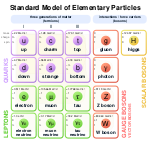 | ||||||||
|---|---|---|---|---|---|---|---|---|---|
| Constituents | |||||||||
| Beyond the Standard Model |
| ||||||||
| Experiments | |||||||||

| Background | |
|---|---|
| History of cosmological theories | |
| Past universe | |
| Present universe | |
| Future universe | |
| Components | |
| Structure formation | |
| Observations | |

- CS1 الإنجليزية الأمريكية-language sources (en-us)
- CS1 الفرنسية-language sources (fr)
- CS1 الألمانية-language sources (de)
- Pages using sidebar with the child parameter
- Articles containing فرنسية-language text
- Articles containing ألمانية-language text
- Articles with hatnote templates targeting a nonexistent page
- Articles with unsourced statements from April 2016
- ميكانيكا فلكية
- علم الكون الفيزيائي
- مادة مظلمة
- بنية الكون من منظار واسع
- فيزياء الجسيمات الفلكية
- مادة شاذة
- مسائل غير محلولة في علم الفلك
- فيزياء ما بعد النموذج القياسي
- فيزياء الجسيمات
- فيزياء نظرية
- جسيمات افتراضية