The Brahmi script has been dated to the beginning of the 4th century BCE from sherds inscribed with the script found at Anuradhapura.[2]
Some of the earliest and best-known Brahmi inscriptions are the rock-cut edicts of Ashoka in north-central India, dating to 250–232 BCE. The first successful attempts at deciphering Brahmi were made in 1836 by Norwegian scholar Christian Lassen, who used the bilingual Greek-Brahmi coins of Indo-Greek kings Agathocles and Pantaleon to correctly identify several Brahmi letters.[7] The script was fully deciphered in 1837 by James Prinsep, an archaeologist, philologist, and official of the East India Company, with the help of Alexander Cunningham.[8][7][9] The origin of the script is still much debated, with some scholars stating that Brahmi was derived from or at least influenced by one or more contemporary Semitic scripts, while others favor the idea of an indigenous origin or connection to the much older and as-yet undeciphered Indus script of the Indus Valley Civilization.[10][11]
Brahmi was at one time referred to in English as the "pin-man" script,[12] that is "stick figure" script. It was known by a variety of other names[13] until the 1880s when Albert Étienne Jean Baptiste Terrien de Lacouperie, based on an observation by Gabriel Devéria, associated it with the Brahmi script, the first in a list of scripts mentioned in the Lalitavistara Sūtra. Thence the name was adopted in the influential work of Georg Bühler, albeit in the variant form "Brahma".[14] The Gupta script of the fifth century is sometimes called "Late Brahmi".
The Brahmi script diversified into numerous local variants classified together as the Brahmic scripts. Dozens of modern scripts used across South Asia have descended from Brahmi, making it one of the world's most influential writing traditions.[15] One survey found 198 scripts that ultimately derive from it.[16] The script was associated with its own Brahmi numerals, which ultimately provided the graphic forms for the Hindu–Arabic numeral system now used through most of the world.[17]
النصوص
The Brahmi script is mentioned in the ancient Indian texts of Hinduism, Jainism and Buddhism, as well as their Chinese translations.[18][19] For example, the Lipisala samdarshana parivarta lists 64 lipi (scripts), with the Brahmi script starting the list. The Lalitavistara Sūtra states that young Siddhartha, the future Gautama Buddha (~500 BCE), mastered philology, Brahmi and other scripts from the Brahmin Lipikāra and Deva Vidyāiṃha at a school.[20][18]
A shorter list of eighteen ancient scripts is found in the texts of Jainism, such as the Pannavana Sutra (2nd century BCE) and the Samavayanga Sutra (3rd century BCE).[21][22] These Jaina script lists include Brahmi at number 1 and Kharoṣṭhi at number 4 but also Javanaliya (probably Greek) and others not found in the Buddhist lists.[22]
While the contemporary Kharoṣṭhī script is widely accepted to be a derivation of the Aramaic alphabet, the genesis of the Brahmi script is less straightforward. Salomon reviewed existing theories in 1998,[4] while Falk provided an overview in 1993.[23]
Early theories proposed a pictographic-acrophonic origin for the Brahmi script, on the model of the Egyptian hieroglyphic script. These ideas however have lost credence, as they are "purely imaginative and speculative".[24] Similar ideas have tried to connect the Brahmi script with the Indus script, but they remain unproven, and particularly suffer from the fact that the Indus script is as yet undeciphered.[24]
Heliodorus pillar in the Indian state of Madhya Pradesh. Installed about 120 BCE and now named after the Indo-Greek, the pillar's Brahmi-script inscription states that Heliodorus is a Bhagvatena (devotee) of Vishnu. A couplet in it closely paraphrases a Sanskrit verse from the Mahabharata.[25][26]
Semitic model hypothesis
Left pillar No. 9 of the Great Chatya at Karla Caves. This pillar was donated by a Yavana (Indo-Greek), circa 120 CE, like five other pillars. The inscription of this pillar reads: "dhenukākaṭa yavanasa / yasavadhanānaṃ / thabo danaṃ" i.e. "(This) pillar (is) the gift of the Yavana Yasavadhana from Denukakata".[27] Below: detail of the word "Ya-va-na-sa" (𑀬𑀯𑀦𑀲, adjectival form of "Yavana", Brahmi script).
James Prinsep, known for deciphering Brahmi in the early 19th century, was first to propose a connection between Indian scripts and Greek. He suggested that the oldest Greek was a "topsy-turvy" version of an ancient Indian language.[28] K. Ottfried Muller reversed this proposal suggesting that Brahmi was derived from Greek after the arrival of Alexander the Great.[28]
Bühler's theory
According to the Semitic hypothesis as laid out by Bühler in 1898, the oldest Brahmi inscriptions were derived from a Phoenician prototype.[29][note 1] Salomon states Bühler's arguments are "weak historical, geographical, and chronological justifications for a Phoenician prototype". Discoveries made since Bühler's proposal, such as of six Mauryan inscriptions in Aramaic, suggest Bühler's proposal about Phoenician as weak. It is more likely that Aramaic, which was virtually certain the prototype for Kharoṣṭhī, also may have been the basis for Brahmi. However, it is unclear why the ancient Indians would have developed two very different scripts.[31]
According to Bühler, Brahmi added symbols for certain sounds not found in Semitic languages, and either deleted or repurposed symbols for Aramaic sounds not found in Prakrit. For example, Aramaic lacks the phonetic retroflex feature that appears among Prakrit dental stops, such as ḍ, and in Brahmi the symbols of the retroflex and non-retroflex consonants are graphically very similar, as if both had been derived from a single prototype. (See Tibetan alphabet for a similar later development.) Aramaic did not have Brahmi's aspirated consonants (kh, th, etc.), whereas Brahmi did not have Aramaic's emphatic consonants (q, ṭ, ṣ), and it appears that these unneeded emphatic letters filled in for some of Brahmi's aspirates: Aramaic q for Brahmi kh, Aramaic ṭ (Θ) for Brahmi th (ʘ), etc. And just where Aramaic did not have a corresponding emphatic stop, p, Brahmi seems to have doubled up for the corresponding aspirate: Brahmi p and ph are graphically very similar, as if taken from the same source in Aramaic p. Bühler saw a systematic derivational principle for the other aspirates ch, jh, ph, bh, and dh, which involved adding a curve or upward hook to the right side of the character (which has been speculated to derive from h, ), while d and ṭ (not to be confused with the Semitic emphatic ṭ) were derived by back formation from dh and ṭh.[32]
Bühler's aspirate derivations
IAST
-aspirate
+aspirate
origin of aspirate according to Bühler
k/kh
Semitic emphatic (qoph)
g/gh
Semitic emphatic (heth) (hook addition in Bhattiprolu script)
c/ch
curve addition
j/jh
hook addition with some alteration
p/ph
curve addition
b/bh
hook addition with some alteration
t/th
Semitic emphatic (teth)
d/dh
unaspirated glyph back formed
ṭ/ṭh
unaspirated glyph back formed as if aspirated glyph with curve
ḍ/ḍh
curve addition
The following table lists the correspondences between Brahmi and North Semitic scripts.[33][34]
Comparison of North Semitic and Brahmi scripts[34][note 2]
Bühler states that both Phoenician and Brahmi had three voiceless sibilants, but because the alphabetical ordering was lost, the correspondences among them are not clear. Bühler was able to suggest Brahmi derivatives corresponding to all of the 22 North Semitic characters, though clearly, as Bühler himself recognized, some are more confident than others. He tended to place much weight on phonetic congruence as a guideline, for example connecting c to tsade rather than kaph, as preferred by many of his predecessors.
One of the key problems with a Phoenician derivation is the lack of evidence for historical contact with Phoenicians in the relevant period.[31] Bühler explained this by proposing that the initial borrowing of Brahmi characters dates back considerably earlier than the earliest known evidence, as far back as 800 BCE, contemporary with the Phoenician glyph forms that he mainly compared. Bühler cited a near-modern practice of writing Brahmic scripts informally without vowel diacritics as a possible continuation of this earlier abjad-like stage in development.[36]
The weakest forms of the Semitic hypothesis are similar to Gnanadesikan's trans-cultural diffusion view of the development of Brahmi and Kharoṣṭhī, in which the idea of alphabetic sound representation was learned from the Aramaic-speaking Persians, but much of the writing system was a novel development tailored to the phonology of Prakrit.[37]
Some common variants of Brahmic letters
Another evidence cited in favor of Persian influence has been the Hultzsch proposal in 1925 that the Prakrit/Sanskrit word for writing itself, lipi is similar to the Old Persian word dipi, suggesting a probable borrowing.[38][39] A few of the Ashoka edicts from the region nearest the Persian empire use dipi as the Prakrit word for writing, which appears as lipi elsewhere, and this geographic distribution has long been taken, at least back to Bühler's time, as an indication that the standard lipi form is a later alteration that appeared as it diffused away from the Persian sphere of influence. Persian dipi itself is thought to be an Elamite loanword.[40]
Falk's theory
Falk's 1993 book Schrift im Alten Indien is considered a definitive study on writing in ancient India.[41][42] Falk's section on the origins of the Brahmi script[23] features an extensive review of the literature up to that time. Falk also puts forth his own ideas. As have a number of other authors, Falk sees the basic writingsystem of Brahmi as being derived from the Kharoṣṭhī script, itself a derivative of Aramaic. At the time of his writing, the Ashoka edicts were the oldest confidently dateable examples of Brahmi, and he perceives in them "a clear development in language from a faulty linguistic style to a well honed one"[43] over time, which he takes to indicate that the script had been recently developed.[23][44] Falk deviates from the mainstream of opinion in seeing Greek as also being a significant source for Brahmi. On this point particularly, Salomon disagrees with Falk, and after presenting evidence of very different methodology between Greek and Brahmi notation of vowel quantity, he states "it is doubtful whether Brahmi derived even the basic concept from a Greek prototype".[28] Further, adds Salomon, in a "limited sense Brahmi can be said to be derived from Kharosthi, but in terms of the actual forms of the characters, the differences between the two Indian scripts are much greater than the similarities".[45]
Falk also dated the origin of Kharoṣṭhī to no earlier than 325 BCE, based on a proposed connection to the Greek conquest.[46] Salomon questions Falk's arguments as to the date of Kharoṣṭhī and writes that it is "speculative at best and hardly constitutes firm grounds for a late date for Kharoṣṭhī. The stronger argument for this position is that we have no specimen of the script before the time of Ashoka, nor any direct evidence of intermediate stages in its development; but of course this does not mean that such earlier forms did not exist, only that, if they did exist, they have not survived, presumably because they were not employed for monumental purposes before Ashoka".[44]
Coin of Agathocles with Hindu deities, in Greek and Brahmi. ObvBalarama-Samkarshana with Greek legend: ΒΑΣΙΛΕΩΣ ΑΓΑΘΟΚΛΕΟΥΣ. RevVasudeva-Krishna with Brahmi legend:𑀭𑀸𑀚𑀦𑁂 𑀅𑀕𑀣𑀼𑀓𑁆𑀮𑀬𑁂𑀲 Rājane Agathukleyesa "King Agathocles". Circa 180 BCE.Coin of the Vemaka or Audumbaras tribe. Obverse: Bhagavata mahadevasa rajarana in Kharosthi. Reverse: Bhagavata-mahadevasa rajarana in Brahmi. 1st century BCE.[47][بحاجة لمصدر أفضل]A 2nd-century BCE Tamil Brahmi inscription from Arittapatti, Madurai India. The southern state of Tamil Nadu has emerged as a major source of Brahmi inscriptions dated between 3rd to 1st-centuries BCE.[48][49]
Unlike Bühler, Falk does not provide details of which and how the presumptive prototypes may have been mapped to the individual characters of Brahmi. Further, states Salomon, Falk accepts there are anomalies in phonetic value and diacritics in Brahmi script that are not found in the presumed Kharoṣṭhī script source. Falk attempts to explain these anomalies by reviving the Greek influence hypothesis, a hypothesis that had previously fallen out of favor.[44][50]
Hartmut Scharfe, in his 2002 review of Kharoṣṭī and Brāhmī scripts, concurs with Salomon's questioning of Falk's proposal, and states, "the pattern of the phonemic analysis of the Sanskrit language achieved by the Vedic scholars is much closer to the Brahmi script than the Greek alphabet".[11]
Indigenous origin theory
The idea of an indigenous origin such as a connection to the Indus script is supported by some Western and Indian scholars and writers. The theory that there are similarities to the Indus script was suggested by early European scholars such as the Cambridge University archaeologist John Marshall[51] and the Oxford University professor Stephen Langdon,[52] and it continues to be suggested by scholars and writers such as (among others) the computer scientist Subhash Kak, the German Indologist Georg Feuerstein, the American teacher David Frawley, the British archaeologist Raymond Allchin, and the Cambridge University professor Jack Goody.[53][54][55]
A proposed connection between the Brahmi and Indus scripts, made in the 19th century by Alexander Cunningham.
Another form of the indigenous origin theory is that Brahmi was invented ex nihilo, entirely independently from either Semitic models or the Indus script, though Salomon found these theories to be wholly speculative in nature.[56]
Foreign origination
The word Lipī (𑀮𑀺𑀧𑀻) used by Ashoka to describe his "Edicts". Brahmi script (Li=𑀮La+𑀺i; pī=𑀧Pa+𑀻ii). The word would be of Old Persian origin ("Dipi").
Pāṇini (6th to 4th century BCE) mentions lipi, the Indian word for writing scripts in his definitive work on Sanskrit grammar, the Ashtadhyayi. According to Scharfe, the words lipi and libi are borrowed from the Old Persiandipi, in turn derived from Sumerian dup.[39][57] To describe his own Edicts, Ashoka used the word Lipī, now generally simply translated as "writing" or "inscription". It is thought the word "lipi", which is also orthographed "dipi" in the two Kharosthi-version of the rock edicts,[note 3] comes from an Old Persian prototype dipî also meaning "inscription", which is used for example by Darius I in his Behistun inscription,[note 4] suggesting borrowing and diffusion.[58][59][60]
Issues with current theories on Brahmi script origins
Connections between Phoenician (4th column) and Brahmi (5th column). Note that 6th-to-4th-century BCE Aramaic (not shown) is in many cases intermediate in form between the two.
أصل الاسم
Several divergent accounts of the origin of the name "Brahmi" appear in history and legend. Several Sutras of Jainism such as the Vyakhya Pragyapti Sutra, the Samvayanga Sutra and the Pragyapna Sutra of the Jain Agamas include a list of 18 writing scripts known to teachers before the Mahavira was born, with the Brahmi script (bambhī in the original Prakrit) leading all these lists. The Brahmi script is missing from the 18 script list in the surviving versions of two later Jaina Sutras, namely the Vishesha Avashyaka and the Kalpa Sutra. Jain legend recounts that 18 writing scripts were taught by their first Tirthankara Rishabhanatha to his daughter Brahmi, she emphasized Brahmi as the main script as she taught others, and therefore the name Brahmi for the script comes after her name.[61]
A Chinese Buddhist account of the 6th century CE attributes its creation to the god Brahma, though Monier Monier-Williams, Sylvain Lévi and others thought it was more likely to have been given the name because it was moulded by the Brahmins.[62][63]
The term Brahmi appears in ancient Indian texts in different contexts. According to the rules of the Sanskrit language, it is a feminine word which literally means "of Brahma" or "the female energy of the Brahman".[64] In other texts such as the Mahabharata, it appears in the sense of a goddess, particularly for Saraswati as the goddess of speech and elsewhere as "personified Shakti (energy) of Brahma".[65]
The earliest known full inscriptions of Brahmi are in Prakrit, dated to be from 3rd to 1st-century BCE, particularly the Edicts of Ashoka, c. 250 BCE.[66] Prakrit records predominate the epigraphic records discovered in the Indian subcontinent through about 1st-century CE.[66] The earliest known Brahmi inscriptions in Sanskrit are from the 1st-century BCE, such as the few discovered in Ayodhya, Ghosundi and Hathibada (both near Chittorgarh).[67][note 5] Ancient inscriptions have also been discovered in many North and Central Indian sites, occasionally in South India as well, that are in hybrid Sanskrit-Prakrit language called "Epigraphical Hybrid Sanskrit".[note 6] These are dated by modern techniques to between 1st and 4th-century CE.[70][71] Surviving ancient records of the Brahmi script are found as engravings on pillars, temple walls, metal plates, terra-cotta, coins, crystals and manuscripts.[72][71]
فك الرموز
Consonants of the Brahmi script, and evolution down to modern Devanagari, according to James Prinsep, as published in the Journal of the Asiatic Society of Bengal, in March 1838. All the letters are correctly deciphered, except for two missing on the right: 𑀰(ś) and 𑀱(ṣ).[73] Vowels and compounds here.
Besides a few inscriptions in Greek and Aramaic (which were only discovered in the 20th century), the Edicts of Ashoka were written in the Brahmi script and sometimes in the Kharoshthi script in the northwest, which had both become extinct around the 4th century CE, and were yet undeciphered at the time the Edicts were discovered and investigated in the 19th century.[74][7]
البحر الأحمر وجنوب شرق آسيا
The Khuan Luk Pat inscription discovered in تايلند is in Tamil Brahmi script. Its date is uncertain and has been proposed to be from the early centuries of the common era.[75][76] According to Frederick Asher, Tamil Brahmi inscriptions on postherds have been found in Quseir al-Qadim and in Berenike, Egypt which suggest that merchant and trade activity was flourishing in ancient times between India and the Red Sea region.[76] Additional Tamil Brahmi inscription has been found in Khor Rori region of Oman on an archaeological site storage jar.[76]
السمات
Brahmi is usually written from left to right, as in the case of its descendants. However, an early coin found in Eran is inscribed with Brahmi running from right to left, as in Aramaic. Several other instances of variation in the writing direction are known, though directional instability is fairly common in ancient writing systems.[77]
Consonants
Brahmi is an abugida, meaning that each letter represents a consonant, while vowels are written with obligatory diacritics called mātrās in Sanskrit, except when the vowels commence a word. When no vowel is written, the vowel /a/ is understood. This "default short a" is a characteristic shared with Kharosthī, though the treatment of vowels differs in other respects.
Special conjunct consonants are used to write consonant clusters such as /pr/ or /rv/. In modern Devanagari the components of a conjunct are written left to right when possible (when the first consonant has a vertical stem that can be removed at the right), whereas in Brahmi characters are joined vertically downwards.
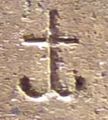
Kya (vertical assembly of consonants "Ka" and "Ya" ), as in "Sa-kya-mu-nī " ( 𑀲𑀓𑁆𑀬𑀫𑀼𑀦𑀻, "Sage of the Shakyas")
Sva (Sa+Va)
Kla (Ka+La)
Sya (Sa+Ya)
Hmī (Ha+Ma+i+i), as in the word "Brāhmī" (𑀩𑁆𑀭𑀸𑀳𑁆𑀫𑀻).
Vowels
Brahmi diacritic vowels.The Brahmi symbol for /ka/, modified to represent different vowels
A 1st century BCE/CE inscription from Sanchi: "Vedisakehi daṃtakārehi rupakaṃmaṃ kataṃ" (𑀯𑁂𑀤𑀺𑀲𑀓𑁂𑀨𑀺 𑀤𑀁𑀢𑀓𑀸𑀭𑁂𑀨𑀺 𑀭𑀼𑀧𑀓𑀁𑀫𑀁 𑀓𑀢𑀁, "Ivory workers from Vidisha have done the carving").[78]
Over the course of a millennium, Brahmi developed into numerous regional scripts, commonly classified into a more rounded Southern India group and a more angular Northern India group. Over time, these regional scripts became associated with the local languages. A Northern Brahmi gave rise to the Gupta script during the Gupta Empire, sometimes also called "Late Brahmi" (used during the 5th century), which in turn diversified into a number of cursives during the Middle Ages, including the Siddhaṃ script (6th century), Śāradā script (9th century) and Devanagari (10th century).
Also in the Brahmic family of scripts are several Central Asian scripts such as Tibetan, Tocharian (also called slanting Brahmi), and the one used to write the Saka language.
Brahmi was added to the Unicode Standard in October, 2010 with the release of version 6.0.
The Unicode block for Brahmi is U+11000–U+1107F. It lies within Supplementary Multilingual Plane. As of August 2014 there are two non-commercially available fonts that support Brahmi, namely Noto Sans Brahmi commissioned by Google which covers all the characters,[79] and Adinatha which only covers Tamil Brahmi.[80]Segoe UI Historic, tied in with Windows 10, also features Brahmi glyphs.[81]
The Sanskrit word for Brahmi, ब्राह्मी (IASTBrāhmī) in the Brahmi script should be rendered as follows: 𑀩𑁆𑀭𑀸𑀳𑁆𑀫𑀻.
The Brahmi script was the medium for some of the most famous inscriptions of ancient India, starting with the Edicts of Ashoka, circa 250 BCE.
مسقط رأس بوذا التاريخي
في المرسوم ذائع الصيت، مرسوم رومـِّندِيْ في لومبيني، نـِپال، يصف أشوكا زيارته في السنة 21 من عهده، ويصف لومبيني بأنها مسقط رأس البوذا. He also, for the first time in historical records, uses the epithet "Sakyamuni" (Sage of the Shakyas)، لوصف بوذا.[82]
When King Devanampriya Priyadarsin had been anointed twenty years, he came himself and worshipped (this spot) because the Buddha Shakyamuni was born here. (He) both caused to be made a stone bearing a horse (?) and caused a stone pillar to be set up, (in order to show) that the Blessed One was born here. (He) made the village of Lummini free of taxes, and paying (only) an eighth share (of the produce).
This Garuda-standard of Vāsudeva, the God of Gods
was erected here by the devotee Heliodoros,
the son of Dion, a man of Taxila,
sent by the Great Yona King Antialkidas, as ambassador
to King Kasiputra Bhagabhadra,
the Savior son of the princess from Varanasi,
in the fourteenth year of his reign.
^Aramaic is written from right to left, as are several early examples of Brahmi.[30][صفحة مطلوبة] For example, Brahmi and Aramaic g ( and ) and Brahmi and Aramaic t ( and ) are nearly identical, as are several other pairs. Bühler also perceived a pattern of derivation in which certain characters were turned upside down, as with pe and pa, which he attributed to a stylistic preference against top-heavy characters.
^Bühler notes that other authors derive (cha) from qoph. "M.L." indicates that the letter was used as a mater lectionis in some phase of Phoenician or Aramaic. The matres lectionis functioned as occasional vowel markers to indicate medial and final vowels in the otherwise consonant-only script. Aleph and particularly ʿayin only developed this function in later phases of Phoenician and related scripts, though also sometimes functioned to mark an initial prosthetic (or prothetic) vowel from a very early period.[35]
^More numerous inscribed Sanskrit records in Brahmi have been found near Mathura and elsewhere, but these are from the 1st century CE onwards.[68]
^The archeological sites near the northern Indian city of Mathura has been one of the largest source of such ancient inscriptions. Andhau (Gujarat) and Nasik (Maharashtra) are other important sources of Brahmi inscriptions from the 1st-century CE.[69]
^Brahmi, Encyclopedia Britannica (1999), Quote: "Brāhmī, writing system ancestral to all Indian scripts except Kharoṣṭhī. Of Aramaic derivation or inspiration, it can be traced to the 8th or 7th century BC, when it may have been introduced to Indian merchants by people of Semitic origin. (...) a coin of the 4th century BC, discovered in Madhya Pradesh, is inscribed with Brāhmī characters running from right to left."
^خطأ استشهاد: وسم <ref> غير صحيح؛ لا نص تم توفيره للمراجع المسماة Salomon 1995
^Brahmi, Encyclopedia Britannica (1999), Quote: "Among the many descendants of Brāhmī are Devanāgarī (used for Sanskrit, Hindi, and other Indian languages), the Bengali and Gujarati scripts, and those of the Dravidian languages"
^ أبGeorg Bühler (1898). On the Origin of the Indian Brahma Alphabet. K.J. Trübner. pp. 6, 14–15, 23, 29., Quote: "(...) a passage of the Lalitavistara which describes the first visit of Prince Siddhartha, the future Buddha, to the writing school..." (page 6); "In the account of Prince Siddhartha's first visit to the writing school, extracted by Professor Terrien de la Couperie from the Chinese translation of the Lalitavistara of 308 AD, there occurs besides the mention of the sixty-four alphabets, known also from the printed Sanskrit text, the utterance of the Master Visvamitra[.]"
^Nado, Lopon (1982). "The Development of Language in Bhutan". The Journal of the International Association of Buddhist Studies. 5 (2): 95. Under different teachers, such as the Brahmin Lipikara and Deva Vidyasinha, he mastered Indian philology and scripts. According to Lalitavistara, there were as many as sixty-four scripts in India.
^Tsung-i, Jao (1964). "CHINESE SOURCES ON BRĀHMĪ AND KHAROṢṬHĪ". Annals of the Bhandarkar Oriental Research Institute. 45 (1/4): 39–47. doi:10.2307/41682442. JSTOR41682442.
^L. A. Waddell (1914), Besnagar Pillar Inscription B Re-Interpreted, The Journal of the Royal Asiatic Society of Great Britain and Ireland, Cambridge University Press, pages 1031-1037
^Andersen, F.I.; Freedman, D.N. (1992). "Aleph as a vowel in Old Aramaic". Studies in Hebrew and Aramaic Orthography. Winona Lake, Indiana: Eisenbrauns. pp. 79–90.
^ أبتSalomon, Richard (1995). "Review: On the Origin of the Early Indian Scripts". Journal of the American Oriental Society. 115 (2): 271–278. doi:10.2307/604670.
^Iravatham Mahadevan (2003). Early Tamil Epigraphy. Harvard University Department of Sanskrit and Indian Studies. pp. 91–94. ISBN978-0-674-01227-1.; Iravatham Mahadevan (1970). Tamil-Brahmi Inscriptions. State Department of Archaeology, Government of Tamil Nadu. pp. 1–12.
^Jack Goody (1987). The Interface Between the Written and the Oral. Cambridge University Press. pp. 301 footnote 4. ISBN978-0-521-33794-6., Quote: "In recent years, I have been leaning towards the view that the Brahmi script had an independent Indian evolution, probably emerging from the breakdown of the old Harappan script in the first half of the second millennium BC".
^"The word dipi appears in the Old Persian inscription of Darius I at Behistan (Column IV. 39) having the meaning inscription or "written document" in Congress, Indian History (2007). Proceedings - Indian History Congress (in الإنجليزية). p. 90.
^Nagrajji, Acharya Shri (2003), Āgama Aura Tripiṭaka, Eka Anuśilana: Language and literature, New Delhi: Concept Publishing
^Sukthankar, Vishnu Sitaram, V. S. Sukthankar Memorial Edition, Vol. II: Analecta, Bombay: Karnatak Publishing House 1945 p.266
^ أبR. Salomon, Indian Epigraphy. A Guide to the Study of Inscriptions in
Sanskrit, Prakrit, and the Other Indo-Aryan Languages (Oxford, 1998), 265–7
^International Dunhuang Project. "Or.8212/162". British Library.
ببليوگرافيا
Annette Wilke; Oliver Moebus (2011). Sound and Communication: An Aesthetic Cultural History of Sanskrit Hinduism. Walter de Gruyter. ISBN978-3-11-024003-0. {{cite book}}: Invalid |ref=harv (help)
Falk, Harry (1993). Schrift im alten Indien: ein Forschungsbericht mit Anmerkungen (in German). Gunter Narr Verlag. {{cite book}}: Invalid |ref=harv (help)CS1 maint: unrecognized language (link)
Gérard Fussman, Les premiers systèmes d'écriture en Inde, in Annuaire du Collège de France 1988–1989 (in French)
Oscar von Hinüber, Der Beginn der Schrift und frühe Schriftlichkeit in Indien, Franz Steiner Verlag, 1990 (in German)
Norman, Kenneth R. (1992). "The Development of Writing in India and its Effect upon the Pāli Canon". Wiener Zeitschrift für die Kunde Südasiens / Vienna Journal of South Asian Studies. 36 (Proceedings of the VIIIth World Sanskrit Conference Vienna): 239–249.
Salomon, Richard (1995). "On the Origin of the Early Indian Scripts". Journal of the American Oriental Society. 115 (2): 271–279. doi:10.2307/604670. JSTOR604670.
Salomon, Richard (1998). Indian Epigraphy: A Guide to the Study of Inscriptions in Sanskrit, Prakrit, and the Other Indo-Aryan Languages. Oxford: Oxford University Press. ISBN0-19-509984-2. {{cite book}}: Invalid |ref=harv (help)


 ), while d and ṭ (not to be confused with the Semitic emphatic ṭ) were derived by back formation from dh and ṭh.[32]


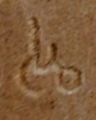 Sva (Sa+Va)
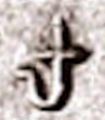 Kla (Ka+La)
 Sya (Sa+Ya)
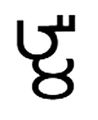 Hmī (Ha+Ma+i+i), as in the word "Brāhmī" (𑀩𑁆𑀭𑀸𑀳𑁆𑀫𑀻).
_conjunct_consonant.jpg&filetimestamp=20190403110416&)
.jpg&filetimestamp=20190403110415&)
.jpg&filetimestamp=20190403110418&)
.jpg&filetimestamp=20190403110418&)
.jpg&filetimestamp=20190403110417&)


.jpg&filetimestamp=20190403110407&)

,_scroll,_26x385cm,_Dunhuang_Mogao,_British_Library.jpg&filetimestamp=20190403114057&)
 and
and  ) and Brahmi and Aramaic t (
 and
and  ) are nearly identical, as are several other pairs. Bühler also perceived a pattern of derivation in which certain characters were turned upside down, as with pe
  and
and  pa, which he attributed to a stylistic preference against top-heavy characters.
 (cha) from qoph. "M.L." indicates that the letter was used as a mater lectionis in some phase of Phoenician or Aramaic. The matres lectionis functioned as occasional vowel markers to indicate medial and final vowels in the otherwise consonant-only script. Aleph
  and particularly ʿayin
  only developed this function in later phases of Phoenician and related scripts, though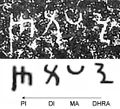
 rather than "Li"
  ).
).


