شكل هيكلي

الشكل الهيكلي أو الصيغة الهيكلية Skeletal formula هو شكل ثلاثي الأبعاد للجزيء يعرض شكل الجزيء، ويتضمن زوايا الروابط. وليس من المهم عرض العناصر داخل الجزيء. كما أن الروابط ترسم على هيئة خطوط، وكل خط يمثل رابطة. ويعرف أن عند كل إنحناءة خط ذرة كربون، أو في نهاية أى خط. كما أن ذرات الهيدروجين يفهم أنها توجد في أى مكان يستلزم وجودها لإكمال أى عدد ناقص من الروابط لأى عنصر. وأى عنصر أخر يتم توضيحه كتابة، وتوضيح عدد الروابط اللازمة له. وهناك بعض المجموعات مثل البنزين، يمكن أن يتم إختصارها طبقا لما هو متعارف عليه واحبانا تتضمن البنزن حلقة أو عدة حلقات موجودة في المركبات الكربونية ولها عدة أشكال هندسية أو ثلاثية الأبعاد أو خماسية أو سداسية حسب عدد ذرات الكربون المرتبطة بالمركب وكما ان الروابط تلعب دورا رئيسيا في تشكيل شكل الجزيء أو المركب العضوي الموجود أو المتضمن.
الذرات واضحة التباين وذرات الهيدروجين
All atoms that are not carbon or hydrogen are signified by their chemical symbol, for instance Cl for chlorine, O for oxygen, Na for sodium, and so forth. In the context of organic chemistry, these atoms are commonly known as heteroatoms (the prefix hetero- comes from Greek ἕτερος héteros, meaning "other").
Any hydrogen atoms bonded to heteroatoms are drawn explicitly. In ethanol, C2H5OH, for instance, the hydrogen atom bonded to oxygen is denoted by the symbol H, whereas the hydrogen atoms which are bonded to carbon atoms are not shown directly.
Lines representing heteroatom-hydrogen bonds are usually omitted for clarity and compactness, so a functional group like the hydroxyl group is most often written −OH instead of −O−H. These bonds are sometimes drawn out in full in order to accentuate their presence when they participate in reaction mechanisms.
Shown below for comparison are a skeletal formula (top), its Lewis structure (middle) and its ball-and-stick model (bottom) of the actual 3D structure of the ethanol molecule in the gas phase, as determined by microwave spectroscopy.
-
 The skeletal structure of ethanol
 -
 The Lewis structure of ethanol
 -
 The 3d ball representation of ethanol


البحوث العنصرية الكاذبة
There are also symbols that appear to be chemical element symbols, but represent certain very common substituents or indicate an unspecified member of a group of elements. These are called pseudoelement symbols or organic elements and are treated like univalent "elements" in skeletal formulae.[1] A list of common pseudoelement symbols:
General symbols
- X for any (pseudo)halogen atom[2] (in the related MLXZ notation, X represents a one-electron donor ligand)
- L or Ln for a ligand or ligands (in the related MLXZ notation, L represents a two-electron donor ligand)
- M or Met for any metal atom ([M] is used to indicate a ligated metal, MLn, when the identities of the ligands are unknown or irrelevant)
- E or El for any electrophile (in some contexts, E is also used to indicate any p-block element)
- Nu for any nucleophile[2]
- Z for conjugating electron-withdrawing groups (in the related MLXZ notation, Z represents a zero-electron donor ligand; in unrelated usage, Z is also an abbreviation for the carboxybenzyl group.)
- D for deuterium (2H)[2]
- T for tritium (3H)
مجموعات الألكيل
- R for any alkyl group or even any organyl group (Alk can be used to unambiguously indicate an alkyl group)[2]
- Me for the methyl group[2]
- Et for the ethyl group[2]
- Pr, n-Pr, or nPr for the (normal) propyl group (Pr is also the symbol for the element praseodymium.[2] However, since the propyl group is monovalent, while praseodymium is nearly always trivalent, ambiguity rarely, if ever, arises in practice.)
- i-Pr or iPr for the isopropyl group
- All for the allyl group (uncommon)
- Bu, n-Bu or nBu for the (normal) butyl group[2]
- i-Bu or iBu (i often italicized) for the isobutyl group
- s-Bu or sBu for the secondary butyl group
- t-Bu or tBu for the tertiary butyl group
- Pn for the pentyl group (or Am for the synonymous amyl group, although Am is also the symbol for americium.)
- Np or Neo for the neopentyl group (Warning: Organometallic chemists often use Np for the related neophyl group, PhMe2C–. Np is also the symbol for the element neptunium.)
- Cy or Chx for the cyclohexyl group[2]
- Ad for the 1-adamantyl group[2]
- Tr or Trt for the trityl group
Aromatic and unsaturated substituents
- Ar for any aromatic substituent (Ar is also the symbol for the element argon. However, argon is inert under all usual conditions encountered in organic chemistry, so the use of Ar to represent an aryl substituent never causes confusion.)
- Het for any heteroaromatic substituent
- Bn or Bzl for the benzyl group (not to be confused with Bz for benzoyl group; However, old literature may use Bz for benzyl group.)
- Dipp for the 2,6-diisopropylphenyl group
- Mes for the mesityl group
- Ph, Φ, or φ for the phenyl group (the use of phi for phenyl has been in decline)
- Tol for the tolyl group, usually the para isomer
- Is or Tipp for the 2,4,6-triisopropylphenyl group (the former symbol is derived from the synonym isityl)
- An for the anisyl group, usually the para isomer (An is also the symbol for a generic actinoid element. However, since the anisyl group is monovalent, while the actinides are usually divalent, trivalent, or even higher valency, ambiguity rarely, if ever, arises in practice.)
- Cp for the cyclopentadienyl group (Cp was the symbol for cassiopeium, a former name for lutetium)
- Cp* for the pentamethylcyclopentadienyl group
- Vi for the vinyl group (uncommon)
Functional groups
- Ac for the acetyl group (Ac is also the symbol for the element actinium. However, actinium is almost never encountered in organic chemistry, so the use of Ac to represent the acetyl group never causes confusion);
- Bz for the benzoyl group; OBz is the benzoate group
- Piv for the pivalyl (t-butylcarbonyl) group; OPiv is the pivalate group
- Bt for the 1-benzotriazolyl group
- Im for the 1-imidazolyl group
- NPhth for the phthalimide-1-yl group
Sulfonyl/sulfonate groups
Sulfonate esters are often leaving groups in nucleophilic substitution reactions. See the articles on sulfonyl and sulfonate groups for further information.
- Bs for the brosyl (p-bromobenzenesulfonyl) group; OBs is the brosylate group
- Ms for the mesyl (methanesulfonyl) group; OMs is the mesylate group
- Ns for the nosyl (p-nitrobenzenesulfonyl) group (Ns was the chemical symbol for nielsbohrium, but that was renamed bohrium, Bh); ONs is the nosylate group
- Tf for the triflyl (trifluoromethanesulfonyl) group; OTf is the triflate group
- Nf for the nonaflyl (nonafluorobutanesulfonyl) group, CF 3(CF 2) 3SO 2; ONf is the nonaflate group
- Ts for tosyl (p-toluenesulfonyl) group (Ts is also the symbol for the element tennessine. However, tennessine is too unstable to ever be encountered in organic chemistry, so the use of Ts to represent tosyl never causes confusion); OTs is the tosylate group
Protecting groups
A protecting group or protective group is introduced into a molecule by chemical modification of a functional group to obtain chemoselectivity in a subsequent chemical reaction, facilitating multistep organic synthesis.
- Boc for the t-butoxycarbonyl group
- Cbz or Z for the carboxybenzyl group
- Fmoc for the fluorenylmethoxycarbonyl group
- Alloc for the allyloxycarbonyl group
- Troc for the trichloroethoxycarbonyl group
- TMS, TBDMS, TES, TBDPS, TIPS, ... for various silyl ether groups
- PMB for the 4-methoxybenzyl group
- MOM for the methoxymethyl group
- THP for the 2-tetrahydropyranyl group
الروابط المتعددة
Two atoms can be bonded by sharing more than one pair of electrons. The common bonds to carbon are single, double and triple bonds. Single bonds are most common and are represented by a single, solid line between two atoms in a skeletal formula. Double bonds are denoted by two parallel lines, and triple bonds are shown by three parallel lines.
In more advanced theories of bonding, non-integer values of bond order exist. In these cases, a combination of solid and dashed lines indicate the integer and non-integer parts of the bond order, respectively.
- Examples of multiple bonds in skeletal formulae[أ]
-
 Hex-3-ene has an internal carbon–carbon double bond
 -
 Hex-1-ene has a terminal double bond
 -
 Hex-3-yne has an internal carbon–carbon triple bond
 -
 Hex-1-yne has a terminal triple bond


حلقات البنزين

In recent years, benzene is generally depicted as a hexagon with alternating single and double bonds, much like the structure Kekulé originally proposed in 1872. As mentioned above, the alternating single and double bonds of "1,3,5-cyclohexatriene" are understood to be a drawing of one of the two equivalent canonical forms of benzene (the one explicitly shown and the one with the opposite pattern of formal single and double bonds), in which all carbon–carbon bonds are of equivalent length and have a bond order of exactly 1.5. For aryl rings in general, the two analogous canonical forms are almost always the primary contributors to the structure, but they are nonequivalent, so one structure may make a slightly greater contribution than the other, and bond orders may differ somewhat from 1.5.
An alternate representation that emphasizes this delocalization uses a circle, drawn inside the hexagon of single bonds, to represent the delocalized pi orbital. This style, based on one proposed by Johannes Thiele, used to be very common in introductory organic chemistry textbooks and is still frequently used in informal settings. However, because this depiction does not keep track of electron pairs and is unable to show the precise movement of electrons, it has largely been superseded by the Kekuléan depiction in pedagogical and formal academic contexts.[ب]
الكيمياء الفراغية

Stereochemistry is conveniently denoted in skeletal formulae:[3]
-
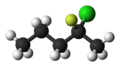 Ball-and-stick model of
(R)-2-chloro-2-fluoropentane -
 Skeletal formula of
(R)-2-chloro-2-fluoropentane -
 Skeletal formula of
(S)-2-chloro-2-fluoropentane -


-2-Chloro-2-fluoropentane.svg&filetimestamp=20260513165914&)
-2-Chloro-2-fluoropentane.svg&filetimestamp=20260513170022&)


The relevant chemical bonds can be depicted in several ways:
- Solid lines represent bonds in the plane of the paper or screen.
- Solid wedges represent bonds that point out of the plane of the paper or screen, towards the observer.
- Hashed wedges or dashed lines (thick or thin) represent bonds that point into the plane of the paper or screen, away from the observer.[ت]
- Wavy lines represent either unknown stereochemistry or a mixture of the two possible stereoisomers at that point.
- An obsolescent[ث] depiction of hydrogen stereochemistry that used to be common in steroid chemistry is the use of a filled circle centered on a vertex (sometimes called H-dot/H-dash/H-circle, respectively) for an upward pointing hydrogen atom and two hash marks next to vertex or a hollow circle for a downward pointing hydrogen atom.

An early use of this notation can be traced back to Richard Kuhn who in 1932 used solid thick lines and dotted lines in a publication. The modern solid and hashed wedges were introduced in the 1940s by Giulio Natta to represent the structure of high polymers, and extensively popularised in the 1959 textbook Organic Chemistry by Donald J. Cram and George S. Hammond.[4]

Skeletal formulae can depict cis and trans isomers of alkenes. Wavy single bonds are the standard way to represent unknown or unspecified stereochemistry or a mixture of isomers (as with tetrahedral stereocenters). A crossed double-bond has been used sometimes; it is no longer considered an acceptable style for general use but may still be required by computer software.[3]
روابط الهيدروجين

Hydrogen bonds are generally denoted by dotted or dashed lines. In other contexts, dashed lines may also represent partially formed or broken bonds in a transition state.
ملاحظات
- ^ In this gallery, double bonds have been shown in red and triple bonds in blue. This was added for clarity – multiple bonds are not normally coloured in skeletal formulae.
- ^ For instance, the acclaimed 1959 textbook by Morrison and Boyd (6th edition, 1992) uses the Thiele notation as its standard depiction of the aryl ring, while the 2001 textbook by Clayden, Greeves, Warren, and Wothers (2nd edition, 2012) uses the Kekulé notation throughout and warns students to avoid using the Thiele notation when writing mechanisms (p. 144, 2nd ed.).
- ^ American and European chemists use slightly different conventions for a hashed bond. Whereas most American chemists draw hashed bonds with short hash marks close to the stereocenter and long hash marks further away (in analogy to wedged bonds), most European chemists start with long hash marks close to the stereocenter that gradually become shorter moving away (in analogy to perspective drawing). In the past, the IUPAC has suggested the use of a hashed bond with hash marks of equal length throughout as a compromise but now prefers the American-style hashed bonds (Brecher, 2006, p. 1905). Some chemists use a thick bond and dotted bond (or hashed bond with equal length hashes) to depict relative stereochemistry and a wedged bond and hashed bond with unequal hashes to depict absolute stereochemistry; most others do not make this distinction.
- ^ The IUPAC now strongly deprecates this notation.
المصادر
- ويكيبيديا الإنجليزية.
المراجع
- ^ Clayden, Jonathan; Greeves, Nick; Warren, Stuart; Wothers, Peter (2001). Organic Chemistry (1st ed.). Oxford University Press. p. 27. ISBN 978-0-19-850346-0.
- ^ أ ب ت ث ج ح خ د ذ ر Haynes, William M., ed. (2014). CRC Handbook of Chemistry and Physics (95, revised ed.). CRC Press. p. 2–29. ISBN 978-1-4822-0868-9.
- ^ أ ب Brecher, Jonathan (2006). "Graphical representation of stereochemical configuration (IUPAC Recommendations 2006)" (PDF). Pure and Applied Chemistry. 78 (10): 1897–1970. doi:10.1351/pac200678101897. S2CID 97528124.
- ^ Jensen, William B. (2013). "The Historical Origins of Stereochemical Line and Wedge Symbolism". Journal of Chemical Education. 90 (5): 676–677. Bibcode:2013JChEd..90..676J. doi:10.1021/ed200177u.
وصلات خارجية
- Drawing organic molecules from chemguide.co.uk