الشعوب الأصلية في كولومبيا
Colombianos nativos (Spanish) | |
|---|---|
 Flag of the Indigenous Colombians | |
| إجمالي التعداد | |
| ▲ 1,905,617 (2018 Census)[1][2] ▲ 4.31% of the Colombian population ح. 5,200,000 (Estimation)[3][4][5] ~10% of the Colombian population 2%–10.4%[4][6][7] of the Colombian population (other sources) | |
| المناطق ذات التجمعات المعتبرة | |
| Throughout the country, especially in the Amazonía Region, Andean region and Caribbean Region | |
 La Guajira La Guajira | 394,683 |
 Cauca Cauca | 308,455 |
 Nariño Nariño | 206,455 |
 Córdoba Córdoba | 202,621 |
| قالب:Country data Sucre, Colombia Sucre | 104,890 |
| اللغات | |
| Spanish • Indigenous languages (including Wayuu, Sinúfana, Páez, Emberá) | |
| الدين | |
| Majority: Roman Catholicism Minority: Native American religions | |
| الجماعات العرقية ذات الصلة | |
الشعوب الأصلية في كولومبيا (إسپانية: Pueblos indígenas en Colombia), also known as Native Colombians (إسپانية: Colombianos nativos), are the ethnic groups who have inhabited Colombia before the Spanish colonization of Colombia, in the early 16th century.
Estimates on the percentage of Colombians who are indigenous vary, from 3% or 1.5 million to 10% or 5 million. According to the 2018 Colombian census, they comprise 4.4% of the country's population, belonging to 115 different tribes, up from 3.4% in the 2005 Colombian census.[1][8] However, a Latinobarómetro survey from the same year found that 10.4% of Colombian respondents self-identified as indigenous.[4][5] The most recent estimation of the number of indigenous peoples of Colombia places it at around 9.5% of the population. This places that Colombia as having the seventh highest percentage of Indigenous peoples in the Americas with Bolivia, Chile, Ecuador, Guatemala, Peru, and Panama having a higher estimated percentage of Indigenous peoples than Colombia.[3] The percentage of Indigenous peoples has been growing since an all-time low of 1965, where it was estimated only 1% of Colombians were indigenous.[9]
Approximately two thirds of the registered Indigenous peoples live in La Guajira, Cauca, Nariño, Córdoba and Sucre Departments. The Amazon basin, a sparsely populated region, is home to over 70 different Indigenous ethnic groups.[1]
Both historically and in recent times, they have been subjected to violence and oppression, ranging from land theft to massacres to the targeted killings of Indigenous activists and politicians.[10]
تاريخ التعداد
In the pre-Columbian era, the total population of Colombia had an estimated 6 million people.[11][12] However, after Spanish conquest, the population of Colombia was lowered to only 750,000 people in which native people made up 80% of the population, at 600,000.[13] That percentage would lower after independence, when the population grew to 1.327 million in which native people made up 53% of the population, at 700,000.[14]
In the 1912 census, the native population accounted for 6.3% of the people, down from the 17.8% reported in 1852. By the 1993 census, that had further lowered to 1%. However, increased recognition from the government made the propotion of registered indigenous people grow to 3.4% in the 2005 census and further to 4.3% in the 2018 census.[15] The demographic decline can be explained by liberal policies implemented by new republican elites, which tried to abolish indigenous collective land ownership, which had been recognized by the Spanish monarchy, and they forced natives to assimilate in mainstream national culture.[16]
As of 2023, the total population of Colombia has grown significantly to around 52 million people in which full-blooded native people are estimated to make up around 10% of the population, at 5.2 million. The increase is caused by the raised awareness among Colombians about their indigenous identity and from the 1991 constitution, which gave more legal rights to indigenous communities.[17]
Despite the reduction in percentage of the total population, native people make up a large part of the genetic ancestry of Colombians. A study from Rojas et al. determines that the average Colombian (of all races) has a mixture of 47% Amerindian, 42% European, and 11% African,[18] with native people having the most significant contribution in the study.
| الكولومبيون الأصليون 1600–2023 | |||||||
|---|---|---|---|---|---|---|---|
| السنة | التعداد | % من كولومبيا | |||||
| 1600 | 600,000 |  80% 80%
| |||||
| 1825 | 700,000 |  53% 53%
| |||||
| 1852 | 421,000 | 17.8%
| |||||
| 1912 | 344,198 | 6.79%
| |||||
| 1918 | 158,428 | 2.71%
| |||||
| 1938 | 100,422 | 1.15%
| |||||
| 1951 | 157,791 | ▲ 1.37% | |||||
| 1964 | 119,180 | 0.68%
| |||||
| 1973 | 383,629 | ▲ 1.86% | |||||
| 1985 | 237,759 | 0.79%
| |||||
| 1993 | 532,233 | ▲ 1.61% | |||||
| 2005 | 1,392,623 | ▲ 3.40% | |||||
| 2018 | 1,905,617 | ▲ 4.31% | |||||
| 2023 (Estimation) | ح. 5,200,000 | ▲ 10% | |||||
| Source: Colombian census [19][20][note 1] | |||||||
التاريخ
Some theories claim the earliest human habitation of South America to be as early as 43,000 BC, but the current scholarly consensus among archaeologists is that human habitation in South America only dates back to around 15,000 BC at the earliest.[citation needed] Anthropologist Tom Dillehay dates the earliest hunter-gatherer cultures on the continent at almost 10,000 BC, during the late Pleistocene and early Holocene periods.[21] According to his evidence based on rock shelters, Colombia's first human inhabitants were probably concentrated along the Caribbean coast and on the Andean highland slopes.[21] By that time, these regions were forested and had a climate resembling today's.[21] Dillehay has noted that Tibitó, located just north of Bogotá, is one of the oldest known and most widely accepted sites of early human occupation in Colombia, dating from about 9,790 BC. There is evidence that the highlands of Colombia were occupied by significant numbers of human foragers by 9,000 BC, with permanent village settlement in northern Colombia by 2,000 BC.[21]
Beginning in the 1st millennium BC, groups of Amerindians including the Muisca, Quimbaya, Tairona, Calima, Zenú, Tierradentro, San Agustín, Tolima, and Urabá became skilled in farming, mining, and metalcraft; and some developed the political system of cacicazgos with a pyramidal structure of power headed by caciques.
Colombia's Indigenous culture evolved from three main groups—the Quimbaya, who inhabited the western slopes of the Cordillera Central; the Chibchas; and the Kalina (Caribs).[21] When the Spanish arrived in 1509, they found a flourishing and heterogeneous Amerindian population that numbered around 6 million,[22] belonged to several hundred tribes, and largely spoke mutually unintelligible dialects.[21] The two most advanced cultures of Amerindian peoples at the time were the Muisca and Taironas, who belonged to the Chibcha group and were skilled in farming, mining, and metalcraft.[21] The Muisca lived mainly in the present departments of Cundinamarca and Boyacá, where they had fled centuries earlier after raids by the warlike Caribs, some of whom eventually migrated to Caribbean islands near the end of the first millennium A.D.[21] The Taironas, who were divided into two subgroups, lived in the Caribbean lowlands and the highlands of the Sierra Nevada de Santa Marta.[21] The Muisca civilization was well organized into distinct provinces governed by communal land laws and powerful caciques, who reported to one of the two supreme leaders.[21]
- Pre-Columbian
-
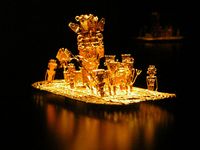 The zipa used to cover his body in gold and, from his Muisca raft, he offered treasures to the Guatavita goddess in the middle of the sacred lake. This old Muisca tradition became the origin of the El Dorado legend.
 -

-
 Tairona figure pendants in gold.
 -

-
![San Agustín Archaeological Park (UNESCO World Heritage Site), contains the largest collection of religious monuments and megalithic sculptures in Latin America[23] and is considered the world's largest necropolis.](/w/images/thumb/4/4c/Parque_Arqueol%C3%B3gico_de_San_Agust%C3%ADn_-_tomb_of_a_deity_with_supporting_warriors.jpg/226px-Parque_Arqueol%C3%B3gico_de_San_Agust%C3%ADn_-_tomb_of_a_deity_with_supporting_warriors.jpg) San Agustín Archaeological Park (UNESCO World Heritage Site), contains the largest collection of religious monuments and megalithic sculptures in Latin America[23] and is considered the world's largest necropolis.
San Agustín Archaeological Park (UNESCO World Heritage Site), contains the largest collection of religious monuments and megalithic sculptures in Latin America[23] and is considered the world's largest necropolis. -
![Ciudad Perdida is a major settlement believed to have been founded around 800 CE. It consists of a series of 169 terraces carved into the mountainside, a net of tiled roads and several small circular plazas. The entrance can only be accessed by a climb up some 1,200 stone steps through dense jungle.[24]](/w/images/thumb/0/0e/Lost_City_Ruins.jpg/268px-Lost_City_Ruins.jpg) Ciudad Perdida is a major settlement believed to have been founded around 800 CE. It consists of a series of 169 terraces carved into the mountainside, a net of tiled roads and several small circular plazas. The entrance can only be accessed by a climb up some 1,200 stone steps through dense jungle.[24]
Ciudad Perdida is a major settlement believed to have been founded around 800 CE. It consists of a series of 169 terraces carved into the mountainside, a net of tiled roads and several small circular plazas. The entrance can only be accessed by a climb up some 1,200 stone steps through dense jungle.[24]


_01.jpg&filetimestamp=20240513163711&)
![San Agustín Archaeological Park (UNESCO World Heritage Site), contains the largest collection of religious monuments and megalithic sculptures in Latin America[23] and is considered the world's largest necropolis.](/w/index.php?title=%D9%85%D9%84%D9%81:Parque_Arqueol%C3%B3gico_de_San_Agust%C3%ADn_-_tomb_of_a_deity_with_supporting_warriors.jpg&filetimestamp=20240513163706&)
![Ciudad Perdida is a major settlement believed to have been founded around 800 CE. It consists of a series of 169 terraces carved into the mountainside, a net of tiled roads and several small circular plazas. The entrance can only be accessed by a climb up some 1,200 stone steps through dense jungle.[24]](/w/index.php?title=%D9%85%D9%84%D9%81:Lost_City_Ruins.jpg&filetimestamp=20240513163700&)
تاريخ ما قبل كلومبس

The complexity of the Indigenous peoples' social organization and technology varied tremendously, from stratified agricultural chiefdoms to tropical farm villages and nomadic hunting and food-gathering groups.[21] At the end of the colonial period, the native population still constituted about half of the total population.[21] In the agricultural chiefdoms of the highlands, the Spaniards successfully imposed institutions designed to ensure their control of the Amerindians and thereby the use of their labor.[21] The colonists had organized political and religious administration by the end of the sixteenth century, and they had begun attempts to religiously convert the Amerindians to Christianity, specifically Roman Catholicism.[21]
The most important institution that regulated the lives and welfare of the highland Amerindians was the resguardo, a reservation system of communal landholdings.[21] Under this system, Amerindians were allowed to use the land but could not sell it.[21] Similar in some respects to the Native American reservation system of the United States, the resguardo has lasted with some changes even to the present and has been an enduring link between the government and the remaining highland tribes.[21] As land pressures increased, however, encroachment of white or mestizo settlers onto resguardo lands accelerated, often without opposition from the government.[21]
The government generally had not attempted to legislate in the past in matters affecting the forest Amerindians.[21] During the colonial period, Roman Catholic missions were granted jurisdiction over the lowland tribes.[21] With the financial support of the government, a series of agreements with the Holy See from 1887 to 1953 entrusted the evangelization and education of these Amerindians to the missions, which worked together with government agencies.[21] Division of the resguardos stopped in 1958, and a new program of community development began to try to bring the Amerindians more fully into the national society.[21]
The struggle of the Indigenous people on these lands to protect their holdings from neighboring landlords and to preserve their traditions continued into the late 20th century, when the 1991 constitution incorporated many of the Amerindian demands.[21] New resguardos have been created, and others have been reconstituted, among forest tribes as well as highland communities.[21] The 1991 constitution opened special political and social arenas for Indigenous and other minority groups.[21] For example, it allowed for creation of a special commission to design a law recognizing the black communities occupying unsettled lands in the riverine areas of the Pacific Coast.[21] Article 171 provides special Senate representation for Amerindians and other ethnic groups, while Article 176 provides special representation in the Chamber of Representatives: two seats "for the black communities, one for Indian communities, one for political minorities, and one for Colombians residing abroad".[21] Article 356 guarantees Amerindian territorial and cultural rights, and several laws and decrees have been enacted protecting them.[21] Article 356 refers somewhat vaguely to both "Indigenous territorial entities" and Indigenous resguardos.[21]
By 1991 the country's 587 resguardos contained 800,271 people, including 60,503 families.[21] The general regional distribution of these resguardos was as follows: Amazonia, 88; llanos, 106; Caribbean lowlands, 31; Andean highlands, 104; and Pacific lowlands, 258.[21] They totaled 27،900،000 هكتار (108،000 sq mi), or about 24 percent of the national territory.[21] Colombia today may have as many as 710 resguardos in 27 of the 32 departments.[21]
النظام السياسي الأصلي
Individual Indigenous groups have a variety of governance structures. A number of Indigenous groups are represented through the National Indigenous Organization of Colombia (ONIC - Organización Nacional Indígena de Colombia). Increasing organization and agitation have sharply broadened the Indigenous land base over the past forty years. The government titled more than 200 new reserves from 1960 to 1990, with 334 total operating as autonomous municipalities by 1997.[25]
الإقليم


Indigenous peoples hold title to substantial portions of Colombia, primarily in the form of Indigenous Reserves (إسپانية: resguardos), which encompass one-third of the country's land.[1] The Indigenous Affairs division of the Ministry of Interior has 567 reserves on record, covering approximately 365,004 km2 which are home to 800,272 persons in 67,503 families.[26]
The 1991 National Constitution of Colombia defined Territorial Entities (Entidades Territoriales) as departments, districts, municipalities and Indigenous territories. Within an Indigenous Territory Entity (ETI) the people have autonomy in managing their interests, and within the limits of the constitution have the right to manage resources and define taxes required to perform their duties. ETIs are to be defined by the government in conformance with the Organic Law on Land Management. However, this law has yet to be sanctioned so in practice the territories are unregulated.[27]
الأقاليم ذات الأغلبية من الشعوب الأصلية
المحافظات
| Department | Total population (2018) | Indigenous population[28] | Percentage[28] |
|---|---|---|---|
 Amazonas Amazonas
|
66,056 | 38,130 | 57.7 |
 Guainía Guainía
|
44,431 | 33,280 | 74.9 |
 Vaupés Vaupés
|
37,690 | 30,787 | 81.7 |
 Vichada Vichada
|
76,642 | 44,578 | 58.2 |
Municipalities


الجماعات العرقية الرئيسية

According to the National Indigenous Organization of Colombia (ONIC), there are 102 Indigenous groups in Colombia.[30] The ethnic groups with the greatest number of members are the Wayuu (380,460), Zenú, (307,091), Nasa (243,176) and Pastos (163,873). These peoples account for 58.1% of Colombia's Indigenous population.[31]
Highland peoples refer to the cultures of the Andes and the Sierra Nevada de Santa Marta of Colombia, while lowland peoples refer to the inhabitants of Chocó, Amazonía, Guajira and the Caribbean Coast, the Urabá Region and other non-mountain cultures.
النضال من أجل الحقوق
Indigenous people are 4.4–10% of the population of Colombia, and their level of income and the indicators of human development as education and health conditions are lower than those of the rest of Colombians.[33] During the last 20 years, there has been a remarkable increase of the interest dedicated to the concerns of Indigenous communities all over the world. Therefore, the United Nations proclaimed the disclosure of the International Decade of the World's Indigenous People and in Latin America on 10 December 1994 and in Latin America. More than in any other region, the period was characterized by a wave of Indigenous movements that practised a growing political power from the Chiapas resistance of 1994 until the fall of the governments of Ecuador and Bolivia.
The rise of Indigenous mobilization in Colombia is explained as a reaction of crisis at various levels: a crisis of representation caused by the shortcomings of political parties with sufficient representation to shoulder all collectives' interests. a crisis of participation from the lack of citizens' participation in public affairs and a legitimation crisis from discrimination against some social groups.[34]
During their struggle for rights, Indigenous people abandoned the armed struggle of the 1980s, and their new strategy included forms of legal liberalism, a politics of identity, and the use of transnational networks putting pressure on the state to achieve recognition and respect.[citation needed] That ha no't always led to success and often turned into victims of the cultural project of neoliberalism.[citation needed] Indigenous people's cultural accomplishments were accompanied by an escalation of the acts of persecution and the number of violations committed against them.[citation needed]
According to the Indigenous National Organization of Colombia (ONIC), there are 102 Indigenous peoples in Colombia, and only 82 of them are recognized by the Colombian government. One of the main problems that the Colombian Indigenous communities currently face is the lack of recognition of their right to be consulted. Poverty is another aspect that is central to understand the contemporary situation of the Indigenes of Colombia, which has been measured by using of the Unsatisfied Basic Needs (UBN), whoch conders poverty to be insufficiencies in living, services, and education.
There are differences among zones: those of greater influence of poverty measured with the UBN standard are Chocó, Sucre, Boyacá, Nariño, and Córdoba, which exceed the 50% of the population and those of less influence are found in Bogotá and the departments of El Valle, Atlántico and the coffee core: Caldas, Quindío, and Risaralda.
In 1986, the concept of pobreza absoluta was introduced in the nation during a crisis of governability and an escalation of problems concerning the armed conflict. With the politics of struggle against poverty, the state tried to consolidate its presenece in zones thatwere considered "marginal," especially those areas including Indigenous people.[citation needed]
Policies between 1986 and 1990 tried to rehabilitate the marginal zones and their integration to achieve development. Specific institutions were set up to work with Indigenous communities, which were seen as farmer communities whose habits and forms of production had to be modernized. As a consequence, the Indigenous minorities revolted and argued that it was not up to them to reintegrate but for the state to reform its ideas and recognize the people as the original Colombians.
The goal was to solve the crisis of governability by eliminating poverty without excluding local necessities and to encourage development from the perspective of diversity. The Indigenous communities were considered to be marginal sectors in disadvantage and highly retarded populations, which had to be incorporated and integrated in greater society. The Indigenous people were not seen as a part of the diversity of the nation whose participation was needed for its construction. That conception has survived since the colonization of the continent until now; Indigenous and black people are generally still seen as negative elements, whose diversity needs to be reduced or wiped out to guarantee Latin American societies' development and modernization.[citation needed]
Despite the Constitution of 1991 introducing the multiethnic and multicultural character of the Colombian nation, the contemporary relation between the state and the Indigenous communities seems to be contradictory, particularly since the communities demand autonomy. The Colombian government has always recognized the Indigenous groups only as communities since they are considered to be culturally diverse and to require therefore different political strategies to be integrated in the national society.
Different forms of participation have been assigned to the communities but always in conformity with the state's legal and constitutional regulations, as has defined and established throughout history. The 1990s were a decade of mobilization and, in some way, a victory in terms of neoliberal multiculturalism, but 20 years of the Constitution of 1991 has made people realize the need to turn to other forms of mobilization, more than legal mobilization. They have seen that the recognition of equality is not enough, and Indigenous peoples have also demanded their right to difference: access to particular rights as Indigenous communities.
Many people in Colombia choose not to identify as Indigenous because the history of discrimination against them and the immense wealth gap between those who identify as Indigenous and others. That led to only 1%, or under a million people, of Colombians in the 1993 census identifying as indigenous. During the most recent censuses, however, more people have begun to identify as indigenous, from 3.4% in the 2005 census to 4.31% in the 2018 census. Many scholars estimate the true indigenous population of Colombia to be around 10% of the country's population, or 5 million people.[citation needed]
The same can be said for Afro-Colombians who are estimated to be around 20% of the total population, or 10 million people, despite only 6% of Colombians identifying as Afro-Colombian in the 2018 census.[35][36][37]
Indigenous political participation, both in national and local elections, has remained low for various reasons: the fragmentation of the movement from the several groups within the Colombian Indigenous communities; the loss of the vote from non-Indigenous leaders; and the low number of voters since many who identify as Indigenous comprise a small part of the national population, with most of them living in the countryside without the possibility to vote.
كولومبيون أصليون بارزون

- Hunzahúa (c. 1470), zaque of Hunza within the Muisca Confederation.
- India Catalina (c. 1495–1538), interpreter and translator, of Mokaná descent.
- Aquiminzaque (unknown–1540), last zaque of Hunza within the Muisca Confederation.
- Agustín Agualongo (1780–1824), military commander of the Royalist forces during the Colombian War of Independence, of Pasto descent.
- José María Melo (1800–1860), 7th President of the Republic of New Granada, of Pijao descent.
- Quintín Lame (1880–1967), Indigenous rebel of Nasa origin.
- Feliciano Valencia (1955–), Senator of Colombia for Cauca, of Nasa origin.
- Lorenzo Muelas (1938–), Indigenous activist of Misak origin.
- María Clemencia Herrera Nemerayema (1968–), Indigenous Amazonian activist, of Witoto origin.
- Aida Quilcué (1973–), Senator of Colombia for Cauca, of Nasa origin.
- Lido Pimienta (1986–), Colombian-Canadian songwriter and musician, of Wayuu descent.
- Martha Peralta Epieyú (1988–), Senator of Colombia for La Guajira, of Wayuu descent.
- Luis Díaz (1997–), Colombian footballer, of Wayuu descent.
انظر أيضاً


- Pre-Columbian cultures of Colombia
- Spanish conquest of the Muisca
- Spanish conquest of the Chibchan Nations
- Indigenous peoples of South America
- National Indigenous Organization of Colombia (ONIC)
- Colombian mythology
- Colombian folklore
- Archaeological sites in Colombia
- Race and ethnicity in Colombia
- Mestizo Colombians
- Concordat of 1928 (mostly deals with Missionary activities among Indigenous peoples)
ببليوجرافيا
- Ideologia mesianico del mundo andino, Juan M. Ossio Acuña, Edicion de Ignacio Prado Pastor
ملاحظات
- ^ The reason for the discrepancy has mainly to do with Indigenous Colombians being undercounted in the censuses and/or choosing to identify with a different race.
المراجع
- ^ أ ب ت ث "Indigenous peoples in Colombia". International Work Group for Indigenous Affairs. Retrieved 11 Dec 2013.
- ^ "POBLACIÓN INDÍGENA DE COLOMBIA RESULTADOS DEL CENSO NACIONAL DE POBLACIÓN Y VIVIENDA 2018" (PDF). www.dane.gov.co.
- ^ أ ب "Raza/Etnia a la que pertenece". Latinobarómetro 2023 Colombia. Retrieved 13 February 2024.
- ^ أ ب ت "Informe Latinobarómetro 2018". Latinobarometro. Archived from the original on June 10, 2021. Retrieved October 3, 2022.
{{cite web}}: CS1 maint: unfit URL (link) - ^ أ ب "Informe Latinobarómetro". Latinobarometro. Retrieved January 30, 2024.
- ^ Simon Schwartzman. "Étnia, condiciones de vida y discriminación" (PDF). Retrieved 2 March 2022.
- ^ Ruiz-Linares, Andrés; Adhikari, Kaustubh; Acuña-Alonzo, Victor; Quinto-Sanchez, Mirsha; Jaramillo, Claudia; Arias, William; Fuentes, Macarena; Pizarro, María; Everardo, Paola; Avila, Francisco de; Gómez-Valdés, Jorge (2014-09-25). "Admixture in Latin America: Geographic Structure, Phenotypic Diversity and Self-Perception of Ancestry Based on 7,342 Individuals". PLOS Genetics (in الإنجليزية). 10 (9) e1004572. Bibcode:2014PLOSG..10.4572R. doi:10.1371/journal.pgen.1004572. ISSN 1553-7404. PMC 4177621. PMID 25254375.
- ^ "POBLACIÓN INDÍGENA DE COLOMBIA RESULTADOS DEL CENSO NACIONAL DE POBLACIÓN Y VIVIENDA 2018" (PDF). www.dane.gov.co.
- ^ Rueda, Ricardo (1974). La población de Colombia. Asociación Colombiana para el Estudio de la Población. p. 78.
- ^ Alexander, Inigo. "Colombia's Indigenous population faces scourge of violence". Al Jazeera. Retrieved 12 December 2023.
- ^ Juan Friede (1966). Invasión del país de los chibchas. Santa Fe de Bogotá: Ediciones Tercer Mundo, pp. 19
- ^ "Caída de la población indígena en Colombia, 1500-1630: tres escenarios" [Decline of the indigenous population in Colombia, 1500-1630: three scenarios] (PDF). Banco de la República.
- ^ Rosenblat, 1954: 59
- ^ Rosenblat, 1954: 36-56
- ^ Palacios, Marco (2002). Colombia. País fragmentado, sociedad dividida. Grupo Editorial Norma. p. 373.
- ^ Instituciones indigenistas en el siglo xix
- ^ Estimates from Latinobarómetro in 2018 and 2023
- ^ Rojas, Winston; Parra, María Victoria; Campo, Omer; Caro, María Antonieta; Lopera, Juan Guillermo; Arias, William; Duque, Constanza; Naranjo, Andrés; García, Jharley; Vergara, Candelaria; Lopera, Jaime; Hernandez, Erick; Valencia, Ana; Caicedo, Yuri; Cuartas, Mauricio (September 2010). "Genetic make up and structure of Colombian populations by means of uniparental and biparental DNA markers". American Journal of Physical Anthropology (in الإنجليزية). 143 (1): 13–20. Bibcode:2010AJPA..143...13R. doi:10.1002/ajpa.21270. ISSN 0002-9483. PMID 20734436.
- ^ "Distribución de la población colombiana según pertenencia étnica" (PDF). Documento DANE - Las Estadísticas Vitales en Colombia. Retrieved 27 October 2016.
- ^ "Estadística de los grupos étnicos 2018". Censo General 2018. Departamento Administrativo Nacional de Estadistica (DANE). Retrieved 10 February 2020.
- ^ أ ب ت ث ج ح خ د ذ ر ز س ش ص ض ط ظ ع غ ف ق ك ل م ن هـ و ي أأ أب أت أث أج Bushnell, David and Rex A. Hudson. "Indigenous Peoples". In Colombia: A Country Study (Rex A. Hudson, ed.), pp. 82-86. Library of Congress Federal Research Division (2010).
 هذا المقال يضم نصاً من هذا المصدر، الذي هو مشاع.
- ^ "Gráfico iii.1. Caída de la población indígena en Colombia, 1500-1630: tres escenarios" (PDF). www.banrep.gov.co.
- ^ "San Agustín Archaeological Park". UNESCO World Heritage Center. Retrieved 27 January 2015.
- ^ "Explore the Site". Global Heritage Fund. Archived from the original on 2014-09-08.
- ^ Brysk, Alison. 2000. From tribal village to global village: Indian rights and international relations in Latin America. Stanford, Calif.: Stanford University Press, p. 267.
- ^ "Los resguardos indígenas" (in الإسبانية). Fundación Hemera. Archived from the original on 2008-07-12. Retrieved 2008-08-01.
- ^ (in es)Entidades Territoriales Indigenas, http://www.territorioindigenaygobernanza.com/col_06.html, retrieved on 2016-07-15
- ^ أ ب "Población Indígena de Colombia" (PDF). dane.gov. September 16, 2019.
- ^ "Autorreconocimiento étnico". Colombia en Mapas. 2018. Retrieved May 10, 2024.
- ^ "Organización Nacional Indígena de Colombia | Pueblos indígenas". Archived from the original on 2014-05-20. Retrieved 2012-08-09.
- ^ "Indigenous World 2020: Colombia". IWGIA - International Work Group for Indigenous Affairs. Retrieved 2020-08-28.
- ^ أ ب "Población Indígena de Colombia" (PDF). dane.gov. September 16, 2019.
- ^ "La visibilización estadística de los grupos étnicos colombianos" (PDF). dane.gov.co. Retrieved 16 October 2017.
- ^ Benavides Vanegas, F. S. (2009) Indigenous people's mobilization and their struggle for rights in Colombia". COPAL.
- ^ "Colombia Under Review for Violence Against Indigenous Peoples while Protests Rage at Home" (in الإنجليزية). Cultural Survival. 2019-12-04. Retrieved 2024-03-15.
- ^ "Ford Foundation Homepage" (in الإنجليزية الأمريكية). Ford Foundation. 2024-03-12. Retrieved 2024-03-15.
- ^ "Colombia's government has forgotten its Indigenous Peoples" (in الإنجليزية). Amnesty International. 2020-08-05. Retrieved 2024-03-15.
13. vaupés: 2011
وصلات خارجية
- UNESCO report on education of indigenous peoples in Colombia
- (in إسپانية) Ethnic groups of Colombia
- Documentary about the Wayuu Indigenous people of Colombia
- Wayuu women
| التاريخ | .svg&filetimestamp=20100102003453&) | ||||
|---|---|---|---|---|---|
| الاستعمار الاوروپي | |||||
| حسب البلد |
| ||||
| موضوعات متعلقة | |||||
Indigenous peoples in أمريكا الجنوبية | ||
|---|---|---|
| الدول ذات السيادة |  | |
| التوابع |
أروبا1 / الأنتيل الهولندية1 (هولندا) · | |
- CS1 maint: unfit URL
- CS1 الإسبانية-language sources (es)
- CS1 الإنجليزية الأمريكية-language sources (en-us)
- Short description with empty Wikidata description
- "Related ethnic groups" needing confirmation
- Articles using infobox ethnic group with image parameters
- Pages using infobox ethnic group with deprecated parameters
- Articles containing إسپانية-language text
- Articles with unsourced statements from December 2022
- Articles with unsourced statements from March 2022
- Articles with unsourced statements from January 2023
- Portal templates with default image
- Articles with إسپانية-language sources (es)
- Indigenous peoples in Colombia
- Indigenous peoples of South America
- Ethnic groups in Colombia
- شعوب الأنديز الأصلية
- Indigenous peoples of the Amazon