جيلدر هولندي
| جيلدر هولندي | |
|---|---|
| ISO 4217 | |
| الكود | NLG |
| الفئات | |
| الوحدات الفرعية | |
| 1⁄100 | cent |
| الجمع | guilders |
| cent | cents |
| الرمز | ƒ |
| الأوراق النقدية | |
| شائع الاستخدام | ƒ10, ƒ25, ƒ50, ƒ100, ƒ250 |
| نادر الاستخدام | ƒ5 (withdrawn in 1995), ƒ1000 |
| العملات | |
| شائع الاستخدام | 5c, 10c, 25c, ƒ1, ƒ21⁄2, ƒ5 |
| نادر الاستخدام | 1c (withdrawn 1 March 1983), 1⁄2c, 21⁄2c (withdrawn 1948), 50c (withdrawn 1930) |
| الديمغرافيا | |
| المستخدم(ون) | None, previously:
 هولندا (until 2002) هولندا (until 2002).svg&filetimestamp=20201013190628&) سورينام (until 1962) سورينام (until 1962).svg&filetimestamp=20080704040337&) الأنتيل الهولندية (until 1940) الأنتيل الهولندية (until 1940) لوكسمبورگ (until 1839) لوكسمبورگ (until 1839).svg&filetimestamp=20080222234820&) بلجيكا (until 1832) بلجيكا (until 1832) |
| الإصدار | |
| البنك المركزي | De Nederlandsche Bank |
| الموقع الإلكتروني | www |
| الطباعة | Joh. Enschedé |
| الموقع الإلكتروني | www |
| مصلحة صك العملة | Royal Dutch Mint |
| الموقع الإلكتروني | www |
| القيمة | |
| التضخم | 2.6% (December 2000) |
| المصدر | worldpress.org, 2000 est. |
| ERM | |
| منذ | 13 March 1979 |
| Fixed rate since | 31 December 1998 |
| Replaced by €, non cash | 1 January 1999 |
| Replaced by €, cash | 1 March 2002 |
| € = | ƒ2.20371 |
الگيلدر الهولندي (Dutch guilder ؛ هولندية: gulden, IPA: [ˈɣɵldə(n)]) or fl. was the currency of the Netherlands from the 17th century until 2002, when it was replaced by the euro. Between 1999 and 2002, the guilder was officially a "national subunit" of the euro. However, physical payments could only be made in guilders, as no euro coins or banknotes were available. The Netherlands Antillean guilder is still in use in Curaçao and Sint Maarten (two countries in the Kingdom of the Netherlands), but this currency is distinct from the Dutch guilder. In 2004, the Surinamese guilder was replaced by the Surinamese dollar.
The Dutch name gulden was a Middle Dutch adjective meaning "golden",[1] and the name indicates the coin was originally made of gold. The symbol ƒ or fl. for the Dutch guilder was derived from another old currency, the florin.
The exact exchange rate, still relevant for old contracts and for exchange of the old currency for euros at the central bank, is 2.20371 Dutch guilders for 1 euro.[2] Inverted, this gives 0.453780 euros for 1 guilder.
The Dutch guilder was the de facto reserve currency in Europe in 17th and 18th centuries.[3][4][5]
التاريخ
The gulden emerged as the official currency of the Burgundian Netherlands after the 1434 monetary reform done under Philip the Good.[6][7] This table summarizes the gulden's value in terms of silver until the gold standard was introduced in 1875.
| Year | g silver |
|---|---|
| 1434–1466 | 32.60 |
| 1500–1560 | 19.07 |
| 1618 | 10.16 |
| 1659–1800 | 9.67 |
| (Gulden banco) | 10.15 |
| 1840 | 9.45 |
| 1875 | 0.6048 g gold |
Prior to 1434 the Dutch issued currency conforming to the Carolingian monetary system, with a pound divided into 20 shillings and a shilling divided into 12 pennies. Dutch versions of the penny first came out in the 9th century, followed by local versions of the one-shilling gros tournois in the 13th century. The most notable version of the latter, the Flemish grote, subsequently depreciated faster than its counterparts in France, from its initial fine silver content of 4.044 g, to around 2.5 g by 1350, and to just 0.815 g before the reforms of 1434.[8]
1434–1466: Burgundian Netherlands

Philip the Good devised a monetary system in 1434 relating the new Dutch currency to that of its neighbors: the French livre parisis of 38.25 g silver, and the English pound sterling of 215.8 g.[9][6] The following units were defined:
- The stuiver of 1.63 g fine silver, equal to 2 Flemish grote or 3 Brabant grote, and approximately equal to the French sol (shilling) of 1.9125 g;
- The gulden, equal to 20 stuiver or 32.6 g fine silver, and approximately equal to the French livre parisis. As the French gold livre was about par with the gold florin of 3.5 g, this new denomination was therefore known as the gouden florijn, or gulden, or florin.
- The shilling Flemish (Schelling Vlaams), equal to 12 Flemish grote or 6 stuivers, and approximately equal to the English shilling of 12 pence sterling.
- And finally, the pound Flemish (pond Vlaams), equal to 240 Flemish grote or 6 gulden, and at 195.6 g fine silver was approximately equal to the English pound sterling.
The stuiver weighed 3.4 g of 23⁄48 silver fineness[7] and was divided into 8 duiten or 16 penningen. As each stuiver was worth approximately 2 English pence, Dutch silver denominations of 1 duit and 1⁄4, 1⁄2, 1 and 2 stuivers neatly matched with English denominations of 1⁄4, 1⁄2, 1, 2 and 4 pence sterling (the latter two sterling coins were rarely minted).
French écus, English nobles and Dutch florins comprised the gold currency of the Low Countries and had a variable rate against the stuiver. A denomination worth 1 gulden did not exist until the 1464 issue of the Sint Andries florin containing 2.735 g of fine gold, but this was a mere two years before the resumption of debasements in the stuiver.
1500–1560: Spanish Netherlands
.jpg&filetimestamp=20260814034523&)
The stuiver modestly depreciated between 1466 and 1475 before incurring more significant debasements up to the end of the 15th century. From 1469 to 1475 an agreement with England made the English groat (4-pence; 2.88 g fine silver) mutually exchangeable with the Burgundian double patard (or 2-stuiver) minted under Charles the Bold.[10]
Follow-up attempts to issue 1-gulden coins resulted in the minting of the gold Karolusgulden of 1.77 g fine gold in 1520, and the silver Karolusgulden of 19.07 grams fine silver in 1541. The bullion content of French and English currencies would eventually approach this value, with the French livre parisis becoming 20.4 g fine silver in 1549, and 1⁄6th of a pound sterling (3 shillings and 4 pence) becoming 19.2 g fine silver in 1551.
1618: Dutch Republic

The pace of depreciation of the Gulden quickened in the second half of the 16th century amidst the huge influx of precious metals from Germany and Spanish America arriving through the Habsburg Netherlands.
The loss in silver content of local Dutch coins in the form of stuivers, schellings (6 stuivers) and daalders (11⁄2 gulden or 30 stuivers) was the result of different provinces continually testing the market with coins of slightly reduced silver, aiming for their acceptance at par with full-bodied coins. As the Northern Dutch Republic just declared its independence from the Spanish crown, there was no central authority powerful enough to penalize the provinces responsible for the deterioration of the quality of Dutch currency. The inevitable official acceptance of new, debased rates for the gulden only set the stage for the next round of depreciations.[11]
As a result, the gulden equivalent of different trade coins passing through the Low Countries also rose in value, as follows:[12]
- The German Reichsthaler of 25.98 g fine silver was valued at 32 stuivers (1.6 G) in 1566.
- The Dutch Republic's leeuwendaalder (lion dollar) of 20.57 g fine silver was valued at 32 stuivers (1.6 G) in 1575.
- The Dutch Republic's Rijksdaalder of 25.40 g fine silver, a local version of the German reichsthaler, was valued at 42 stuivers (2.1 G) in 1583, and repeatedly raised in value until it reached 50 stuivers (2.5 G) in 1618 – hence, 10.16 g silver in a gulden.
- The Spanish Netherlands' Patagon or Albertus thaler of 24.56 g fine silver, valued at 8 shillings Flemish (48 stuivers, 2.4 G) in 1618.
- The Spanish Netherlands' ducaton of 30.70 g fine silver, valued at 10 shillings Flemish (60 stuivers, 3 G) in 1618.
The solution which immediately halted the downward spiral of the gulden was the establishment of the Amsterdam Wisselbank (Bank of Amsterdam) in 1609, mandated to accept and assay the bullion content of coins received from its depositors, and then to credit the equivalent of 1 Rijksdaalder (21⁄2 gulden after 1618) for each 25.40 g fine silver actually received. Combined with rules requiring payments above 600 gulden to be cleared through the bank, it halted incentives for provinces to tamper with the silver content of its coins.
In 1626, Pieter Schaghen wrote in Dutch of the purchase of "the Island Manhattes" (Manhattan) "from the Indians for the value of 60 guilders".[13]
1659: Gulden currency and banco


Even with the Bank of Amsterdam's success in halting the depreciation of Dutch currency, attempts to further increase the stuiver equivalent of trade coins continued among the provinces. After the 1630s came moves to raise the Patagon's value from 48 to 50 stuivers (4.17% advance), followed by moves to raise the Ducaton's value from 60 to 63 stuivers (5.0% advance). Fearing damage to its Europe-wide reputation if 50-stuiver deposits in rixdollars were repaid in cheaper 50-stuiver patagons, in the 1640s the bank firmly rejected the advanced values of these coins and upheld its old values of 48 and 60 stuivers.
This was the origin of a permanent Gulden Banco valued at 5% more against provincial Gulden currency valuations. In 1659 the Dutch Republic made this duality permanent by issuing its own trade coins, namely:
- The silver ducat (zilveren dukaat; also called Rijksdaalder) of 24.36 g fine silver, replacing the Patagon and valued at 48 stuivers banco (2.4 GB) or 50 stuivers currency (2.5 G).
- The Silver Rider Ducaton of 30.45 g fine silver, replacing the Ducaton and valued at 60 stuivers banco (3 GB) or 63 stuivers currency (3.15 G).
The result was a gulden banco unit of 10.15 g silver and a gulden currency unit of 9.67 g silver as determined from the ducaton. These reforms helped cement the Dutch Republic's role as Europe's financial center, made the Bank of Amsterdam the world's first modern central bank, and made the bank-stabilized gulden as Europe's de facto reserve currency until the end of the 18th century. In 1694, a new mint ordinance recognized the gulden as a valid coin for the entire Republic.[15]
As the bank was also an active reseller of negotiepenningen, or trade coins that happen to be undervalued in the Netherlands (e.g. older rixdollars still valued at 50 stuivers currency), Dutch trade coins like lion dollars, rixdollars and silver ducats were exported and became staple currency for the rest of Europe until the end of the 18th century. The Royal Dutch Mint still mints the famed silver ducat to this day.[16]
A silver 1-gulden denomination weighing 10.61 g, 0.91 fine, was minted by the States of Holland and West Friesland in 1680.[17] The gulden design featured Pallas Athena standing, holding a spear topped by a hat in her right hand,[18] resting with her left forearm on Gospels set on an ornate basis, with a small shield in the legend.
19th century: United Netherlands
Following the collapse of the Bank of Amsterdam in the aftermath of the Napoleonic Wars, in 1817 the United Kingdom of the Netherlands redefined the Gulden as either 9.613 g silver or 0.60561 g gold. It was decimally divided into 100 cents, and the 1-gulden coin was permanently issued. This standard was doomed to fail due to
- the existence in the former Austrian Netherlands of silver kronenthalers of 25.71 g fine silver valued at 2.7 gulden (hence, only 9.52 g per gulden), and
- the gulden's gold equivalent of 0.60561 g, at a gold–silver ratio of 15.5 in neighboring France, being worth only 9.39 g in silver.
Following Belgium's secession from the Netherlands in 1830, a more permanent solution was implemented in 1840 by reducing the gulden to 9.45 g fine silver and repealing its fixed equivalence in gold.
Gold standard
As a result of the adoption of the gold standard by the newly established German Empire in 1873, the Netherlands in 1875 repealed the free coinage of silver into gulden coins, substituted by the free coinage of gold into 10-gulden coins containing 6.048 g fine gold. This arrangement continued until the worldwide suspension of the gold standard in 1914 due to the First World War. The gold standard was revived in 1925 but was abandoned in 1936.
After 1914
In 1914, the guilder was traded at a rate of 2.46 guilders = 1 U.S. dollar. As of 1938, the rate was 1.82 guilders = 1 U.S. dollar.[19] One Dutch guilder in 1914 could buy roughly the same amount of goods and services as US$10.02 or €8.17 in December 2017.[citation needed] In 1938, the guilder purchasing power would be approximately equal to US$9.54 or €7.78 in December 2017. Overall, the guilder remained a very stable currency and was also the third highest-valued currency unit in Europe in the interwar period (after the British pound sterling and the Irish pound, which, at this time, were pegged to each other at par).
Following the German occupation, on 10 May 1940, the guilder was pegged to the Reichsmark at a rate of 1 guilder = 1.5 Reichsmark. This rate was reduced to 1.327 on 17 July of the same year. The liberating Allied forces set an exchange rate of 2.652 guilders = 1 U.S. dollar, which became the peg for the guilder within the Bretton Woods system. In 1949, the peg was changed to 3.8 guilders = 1 dollar, approximately matching the devaluation of the British pound. In 1961, the guilder was revalued to 3.62 guilders = 1 dollar, a change approximately in line with that of the German mark. After 1967 guilders were made from nickel instead of silver.
Euro changeover
In 2002, the guilder was replaced by the euro at an exchange rate of 2.20371 guilders = €1. Coins remained exchangeable for euros at branches of the Netherlands Central Bank until 1 January 2007. Most guilder banknotes that were valid at the time of conversion can be exchanged until the deadline of 1 January 2032.[20] There are some exceptions to this, and furthermore no banknote received as payment for commercial goods or services after 27 January 2002 is exchangeable.[21] See Banknotes of the Dutch guilder for a full list of guilder banknotes and their last valid exchange date.[22]
العملات المعدنية


الأوراق المالية
_card_money.jpg&filetimestamp=20201012114643&) |
-
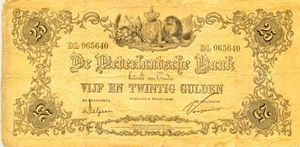 ورقة مالية من فئة 25 خلده من 1861
 -
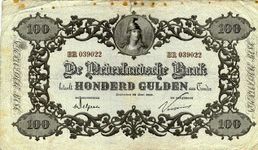 ورقة مالية من فئة 100 خلده من 1921
 -
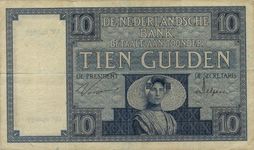 ورقة مالية من فئة 10 خلده، من 1930
 -
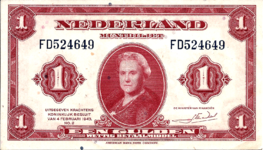 ورقة مالية من فئة 1 خلده، من 1943، أصدرتها الحكومة الهولندية في المنفى في لندن للاستخدام بعد تحرير هولندا.
 -
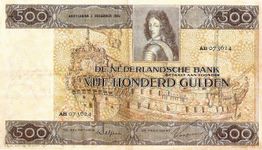 ورقة مالية من فئة 500 خلده من 1930
.jpg&filetimestamp=20201012130820&)


انظر أيضاً
- Aruban florin
- Caribbean guilder
- Dutch euro coins
- Economy of the Netherlands
- Netherlands Antillean guilder
- Netherlands Indian guilder
الهامش
- ^ J. Verdam, Middelnederlandsch Handwoordenboek, The Hague 1932 (reprint of 1994). In modern Dutch, the adjective still exists in certain fossilised forms such as het Gulden Vlies ("the Golden Fleece"). The modern equivalent is gouden.
- ^ "Rules for exchanging guilder notes". De Nederlandsche Bank. Archived from the original on 12 January 2011. Retrieved 31 January 2011.
- ^ Pisani-Ferry, Jean; Posen, Adam S. (2009). The Euro at Ten: The Next Global Currency. United States of America: Peter G. Peterson Institute for International Economies & Brueggel. ISBN 9780881325584.
- ^ The euro as a reserve currency lodz.pl
- ^ The Changing World Order, Ray Dalio
- ^ أ ب p 20: With monetary unification in 1435, the florin or gulden money-of-account thus worth 40d. Flemish gros. Stuiver = 2d. Flemish... The gulden money-of-account is tied to the pond groot, always worth 40 Flemish gros. "MONEY AND COINAGE IN LATE MEDIEVAL AND EARLY MODERN EUROPE" (PDF). p. 20.
- ^ أ ب The stuiver weighs 3.4 g and has a fineness of 479/1000 silver... in 4 silver coins: 1, 1/2, 1/4, 1/8 vierlander. http://www.nbbmuseum.be/en/2008/01/the-vierlander.htm Archived 2021-05-12 at the Wayback Machine
- ^ John H. Munro. "Gold, Guilds and Government: The Impact of Monetary and Labour Policies on the Flemish Cloth Industry, 1390-1435" (PDF).
- ^ nl:Vierlander
- ^ PETER SPUFFORD. "BURGUNDIAN DOUBLE PATARDS IN LATE MEDIEVAL ENGLAND" (PDF). p. 113.
- ^ Quinn, Stephen (2005). "The big problem of large bills: The Bank of Amsterdam and the origins of central banking" (PDF). Working Paper, No. 2005-16, Federal Reserve Bank of Atlanta. hdl:10419/101021.
- ^ Shaw, William Arthur (1896). "The History of Currency, 1252–1894: Being an Account of the Gold and Silver Moneys and Monetary Standards of Europe and America, Together with an Examination of the Effects of Currency and Exchange Phenomena on Commercial and National Progress and Well-being".
- ^ "Pieter Schaghen's 1626 letter". New Netherland Research Center, New York State Library. Archived from the original on 2019-08-02. Retrieved 2019-08-02.
- ^ 3 Gulden Utrecht, Year: 1763–1794; Composition: Silver – 92%; Weight: 31.82 gram; Diameter: 41 mm – https://en.numista.com/catalogue/pieces47591.html
- ^ Polak 1998a, p. 201
- ^ "Silver Ducats".
- ^ Krause, Chester; Mishler, Clifford (2003). [Standard Catalog of World Coins, 1601-1700: Identification and Valuation Guide 17th Century (Standard Catalog of World Coins 17th Century Edition 1601-1700)] (3rd ed.). Krause Publications. p. 932. ISBN 0-87349-666-3.
- ^ Miaschi, John (1 August 2017). "What is the Currency of the Netherlands?". WorldAtlas (in الإنجليزية). Retrieved 2019-08-02.
- ^ Herod, Andrew (2009). [Geographies of Globalization: A Critical Introduction] (1st ed.). John Wiley & Sons. p. 13. ISBN 978-1-40511-091-4.
- ^ "Exchanging national cash". European Central Bank. 2021. Archived from the original on 4 September 2021. Retrieved 5 September 2021.
- ^ "Exchanging guilder banknotes - De Nederlandsche Bank". De Nederlandsche Bank. 5 September 2021. Archived from the original on 5 September 2021. Retrieved 5 September 2021.
- ^ "Exchangeable notes". De Nederlandsche Bank. 5 September 2021. Archived from the original on 5 September 2021. Retrieved 5 September 2021.
- ^ Cuhaj, George S. (2010). Standard Catalog of World Paper Money General Issues (1368-1960) (13 ed.). Krause Publications. p. 1116. ISBN 978-1-4402-1293-2.
وصلات خارجية
- The Marteau Early 18th century Currency Converter with tools to convert early 18th century Dutch Guilders into the major contemporary European currencies.
- Overview of the Dutch guilder and its history from the BBC
- Heiko Otto (ed.). "Historical banknotes of the Netherlands" (in الإنجليزية and الألمانية). Retrieved 2017-05-07.
| سبقه ?, French franc (1794-1815, Southern Netherlands) French franc (1810-1813, Netherlands) |
Dutch currency 15th century–1810, 1813–2002[1] 1815–1832 (Belgium) 1815–1839 (Luxembourg) 1828–1940 (Netherlands Antilles) 1828–1962 (Surinam) |
تبعه Belgian franc (1832, Belgium, 1839, Luxembourg), Netherlands Antillean guilder (1940, Netherlands Antilles), Surinamese guilder (1962, Surinam), Euro |

Euro topics | |||||||||||
|---|---|---|---|---|---|---|---|---|---|---|---|
| General | |||||||||||
| Administration | |||||||||||
| Fiscal provisions | |||||||||||
| Economy | |||||||||||
| International status | |||||||||||
| Denominations |
| ||||||||||
| Coins by country with minting rights |
| ||||||||||
| Adoption by country/territory |
| ||||||||||
| |||||||||||
| History |
| ||||||||||


- Short description is different from Wikidata
- ISO 4217
- Articles containing هولندية-language text
- Pages using Lang-xx templates
- Articles containing فرنسية-language text
- مقالات ينقصها مصادر موثوقة
- مقالات ينقصها مصادر موثوقة from May 2025
- Articles with hatnote templates targeting a nonexistent page
- Articles containing ألمانية-language text
- Articles containing لاتينية-language text
- Articles with unsourced statements from May 2025
- Pages with empty portal template
- CS1 الألمانية-language sources (de)
- تأسيسات 1832 في هولندا
- انحلالات 2001 في هولندا
- عملات أوروپا
- عملات مملكة هولندا
- Currencies replaced by the euro
- Economic history of the Netherlands
- Modern obsolete currencies
- Economic history of the Dutch Republic