كابري
 منظر كاپري من البحر | |
  Capri | |
| الجغرافيا | |
|---|---|
| الموقع | البحر الترهيني |
| الإحداثيات | 40°33′00″N 14°14′00″E / 40.55000°N 14.23333°E |
| المساحة | 10.4 km2 (4.0 sq mi) |
| أعلى منسوب | 589 m (1٬932 ft) |
| أعلى نقطة | مونتى سولارو |
| الإدارة | |
Italy | |
| الإقليم | كامپانيا |
| Metropolitan City | Naples |
| Largest settlement | كاپري (pop. 7,278) |
| السكان | |
| التعداد | 12,200 (2002) |
| الكثافة السكانية | 1٬170 /km2 (3٬030 /sq mi) |
كاپري بالإنجليزية Caprí ، وبالإيطالية Cápri ، هي جزيرة إيطالية بجوار شبه جزيرة سورينتن ، إلى الجنوب من خليج نابولي. وتعتبر منتج سياحي منذ عهد الجمهورية الرومانية. [1]


التاريخ
- انظر أيضا; تاريخ كابري
القدم


Archaeological evidence indicates human presence on Capri dating back to the Neolithic and Bronze Age. The Roman historian Suetonius recounts that when workers excavated the foundations for Emperor Augustus's villa, they discovered giant bones and stone weapons, which Augustus displayed in his residence, the Palazzo a Mare.[2] (Modern analysis suggests these may have been fossils of large extinct mammals.)[3]قالب:Publisher needed
The Roman poet Virgil, in the Aeneid, referred to the island being inhabited by Greek settlers from the Ionian Islands (the Teleboi). The geographer Strabo noted that Capri anciently had two towns, later reduced to one.[4]
Emperor Augustus developed Capri as a private resort, building villas, temples, and aqueducts, and planting gardens.[5][استشهاد ناقص] His successor, Tiberius, constructed twelve villas on the island according to Tacitus. The most famous, Villa Jovis, is one of the best-preserved Roman villas in Italy. In AD 27, Tiberius moved permanently to Capri, governing the Roman Empire from the island until his death in AD 37.[citation needed] Later, in AD 182, Emperor Commodus exiled his sister Lucilla to Capri, where she was subsequently executed.[citation needed]
العصور الوسطى والحديثة

After the fall of the Western Roman Empire, Capri came under the control of the Duchy of Naples. The island suffered raids by pirates and Saracens. In 866, Emperor Louis II granted the island to the Duchy of Amalfi. In 987, Pope John XV established the Diocese of Capri, initially as a suffragan to the Archdiocese of Amalfi.[6] Capri remained a diocese until 1818, when it was absorbed into the Archdiocese of Sorrento with the Papal bull De utiliori.[7] It is now listed as a titular see.[8]
By the end of the conflict for the kingdom of Naples between Louis II of Anjou and Ladislaus, the fort of Capri, controlled by Louis' garrison, was besieged by Ladislaus' forces and captured in July 1399. The French garrison escaped death by joining French marshal Boucicaut's passing ships on their way to fight the Turks in the Aegean Sea.[9]
In 1496, King Frederick IV of Naples established administrative parity between the settlements of Capri and Anacapri. Pirate raids intensified during the 16th century; admirals Barbarossa Hayreddin Pasha and Turgut Reis captured the island for the Ottoman Empire in 1535 and 1553, respectively.[citation needed]
The French antiquarian Jean-Jacques Bouchard visited in the 17th century and is considered one of the first modern tourists; his diary provides valuable insights.[citation needed]
القرن ١٩ إلى الحاضر
During the Napoleonic Wars, French troops occupied Capri in January 1806 but were ousted by the British in May. Britain established a naval base (a "Second Gibraltar"[حسب من؟]) but caused damage to archaeological sites during construction. The French recaptured the island in 1808 and held it until 1815, when it was returned to the Bourbon Kingdom of Naples.[citation needed]
In the 19th century, naturalist Ignazio Cerio catalogued the island's flora and fauna. His work was continued by his son, Edwin Cerio, an author and engineer known for his writings on Capri life.[citation needed]
From the later 19th century, Capri became an increasingly popular resort for European artists, writers, and expatriates. It gained a reputation as a tolerant haven, attracting wealthy gay men and lesbians seeking a more open life than elsewhere in Europe.[10]قالب:Publisher needed Notable figures who lived or spent significant time on the island include John Ellingham Brooks, Somerset Maugham,[11] Norman Douglas,[12] Jacques d'Adelswärd-Fersen, Christian Wilhelm Allers, Emil von Behring, Axel Munthe, Louis Coatalen, Maxim Gorky, Oscar Wilde (briefly),[13] Compton Mackenzie, Romaine Brooks, Dame Gracie Fields, and Lenin (hosted by Gorky in 1908, establishing a Party School[citation needed]). A monument to Lenin by Giacomo Manzù was erected in 1970. Queen Victoria of Baden was a frequent visitor. German industrialist Friedrich Alfred Krupp funded archaeological work but left after a scandal involving accusations of homosexual orgies.[14]
Today, Capri remains a major tourist destination, particularly popular during the summer months, attracting visitors from Italy and abroad.[15]


أهم المزارات

- Villa San Michele
- Grotta Azzurra, the Blue Grotto
- Villa Lysis
- Villa Jovis
- La Piazzetta
- Via Krupp
- Arco Naturale
- Villa Malaparte
- Torre Materita
- Certosa di San Giacomo
- Faraglioni
- Monte Solaro
- Punta Carena
- Marina Grande
 | Please help improve this section by expanding it. Further information might be found on the talk page or at requests for expansion. (June 2008) |
السياحة

النقل
تعتبر العبارات والزوراق البحرية من أكثر طرق النقل شيوعا في جزيرة كابري ، حيث يمكن الوصول للجزيرة من نابولي أو سورينتو عن طريق القوارب أو العبارات في وقت قصير جدا ، وتعتبر الرحلة في حد ذاتها أحد أنواع السياحة البحرية.
المعالم الرئيسية

|
معرض الصور
-
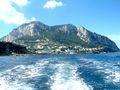 Capri
-
 Faraglione
-
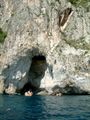 Grotta Meravigliosa
-
 Natural arch
-
 San Giacomo
-
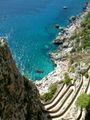 View from August´s Garden
-
 Marina Piccola from August's Garden
-
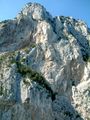 Monte Tiberio
-
 Il Funiculare from Marina Grande to Capri
-
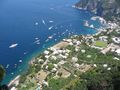 View of Capri
-
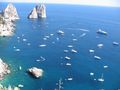 View of Capri


انظر أيضا
المصادر
- ^ الإنجليزية
- ^ Suetonius. The Lives of the Twelve Caesars. Augustus. Chapter 72. Retrieved 19 February 2021.
- ^ See discussion in, e.g., A. Mayor (2000), The First Fossil Hunters.
- ^ Strabo, Geography, 5.4.9
- ^ Fiori, Pamela. "Italy's Pleasure Island Capri". Town & Country.
- ^ Konrad Eubel, Hierarchia Catholica Medii Aevi, vol. 1. Archived 2019-07-09 at the Wayback Machine. p. 164 and subsequent volumes.
- ^ Bolla "De utiliori". Bullarii romani continuatio, Volume XV. 1853. pp. 56–61
- ^ Annuario Pontificio (2013). Vatican Publishing House. ISBN 978-88-209-9070-1. p. 858.
- ^ Lalande, Denis (1988). "Jean II le Meingre, dit Boucicaut (1366–1421)". Étude d'une biographie héroïque. Geneva: Librairie Droz.
- ^ See, e.g., Gregory Woods (2016), Homintern.
- ^ Selina Shirley Hastings (2009). The Secret Lives of Somerset Maugham: A Biography. Random House.
- ^ Douglas, Norman (2025). Capri. Annotazioni antiquarie (in الإيطالية). Milan: La nave di Teseo. p. 10. ISBN 978-8834621240.
- ^ Frankel, Nicholas (2017). Oscar Wilde: the unrepentant years. Cambridge, Massachusetts: Harvard University Press. p. 166. ISBN 978-0674737945.
- ^ Dall'Orto, Giovanni. "Friedrich Alfred Krupp (1854–1902), l'omosessualità e lo scandalo di Capri". Storia gay.
- ^ Swallow, Nicky (2012). Amalfi Coast with Naples, Capri & Pompeii. Hoboken: John Wiley & Sons Inc. p. 265.
وصلات خارجية

- Capri on Wikitravel
- Capri 360 panoramas (بالفرنسية)
- Pages using gadget WikiMiniAtlas
- Articles containing فرنسية-language text
- CS1 الإيطالية-language sources (it)
- Coordinates on Wikidata
- Articles with incomplete citations from August 2026
- All articles with incomplete citations
- Articles with unsourced statements from September 2023
- Articles containing لاتينية-language text
- All articles with specifically marked weasel-worded phrases
- Articles with specifically marked weasel-worded phrases from August 2026
- Articles with unsourced statements from April 2025
- Articles to be expanded since June 2008
- All articles to be expanded
- كاپريK كامپانيا
- جزر كامپانيا
- جزر البحر المتوسط
- البحر الترهيني
- Geography of the Metropolitan City of Naples
- Ionian colonies in Magna Graecia