تلسكوب نانسي جريس رومان الفضائي
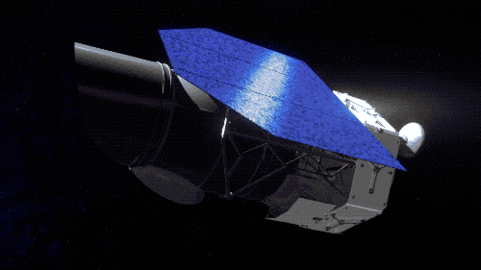
 Rendered model of the Nancy Grace Roman Space Telescope | |||||
| طبيعة المهمة | Infrared space telescope | ||||
|---|---|---|---|---|---|
| المشغل | NASA / GSFC | ||||
| الموقع الإلكتروني | roman | ||||
| مدة المهمة | 5 years (planned)[1] 50 days, 2 hours, 21 minutes (elapsed) | ||||
| خصائص المركبة الفضائية | |||||
| المصنع | NASA Goddard Space Flight Center | ||||
| وزن الإطلاق | 9،174 kg (20،225 lb)[2] | ||||
| الطاقة | 4.5 kW[3] | ||||
| بداية المهمة | |||||
| تاريخ الإطلاق | 30 August 2026, 11:26:04 UTC (7:26:04 AM EDT)[4] | ||||
| الصاروخ | Falcon Heavy Block 5 (B1105 / B1072‑3 / B1104‑1), Flight 13[5] | ||||
| موقع الإطلاق | Kennedy, LC-39A | ||||
| المقاول | SpaceX | ||||
| المتغيرات المدارية | |||||
| النظام المرجعي | Sun–Earth L2 orbit | ||||
| النظام | Halo orbit | ||||
| التلسكوپ الرئيسي | |||||
| Diameter | 2.4 m (7.9 ft) | ||||
| Focal length | 19 m (62 ft) | ||||
| Wavelengths | 0.48–2.30 μm (blue to near-infrared)[6] | ||||
| المرسِلات | |||||
| الحزمة | |||||

| |||||
The Nancy Grace Roman Space Telescope is a NASA infrared space telescope that was launched on a trajectory toward a Sun–Earth L2 orbit on 30 August 2026 by a Falcon Heavy launch vehicle.[7][8][9] It is named after NASA's first chief of astronomy, Nancy Grace Roman.[10]
The telescope is based on an existing 2.4-متر (7.9-قدم) primary mirror with a wide field of view that was donated by the National Reconnaissance Office and will carry two scientific instruments. The Wide-Field Instrument (WFI) is a 300.8-megapixel multi-band visible and near-infrared camera, providing image sharpness comparable to the Hubble Space Telescope over a 0.28-square-degree field of view, 100 times larger than imaging cameras on the Hubble. The Coronagraph Instrument (CGI) is a high-contrast, small-field-of-view camera and spectrometer covering visible and near-infrared wavelengths using novel starlight-suppression technology.
Its objectives include a search for exoplanets using gravitational microlensing,[11] along with probing the chronology of the universe and growth of cosmic structure, with the end goal of measuring the effects of dark energy,[12] the consistency of general relativity, and the curvature of spacetime.[13] Roman was recommended in 2010 by the United States National Research Council Decadal Survey committee as the top priority for the next decade of astronomy. It was approved for development and launch on 17 February 2016.[14] NASA expects to release Roman's first images by early 2027.[15]
Science objectives
The science objectives of Roman aim to address cutting-edge questions in cosmology and exoplanet research, including:[16]
- Answering basic questions about dark energy, complementary to the European Space Agency (ESA) Euclid mission, and including: Is cosmic acceleration caused by a new energy component or by the breakdown of general relativity on cosmological scales? If the cause is a new energy component, is its energy density constant in space and time, or has it evolved over the history of the universe? Roman will use three independent techniques to probe dark energy: baryon acoustic oscillations, observations of distant supernovae, and weak gravitational lensing.
- Completing a census of exoplanets to help answer new questions about the potential for life in the universe: How common are star systems like the Solar System? What kinds of planets exist in the cold, outer regions of planetary systems? What determines the habitability of Earth-like worlds? This census makes use of a technique that can find exoplanets down to a mass only a few times that of the Moon: gravitational microlensing. The census would also include a sample of free-floating planets with masses likely down to the mass of Mars.[17]
- Establishing a guest investigator mode, enabling survey investigations to answer diverse questions about the Milky Way Galaxy and the universe.
- Providing a coronagraph for exoplanet direct imaging that will provide the first direct images and spectra of planets around the Solar System's nearest neighbors, similar to giant planets.
- Detection of primordial black holes.[18]
Instruments
The telescope carries two instruments. Both were installed into the telescope in December 2024.[19]
Wide-Field Instrument
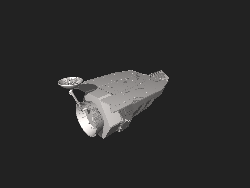
The Wide-Field Instrument (WFI) is the primary science instrument for the mission. It is a 300.8-megapixel camera, providing multiband imaging and spectroscopy from the visible to near-infrared (0.48 to 2.30 μm).[20] Eight science filters, one wide band, and seven more narrow filters, provide high-quality images in subsets of the total spectral bandwidth of the instrument.[21] It carries a high-dispersion grism and lower-dispersion prism assemblies for wide-field slitless spectroscopy. [22]
A "dark element" made out of spectralon can block out the light from space and reflect calibration light onto the detector. The eight filters, two spectroscopy elements, and dark element are all attached to an Element Wheel Assembly (EWA) that rotates one element at a time into the active position.[23]This enables the scientists to choose which colors of light are needed for each mission, or switch between imaging and spectroscopy modes.[24]
A HgCdTe-based focal-plane array (FPA) captures a 0.28 square degree field of view with a resolution of 0.11 arcseconds. The detector array is composed of 18 H4RG-10 detectors provided by Teledyne.[25] The instrument carries on-board calibration capability to help the scientists discern the subtle changes in images from their dark matter mission compared to ordinary distortions of the optics or of the FPA.[26] The FPA is attached to a set of hexapod actuators that can reposition the focal plane into the best focus position based on analysis from the ground to ensure the captured images are always of high quality over the lifetime of the mission. WFI was completed and shipped to NASA in August 2024.[27]
CGI
The Coronagraph Instrument (CGI) is a high-contrast coronagraph covering shorter wavelengths (575 nm to 825 nm) using dual deformable mirror starlight-suppression technology. It is intended to achieve a part-per-billion suppression of starlight to enable the detection and spectroscopy of planets with a visual separation of as little as 0.15 arcseconds from their host stars.[28] CGI is intended as a technology demonstrator for an exoplanet imaging instrument on a future large space-based observatory, such as the Habitable Worlds Observatory (HWO).[29]
-
 Wide Field Instrument
 -
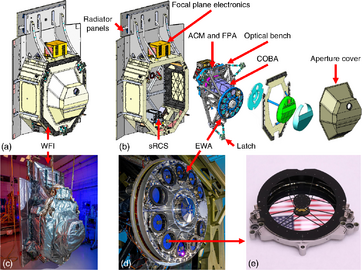 Wide Field Instrument: exploded view
 -
 Roman's Wide Field Instrument focal plane Engineering Test Unit with 18 non-flight H4RG-10 detectors
 -
 Optical Telescope Assembly
 -
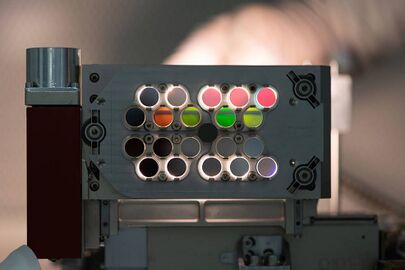 Coronagraph Instrument's color filter assembly
 -
 Coronagraph Instrument focal plane mask


History
Origins
.jpg&filetimestamp=20260907043131&)
The design of the Nancy Grace Roman Space Telescope shares a heritage with various proposed designs for the Joint Dark Energy Mission (JDEM) between NASA and the Department of Energy (DOE). The original design, called WFIRST (Wide-Field Infrared Survey Telescope) Design Reference Mission 1, was studied in 2011–2012, featuring a 1.3-متر (4 ft 3 in) diameter unobstructed three-mirror anastigmat telescope. It contained a single instrument, a visible to near-infrared imager/slitless prism spectrometer.[30]
In 2012, another possibility emerged: NASA could use a second-hand National Reconnaissance Office (NRO) telescope made by Harris Corporation to accomplish a mission like the one planned for WFIRST. NRO offered to donate two telescopes, the same size as the Hubble Space Telescope but with a shorter focal length and hence a wider field of view.[31] This provided important political momentum to the project, even though the telescope represents only a modest fraction of the cost of the mission and the boundary conditions from the NRO design had the potential to push the total cost over that of a fresh design. This mission concept, called WFIRST-AFTA (Astrophysics Focused Telescope Assets), was matured by a scientific and technical team;[32] this mission is now the only present NASA plan for the use of the NRO telescopes.[33] The Roman baseline design includes a coronagraph to enable the direct imaging of exoplanets.[34]
Several implementations of WFIRST/Roman were studied. These included the Joint Dark Energy Mission-Omega configuration, an Interim Design Reference Mission and Design Reference Mission 1, both featuring a 1.3-متر (4 ft 3 in) telescope,[35][36] Design Reference Mission 2 with a 1.1-متر (3 ft 7 in) telescope, and several iterations of the AFTA 2.4-متر (7 ft 10 in) configuration.[37]
Formulation
In the fiscal year 2014, Congress provided US$56 million for Roman, followed by US$50 million in 2015.[38] The fiscal year 2016 spending bill provided US$90 million for Roman, substantially more than NASA's request of US$14 million, allowing the mission to enter the "formulation phase" in February 2016.[38] On 18 February 2016, NASA announced that Roman had formally transitioned from a study to a project, indicating its intent to proceed with the mission as baselined.[14]
At that time, the "AFTA" portion of the mission concept name WFIRST-AFTA was dropped, as only that approach was being pursued with a plan for a mid-2020s launch. The total cost of Roman at that point was expected at more than US$2 billion.[39] NASA's 2015 budget estimate was around US$2.0 billion in 2010 dollars, which corresponds to around US$2.7 billion in real year (inflation-adjusted) dollars.[40]
In the 2015 final report,[13] Roman was considered for both geosynchronous orbit and for an orbit around the Sun-Earth Lagrange point L2. L2 has disadvantages versus geosynchronous orbit in available data rate and propellant required, but advantages for improved observing constraints, better thermal stability, and more benign radiation environment. Some science cases (such as exoplanet microlensing parallax) are improved at L2, but the possibility of robotic servicing at either of the locations is currently unknown. By February 2016, it had been decided to use a halo orbit around L2.[14]
Development


The mission began Phase A development in 2016 with Neil Gehrels, as project scientist, chairing the Formulation Science Working Group with co-chairs Jeremy Kasdin and David Spergel. In April 2017, NASA commissioned an independent review of the project to ensure that the mission scope and cost were understood and aligned.[41] The review acknowledged that Roman offers "groundbreaking and unprecedented survey capabilities for dark energy, exoplanet, and general astrophysics", but directed the mission to "reduce cost and complexity sufficient to have a cost estimate consistent with the US$3.2 billion cost target set at the beginning of Phase B".[42]
In January 2018, NASA announced the reductions[مطلوب توضيح] taken in response to this recommendation, and that Roman would proceed to its mission design review in February 2018 and begin Phase B by April 2018.[43] NASA confirmed (March 2018) that the changes[مطلوب توضيح] made to the project had reduced its estimated life cycle cost to US$3.2 billion and that the Phase B decision[مطلوب توضيح] was on track to begin on 11 April 2018.[44]
In February 2018, the Trump administration proposed an FY2019 budget that would have delayed the funding of the Roman (then called WFIRST), citing higher priorities[مطلوب توضيح] within NASA and the increasing cost of the telescope.[45] The proposed defunding of the project was met with criticism by professional astronomers, who noted that the American astronomical community had rated Roman the highest-priority space mission for the 2020s in the 2010 Decadal Survey.[46][47] The American Astronomical Society expressed "grave concern" about the proposed defunding, and noted that the estimated lifecycle cost for Roman had not changed over the previous two years.[48]
In agreement, the United States Congress approved an FY2018 Roman budget on 22 and 23 March 2018 in excess of the administration's budget request for that year, stating that it "rejects the cancellation of scientific priorities recommended by the National Academy of Sciences decadal survey process", and directed NASA to develop new estimates of Roman's total and annual development costs.[49][44] The President of the United States announced he had signed the bill on 23 March 2018.[50]
In May 2018, NASA awarded a multi-year contract to Ball Aerospace (now called BAE Systems Space & Mission Systems) to provide key components (the Opto-Mechanical Assembly) for the Wide-Field Instrument on Roman.[51] In June 2018, NASA awarded a contract to Teledyne Scientific and Imaging to provide the infrared detectors for the Wide-Field Instrument.[52] On 30 November 2018, NASA announced it had awarded a contract for the telescope.[53] This was for a part called the Optical Telescope Assembly (OTA), and ran to 2025.[53] This was in conjunction with the Goddard Space Flight Center, for which the OTA was planned for delivery as part of the contract.[53]
NASA was funded via a FY2019 appropriations bill on 15 February 2019, with US$312 million for Roman, rejecting the President's reduced Budget Request and reasserting the desire for completion of Roman with a planning budget of US$3.2 billion.[54]
A February 2019 description of the mission's capabilities is available in a white paper issued by members of the Roman team.[55] In March 2019 the Trump administration again proposed to defund the Roman in its FY2020 budget proposal to Congress.[56] In testimony on 27 March 2019, NASA Administrator Jim Bridenstine hinted that NASA would continue Roman after the James Webb Space Telescope, stating "WFIRST will be a critical mission when James Webb is on orbit".[44] In a 26 March 2019 presentation to the National Academies' Committee on Astronomy and Astrophysics, NASA Astrophysics Division Director Paul L. Hertz stated that Roman "is maintaining its US$3.2 billion cost for now ... We need US$542 million in FY2020 to stay on track". At that time, it was stated that Roman would hold its Preliminary Design Review (PDR) for the overall mission in October 2019 followed by a formal mission confirmation in early 2020.[57]
NASA announced the completion of the Preliminary Design Review (PDR) on 1 November 2019, but warned that though the mission remained on track for a 2025 launch date, shortfalls in the Senate's FY2020 budget proposal for Roman threatened to delay it further.[57]
On 2 March 2020, NASA announced that it had approved WFIRST to proceed to implementation, with an expected development cost of US$3.2 billion and a maximum total cost of US$3.934 billion, including the coronagraph and five years of mission science operations.[1] On 20 May 2020, NASA Administrator Jim Bridenstine announced that the mission would be named the Nancy Grace Roman Space Telescope in recognition of the former NASA Chief of Astronomy's role in the field of astronomy.[10]
In March 2021, the NASA Office of Inspector General (OIG) released a report that stated that the development of the telescope had been affected by the COVID-19 pandemic in the United States which had occurred during an acutely important time in its development. NASA was expecting a total impact of US$400 million due to the pandemic and its effect on subcontractors for the project.[58]
On 29 September 2021, NASA announced that Roman had passed its Critical Design Review (CDR), and that with predicted impacts from COVID-19 disruptions, and with flight hardware fabrication completed by 2024 followed by mission integration, the launch date would be no later than May 2027.[59] Via an agreement signed in June 2022,[60] MPIA designed, built, and provided all of CGI's Precision Alignment Mechanisms (PAM) which operate, stabilize, and control optical elements such as optical filters.[61][62] On 19 July 2022, NASA announced that Roman would be launched on a Falcon Heavy launch vehicle, with a contract specifying readiness by October 2026 and a launch cost of approximately $255 million.[63]
Construction

In September 2024, the satellite bus which would carry the telescope, was substantially completed.[64] The following December, the instruments and mirror assembly were successfully integrated onto a section called the "instrument carrier".[65] In October 2024, the telescope passed a major 'spin test'.[66]
In April 2025, the second Trump administration proposed to cut funding for Roman again as part of its FY2026 budget draft. This was part of wider proposed cuts to NASA's science budget, down to US$3.9 billion from its FY2025 budget of US$7.5 billion.[67] On 25 April 2025, the White House Office of Management and Budget announced a plan to cancel dozens of space missions, including the Roman Space Telescope, as part of the cuts.[68] A revised budget released on 31 May 2025 did not include cancellation of the Roman Space Telescope.[69]
During the 2025 federal government shutdown, NASA's Goddard Space Flight Center began closing multiple buildings and consolidating equipment, which the agency describes as a pre-planned "strategic consolidation" not expected to impact missions.[70] A NASA spokesperson told CNN that work on the Nancy Grace Roman Space Telescope and the Dragonfly mission would continue during the shutdown as excepted operations.[70] According to Space.com, some employees at the center expressed concern that the manner and timing of the closures could disrupt work on those projects,[71] and CNN reported that an internal document compiled by Goddard staff cited potential impacts on specialized testing laboratories.[70]
The telescope had finished construction on 25 November 2025.[72] On 21 June 2026, the completed telescope arrived at the Kennedy Space Center, in preparation for launch.[73] During final integration at Kennedy Space Center, in July 2026, technicians installed a commemorative plaque onto the telescope which holds a memory card containing 1,350,144 names submitted by the global public as part of a NASA public outreach campaign.[74][75][76]
Launch
The telescope was launched as planned on 30 August 2026 at 11:26:04 UTC (7:26:04 AM EDT, local time at the launch site).[7][8][9] Soon after separation from the launch vehicle, solar panels deployed and communications were established.[77] On 31 August 2026, the telescope performed a 3-minute mid-course correction burn.[78] On 1 September 2026, the telescope's antenna and sunshade successfully deployed[79] and the Coronagraph Instrument was activated.[80] The telescope will undergo a 90-day commissioning phase.[81] It is expected to reach L2 after approximately 100 days.[82][مطلوب مصدر أفضل]
-
 Roman's encapsulation in August 2026
 -

-
 Falcon Heavy with Roman vertical at LC-39A
 -
 Falcon Heavy launching Roman
 -
 Falcon Heavy launching Roman, transiting the Sun
 -
Visualization following Roman on its trajectory to L2
.jpg&filetimestamp=20260907041241&)
.jpg&filetimestamp=20260907042326&)
.jpg&filetimestamp=20260907042457&)
.jpg&filetimestamp=20260907041106&)
.jpg&filetimestamp=20260907041124&)
Partnerships
The Roman project office is located at NASA's Goddard Space Flight Center (GSFC) in Greenbelt, Maryland, and holds responsibility for overall project management. GSFC also leads the development of the Wide-Field Instrument, the spacecraft, and the telescope.[citation needed]
The Coronagraph Instrument was developed at NASA's Jet Propulsion Laboratory in Pasadena, California. Science support activities for Roman are shared among the Space Telescope Science Institute in Baltimore, Maryland, which is the Science Operations Center; the Infrared Processing and Analysis Center in Pasadena, California; and GSFC.[citation needed]
Four international partners, namely the French space agency CNES, European Space Agency (ESA), Japan Aerospace Exploration Agency (JAXA), and the Max Planck Institute for Astronomy have joined with NASA to provide various components and science support for Roman.[43][83][84] Beginning in 2016 NASA expressed interest in ESA contributions to the spacecraft, coronagraph and ground station support.[85] For the coronagraph instrument, contributions from Europe and Japan have been established.[85] ESA contributed star trackers, batteries, and detectors for the instrument.[86]
In 2018, a contribution from Germany's Max Planck Institute for Astronomy (MPIA) was under consideration, namely the filter wheels for the star-blocking mask inside the coronagraph.[87] In 2016, the Japanese space agency JAXA proposed to add a polarization module for the coronagraph, plus a polarization compensator. An accurate polarimetry capability on Roman may strengthen the science case for exoplanets and planetary disks, which shows polarization.[88][89] Ground support will be provided by a new NASA station in White Sands in New Mexico, the Misasa station in Japan and ESA's New Norcia station in Australia.[90]
Gallery
-
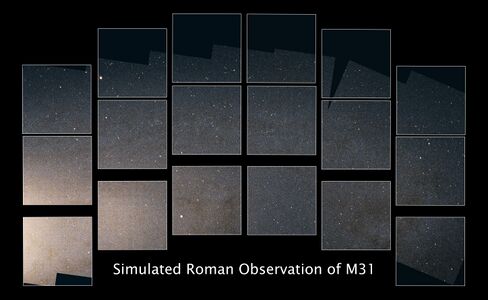 A simulated image of part of the Andromeda Galaxy
 -
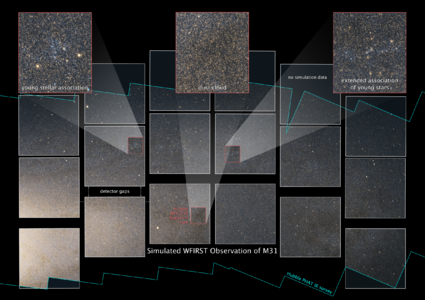 This simulated image showcases the red and infrared light of more than 50 million stars in Andromeda, as they would appear with WFIRST.
 -
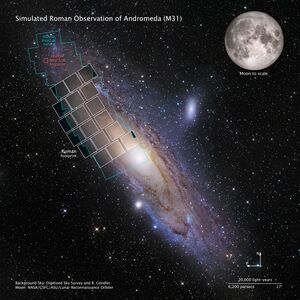 A composite figure shows the region of Andromeda covered by the Roman Space Telescope simulation. Roman would be able to image the main body of Andromeda in just a few pointings, surveying the galaxy nearly 1500 times faster than the Hubble Space Telescope.


See also
- Wide-field Infrared Survey Explorer
- Spitzer Space Telescope
- List of space telescopes
- James Webb Space Telescope
- Xuntian
References
- ^ أ ب "NASA Approves Development of Universe-Studying, Planet-Finding Mission". NASA. 2 مارس 2020. Archived from the original on 3 مارس 2020. Retrieved 14 مارس 2021.
 هذا المقال يضم نصاً من هذا المصدر، الذي هو مشاع.
- ^ McDowell, Jonathan. "I wrote to Lisa Bartusek, Roman team member and the author of the 2022 paper that Wikipedia cites for the 10500 kg design planning value. She tells me the actual launch mass is 9174 kg including 1116 kg of hydrazine. Result!". Bluesky. Retrieved 29 أغسطس 2026.
- ^ (5-12 March 2022) "Nancy Grace Roman Space Telescope Observatory Implementation and Challenges" in 2022 IEEE Aerospace Conference (AERO)., Big Sky, MT, USA: IEEE. doi:10.1109/AERO53065.2022.9843415.
- ^ Brill, Jennifer, ed. (27 يوليو 2026). "Nancy Grace Roman Space Telescope – NASA Science". NASA. Archived from the original on 30 يوليو 2026. Retrieved 31 يوليو 2026.
- ^ "B1104 of Falcon 9 Block 5". Next Spaceflight. 11 مايو 2018. Retrieved 29 أغسطس 2026.
- ^ "Roman Wide-Field Instrument Reference Information" (PDF). 25 يناير 2021. Archived (PDF) from the original on 14 مايو 2021. Retrieved 9 يناير 2022.
- ^ أ ب "The Nancy Grace Roman Space Telescope has launched". The Planetary Society. Archived from the original on 30 أغسطس 2026. Retrieved 30 أغسطس 2026.
- ^ أ ب Cartier, Kimberly M. S. (30 أغسطس 2026). "Roman Telescope Begins Quest to Reveal Evolving Universe". Eos (in الإنجليزية الأمريكية). Archived from the original on 31 أغسطس 2026. Retrieved 30 أغسطس 2026.
- ^ أ ب Warren, Haygen (29 أغسطس 2026). "NASA, SpaceX successfully launch the Nancy Grace Roman Space Telescope from Florida". NASASpaceFlight (in الإنجليزية الأمريكية). Archived from the original on 30 أغسطس 2026. Retrieved 30 أغسطس 2026.
- ^ أ ب "NASA Telescope Named For "Mother of Hubble" Nancy Grace Roman". NASA. 20 مايو 2020. Archived from the original on 20 مايو 2020. Retrieved 14 مارس 2021. هذا المقال يضم نصاً من هذا المصدر، الذي هو مشاع.
- ^ Blandford, Roger D. (2010). New Worlds, New Horizons in Astronomy and Astrophysics (in الإنجليزية الأمريكية). National Research Council staff and the Committee for a Decadal Survey of Astronomy and Astrophysics. Washington, D.C.: National Academies Press. Bibcode:2010nwnh.book....... doi:10.17226/12951. ISBN 978-0-309-15802-2. Retrieved 14 مارس 2021. هذا المقال يضم نصاً من هذا المصدر، الذي هو مشاع.
- ^ "Mission Overview". Nancy Grace Roman Space Telescope. NASA. Archived from the original on 4 سبتمبر 2019. Retrieved 14 مارس 2021. هذا المقال يضم نصاً من هذا المصدر، الذي هو مشاع.
- ^ أ ب "WFIRST-AFTA 2015 Report by the Science Definition Team (SDT) and WFIRST Study Office" (PDF). 10 مارس 2015. Archived (PDF) from the original on 9 أكتوبر 2016. Retrieved 14 مارس 2021. هذا المقال يضم نصاً من هذا المصدر، الذي هو مشاع.
- ^ أ ب ت Northon, Karen (18 فبراير 2016). "NASA Introduces New, Wider Set of Eyes on the Universe". NASA. Archived from the original on 22 فبراير 2016. Retrieved 14 مارس 2021. هذا المقال يضم نصاً من هذا المصدر، الذي هو مشاع.
- ^ Balzer, Ashley (27 أغسطس 2026). "9 Things to Know About NASA's Nancy Grace Roman Space Telescope".
- ^ "Nancy Roman Space Telescope Press Kit" (PDF). nasa.gov. أغسطس 2026. Retrieved 1 سبتمبر 2026.
- ^ "Unveiling Rogue Planets with NASA's Roman Space Telescope". nasa.gov. NASA. 17 أغسطس 2020. Archived from the original on 27 أغسطس 2020. Retrieved 24 أغسطس 2020. هذا المقال يضم نصاً من هذا المصدر، الذي هو مشاع.
- ^ Balzer, Ashley (7 مايو 2024). "How NASA's Roman Mission Will Hunt for Primordial Black Holes". NASA.gov. NASA. Archived from the original on 12 مايو 2024. Retrieved 12 مايو 2024.
- ^ "NASA Successfully Integrates Roman Mission's Telescope, Instruments – NASA". NASA (in الإنجليزية الأمريكية). 12 ديسمبر 2024. Archived from the original on 29 مارس 2026. Retrieved 11 أبريل 2026.
- ^ Kruk, Jeffrey (12 أبريل 2018). "WFIRST Update" (PDF). Archived (PDF) from the original on 10 أكتوبر 2021. Retrieved 10 أكتوبر 2021.
- ^ "WFI Technical – NASA Science". NASA Science (in الإنجليزية الأمريكية). 30 يناير 2026. Archived from the original on 21 أبريل 2026. Retrieved 11 أبريل 2026.
- ^ Eegholm, Bente H.; Marx, Catherine T.; Chambers, Victor J.; Chu, Jenny; Gao, Guangjun; Dominguez, Margaret Z.; Lehan, John P.; Hagopian, John G.; Gong, Qian; Seide, Laurie L.; Bray, Evan; He, Charles; Patel, Jessica B.; Quijada, Manuel A.; Malumuth, Elliot (18 أبريل 2025). "Compact prism assembly for slit-less spectroscopy capability in Roman Space Telescope Wide-Field Instrument". Journal of Astronomical Telescopes, Instruments, and Systems. 11 (2) 025001. Bibcode:2025JATIS..11b5001E. doi:10.1117/1.JATIS.11.2.025001. ISSN 2329-4124.
- ^ Cromey, Benjamin; Sabatke, Derek; Finch, Timothy; Frater, Eric; Marx, Catherine T.; Groff, Tyler; Switzer, Eric; Schlieder, Joshua E.; Leviton, Douglas; Choi, Ami; Valencia, Sebastian; Gao, Guangjun; Rizzo, Maxime; Wake, Shane; Meier, Lane (3 أكتوبر 2025). "Roman Wide Field Instrument Optomechanical Assembly performance summary". Journal of Astronomical Telescopes, Instruments, and Systems. 11 (4) 044001. Bibcode:2025JATIS..11d4001C. doi:10.1117/1.JATIS.11.4.044001. ISSN 2329-4124.
- ^ (2024) "Space Telescopes and Instrumentation 2024: Optical" in SPIE Astronomical Telescopes + Instrumentation (2024). 13092. doi:10.1117/12.3020622.
- ^ Rauscher, Bernard. "Introduction to WFIRST H4RG-10 Detector Arrays" (PDF). NASA. Archived (PDF) from the original on 27 ديسمبر 2016. Retrieved 7 سبتمبر 2018. هذا المقال يضم نصاً من هذا المصدر، الذي هو مشاع.
- ^ "Goddard Team Builds, Tests Calibrator for NASA's Roman in Record Time – NASA". NASA (in الإنجليزية الأمريكية). 18 أبريل 2023. Retrieved 11 أبريل 2026.
- ^ "Primary Instrument for Roman Space Telescope Arrives at NASA Goddard – NASA". NASA (in الإنجليزية الأمريكية). 13 أغسطس 2024. Archived from the original on 29 مارس 2026. Retrieved 11 أبريل 2026.
- ^ "The Nancy Grace Roman Space Telescope". NASA Jet Propulsion Laboratory (JPL). Archived from the original on 20 فبراير 2023. Retrieved 22 فبراير 2023.
- ^ Pueyo, Laurent (2022). "Data driven investigations of CGI as a starlight suppression yardstick. NASA Proposal ID. 22-ROMAN22-0056". NASA NGR Proposal: 56. Bibcode:2022ngr..prop...56P. Retrieved 1 سبتمبر 2026.
- ^ Green, J.; Schechter, P.; Baltay, C.; et al. (2012). "Wide-Field InfraRed Survey Telescope (WFIRST) Final Report". arXiv:1208.4012 [astro-ph.IM].
- ^ "Ex-Spy Telescope May Become a Space Investigator". The New York Times. 4 يونيو 2012. Archived from the original on 4 سبتمبر 2019. Retrieved 17 مارس 2021.
- ^ "WFIRST-AFTA SDT Final Report, revision 1" (PDF). 23 مايو 2013. Archived (PDF) from the original on 4 أبريل 2014. Retrieved 17 مارس 2021. هذا المقال يضم نصاً من هذا المصدر، الذي هو مشاع.
- ^ Leone, Dan (4 يونيو 2013). "Only NASA Astrophysics Remains in Running for Donated NRO Telescope — For Now". SpaceNews. Archived from the original on 2 فبراير 2023. Retrieved 30 أغسطس 2026.
- ^ "WFIRST Science Definition Team Interim Report" (PDF). NASA. 30 أبريل 2014. Archived (PDF) from the original on 5 أبريل 2015. Retrieved 28 أغسطس 2014. هذا المقال يضم نصاً من هذا المصدر، الذي هو مشاع.
- ^ Green, J. & Schechter, P. (11 يوليو 2011). "WFIRST IDRM" (PDF). Archived (PDF) from the original on 9 أكتوبر 2016. Retrieved 23 فبراير 2016. هذا المقال يضم نصاً من هذا المصدر، الذي هو مشاع.
- ^ "WFIRST DRM1" (PDF). 17 مايو 2012. Archived (PDF) from the original on 3 مارس 2016. Retrieved 23 فبراير 2016. هذا المقال يضم نصاً من هذا المصدر، الذي هو مشاع.
- ^ Green, J.; et al. (15 أغسطس 2012). "WFIRST DRM2". arXiv:1208.4012 [astro-ph.IM]. هذا المقال يضم نصاً من هذا المصدر، الذي هو مشاع.
- ^ أ ب Foust, Jeff (7 يناير 2016). "NASA's Next Major Space Telescope Project Officially Starts in February". Space.com. Archived from the original on 20 أكتوبر 2017. Retrieved 9 يناير 2016.
- ^ Clery, Daniel (19 فبراير 2016). "NASA moves ahead with its next space telescope". Science Magazine. Archived from the original on 5 ديسمبر 2022. Retrieved 20 فبراير 2016.
- ^ "NASA Astrophysics: Progress toward New Worlds, New Horizons" (PDF). NRC. 8 أكتوبر 2015. p. 44. Archived (PDF) from the original on 7 مارس 2016. Retrieved 23 فبراير 2016.
- ^ "NASA Taking a Fresh Look at Next Generation Space Telescope Plans". NASA. 17 أبريل 2017. Archived from the original on 21 مايو 2017. Retrieved 19 أكتوبر 2017. هذا المقال يضم نصاً من هذا المصدر، الذي هو مشاع.
- ^ Loff, Sarah (19 أكتوبر 2017). "NASA Receives Findings from WFIRST Independent Review Team". NASA. Archived from the original on 21 أكتوبر 2017. Retrieved 19 أكتوبر 2017. هذا المقال يضم نصاً من هذا المصدر، الذي هو مشاع.
- ^ أ ب Foust, Jeff (9 يناير 2018). "NASA plans to have WFIRST reviews complete by April". SpaceNews. Archived from the original on 2 فبراير 2023. Retrieved 30 أغسطس 2026.
- ^ أ ب ت Foust, Jeff (28 مارس 2018). "WFIRST work continues despite budget and schedule uncertainty". SpaceNews. Archived from the original on 2 فبراير 2023. Retrieved 30 أغسطس 2026.
- ^ "FY 2019 budget estimates" (PDF). 12 فبراير 2018. Archived (PDF) from the original on 24 أغسطس 2019. Retrieved 12 فبراير 2018. هذا المقال يضم نصاً من هذا المصدر، الذي هو مشاع.
- ^ Cofield, Calla (13 فبراير 2018). "What Would it Mean for Astronomers if the WFIRST Space Telescope is Killed?". Space.com. Archived from the original on 31 أغسطس 2019. Retrieved 13 فبراير 2018.
- ^ Overbye, Dennis (19 فبراير 2018). "Astronomers' Dark Energy Hopes Fade to Gray". The New York Times. Archived from the original on 13 سبتمبر 2019. Retrieved 19 فبراير 2018.
- ^ Parriott, Joel (14 فبراير 2018). "American Astronomical Society Leaders Concerned with Proposed Cancellation of WFIRST". American Astronomical Society. Archived from the original on 22 فبراير 2018. Retrieved 21 فبراير 2018.
- ^ Brainard, Jeffrey (23 مارس 2018). "Planetary science wins big in NASA's new spending plan". Science (journal) American Association for the Advancement of Science. Archived from the original on 15 مارس 2022. Retrieved 1 أبريل 2018.
- ^ "President Signs FY 2018 Omnibus with US$3 Billion NIH Increase, Boost for Other Health Programs". Tannaz Rasouli et al. Association of American Medical Colleges. 23 مارس 2018. Archived from the original on 23 مارس 2018. Retrieved 1 أبريل 2018.
- ^ Brown, Katherine (23 مايو 2018). "NASA Awards Contract for Space Telescope Mission". NASA. Archived from the original on 28 مايو 2018. Retrieved 9 أكتوبر 2018. هذا المقال يضم نصاً من هذا المصدر، الذي هو مشاع.
- ^ O'Carroll, Cynthia M. (15 يونيو 2018). "NASA Awards the Short Wave Infra-Red Sensor Chip Assembly for WFIRST". NASA. Archived from the original on 2 فبراير 2023. Retrieved 14 نوفمبر 2018. هذا المقال يضم نصاً من هذا المصدر، الذي هو مشاع.
- ^ أ ب ت "NASA Awards Optical Telescope Assembly for Wide-Field Infrared Survey Telescope Mission". Idaho State Journal. Archived from the original on 3 ديسمبر 2018. Retrieved 2 ديسمبر 2018.
- ^ Wilkins, Ashlee (22 فبراير 2019). "Astronomical Sciences in the Final FY 2019 Spending Agreement". Archived from the original on 1 أبريل 2019. Retrieved 1 أبريل 2019.
- ^ Weinberg, David; et al. (14 فبراير 2019). "The Wide-Field Infrared Survey Telescope: 100 Hubbles for the 2020s". arXiv:1902.05569v1 [astro-ph.IM].
- ^ "NASA FY2020 Budget Request" (PDF). 11 مارس 2019. Archived (PDF) from the original on 15 مارس 2019. Retrieved 1 أبريل 2019. هذا المقال يضم نصاً من هذا المصدر، الذي هو مشاع.
- ^ أ ب Foust, Jeff (11 نوفمبر 2019). "WFIRST passes preliminary design review". SpaceNews. Archived from the original on 2 فبراير 2023. Retrieved 30 أغسطس 2026.
- ^ Foust, Jeff (31 مارس 2021). "Pandemic to cost NASA up to $3 billion". SpaceNews. Archived from the original on 2 فبراير 2023. Retrieved 30 أغسطس 2026.
- ^ "NASA Confirms Roman Mission's Flight Design in Milestone Review". NASA. 29 سبتمبر 2021. Archived from the original on 30 سبتمبر 2021. Retrieved 30 سبتمبر 2021. هذا المقال يضم نصاً من هذا المصدر، الذي هو مشاع.
- ^ "Active International Agreements by Signature Date (as of June 30, 2025)" (PDF). nasa.gov. NASA. 30 يونيو 2025. Archived (PDF) from the original on 10 ديسمبر 2025. Retrieved 13 مارس 2026.
- ^ Krause, Oliver; Müller, Friedrich; Klaas, Ulrich; Ebert, Monica; Rohloff, Ralf-Rainer; Böhm, Armin; Stadler, Tobias; Lee, Roger; Shi, Fang; Zhao, Feng; Colavita, Mark; Moore, Douglas; Krein, Guido; Scott, Tobias; Schäfer, Daniel (24 فبراير 2025). "Precision alignment mechanisms for the Roman Coronagraph Instrument". Journal of Astronomical Telescopes, Instruments, and Systems. 11 (2) 021405. Bibcode:2025JATIS..11b1405K. doi:10.1117/1.JATIS.11.2.021405. ISSN 2329-4124.
- ^ Nielbock, Markus (17 يوليو 2024). "Towards discovering a second Earth". www.mpia.de. Archived from the original on 6 مارس 2026. Retrieved 13 مارس 2026.
- ^ "NASA Awards Launch Services Contract for Roman Space Telescope". NASA (Press release). 19 يوليو 2022. Archived from the original on 7 أغسطس 2022. Retrieved 19 يوليو 2022.
- ^ "NASA Completes Spacecraft to Transport, Support Roman Space Telescope". NASA.gov (in الإنجليزية الأمريكية). 17 سبتمبر 2024. Archived from the original on 17 سبتمبر 2024. Retrieved 17 سبتمبر 2024.
- ^ Jamison, Miles (13 ديسمبر 2024). "NASA Completes Roman Space Telescope Payload Integration". Executive Gov. Archived from the original on 19 ديسمبر 2024. Retrieved 16 ديسمبر 2024.
- ^ Corless, Victoria (19 أكتوبر 2024). "NASA's next-generation Nancy Roman Space Telescope aces crucial 'spin test'". Space.com. Archived from the original on 4 نوفمبر 2024. Retrieved 19 أكتوبر 2024.
- ^ Berger, Eric (11 أبريل 2025). "Trump White House budget proposal eviscerates science funding at NASA". Ars Technica. Archived from the original on 11 أبريل 2025. Retrieved 30 أغسطس 2026.
- ^ Stahl, Asa (8 مايو 2025). "Billions wasted, mysteries unsolved: The missions NASA may be forced to abandon". The Planetary Society. Archived from the original on 6 يونيو 2026. Retrieved 19 مايو 2025.
- ^ Wall, Mike (31 مايو 2025). "Trump's 2026 budget would slash NASA funding by 24% and its workforce by nearly one third". Space.
- ^ أ ب ت Nilsen, Ella; Wattles, Jackie (4 نوفمبر 2025). "NASA may be quietly gutting an iconic campus with what it calls strategic closures, workers fear". CNN. Archived from the original on 5 نوفمبر 2025. Retrieved 7 نوفمبر 2025.
- ^ Dinner, Josh (3 نوفمبر 2025). "NASA is sinking its flagship science center during the government shutdown — critics say it may be breaking the law". Space.com. Archived from the original on 8 نوفمبر 2025. Retrieved 7 نوفمبر 2025.
- ^ Balzer, Ashley (4 ديسمبر 2025). "NASA Completes Nancy Grace Roman Space Telescope Construction". NASA. Archived from the original on 24 أغسطس 2026. Retrieved 30 أغسطس 2026.
- ^ Niles-Carnes, Elyna (21 يونيو 2026). "NASA's Next Generation Telescope Arrives in Florida Ahead of Launch". NASA. Archived from the original on 24 أغسطس 2026. Retrieved 30 أغسطس 2026.
- ^ County, Anthony Leone Brevard. "Send your name to space on the Nancy Grace Roman telescope". mynews13.com. Retrieved 2 سبتمبر 2026.
- ^ "NASA's Roman Telescope to Carry 1.35 Million Names to Deep Space" (in الإنجليزية الأمريكية). Retrieved 2 سبتمبر 2026.
- ^ "Roman Space Telescope Plaque Install - NASA" (in الإنجليزية الأمريكية). Retrieved 2 سبتمبر 2026.
- ^ "Nancy Grace Roman Space Telescope Lifts Off to Open New Insights Into the Universe" (in الإنجليزية الأمريكية). Retrieved 30 أغسطس 2026.
- ^ "NASA's Roman Completes First Mid-Course Correction Burn - NASA Science" (in الإنجليزية الأمريكية). 31 أغسطس 2026. Retrieved 1 سبتمبر 2026.
- ^ "NASA Roman Space Telescope's Antenna, 'Visor' Deployed - NASA Science" (in الإنجليزية الأمريكية). 1 سبتمبر 2026. Retrieved 3 سبتمبر 2026.
- ^ "NASA Roman's Planet Imager Has Powered On - NASA Science" (in الإنجليزية الأمريكية). 1 سبتمبر 2026. Retrieved 2 سبتمبر 2026.
- ^ Ravisetti, Monisha (30 أغسطس 2026). "'What a glorious dawn launch': Why the Roman Space Telescope's picture-perfect liftoff beyond Earth is such a big deal". Space.com. Retrieved 30 أغسطس 2026.
- ^ "Roman Telescope launches from Pad 39A and starts transit to L2 Lagrange Point - AmericaSpace".
- ^ Hertz, Paul (15 يوليو 2019). "NASA Astrophysics" (PDF). Archived (PDF) from the original on 2 سبتمبر 2019. Retrieved 14 سبتمبر 2019.
- ^ Cowing, Keith (25 ديسمبر 2022). "Assembly Begins On Roman Space Telescope Coronagraph Instrument Color Filter Assembly To Study Exoplanets". SpaceRef (in الإنجليزية الأمريكية). Retrieved 12 يونيو 2023.
- ^ أ ب Benford, Dominic (1 مارس 2016). "WFIRST Programmatic Overview" (PDF). NASA. Archived (PDF) from the original on 27 أغسطس 2018. Retrieved 27 أغسطس 2018. هذا المقال يضم نصاً من هذا المصدر، الذي هو مشاع.
- ^ "Roman lifts off on a mission to survey the infrared sky". www.esa.int. Retrieved 31 أغسطس 2026.
- ^ Zhao, Feng; Grady, Trauger (29 يوليو 2018). "WFIRST Coronagraph Instrument (CGI) Status" (PDF). Jet Propulsion Laboratory. Archived (PDF) from the original on 27 أغسطس 2018. Retrieved 28 أغسطس 2018. هذا المقال يضم نصاً من هذا المصدر، الذي هو مشاع.
- ^ Yamada, Toru (10 يناير 2017). "WFIRST" (PDF). Subaru Telescope. Archived (PDF) from the original on 30 أغسطس 2018. Retrieved 30 أغسطس 2018.
- ^ Sumi, Takahiro; Yamada, Toru; Tamura, Motohide; Takada, Masahiro (5 يناير 2017). "WFIRST (Wide-Field Infrared Survey Telescope)". 第17回宇宙科学シンポジウム 講演集 (in اليابانية). JAXA. Archived from the original on 30 أغسطس 2018. Retrieved 30 أغسطس 2018.
- ^ "Ground Antennas". NASA. Archived from the original on 30 مايو 2023. Retrieved 30 مايو 2023. هذا المقال يضم نصاً من هذا المصدر، الذي هو مشاع.
External links
- Roman Science Community page at Goddard Space Flight Center site
- Roman Science Data Center page at the Infrared Processing and Analysis Center (IPAC)
- US$1.6 Billion Telescope Would Search Alien Planets and Probe Dark Energy – Space.com
- The WFIRST/AFTA astrophysics mission: bigger and better for exoplanets Archived 5 أبريل 2016 at the Wayback Machine, Tom Greene
- "Astro2010 Report Release Presentation". Archived from the original on 26 يوليو 2011. Retrieved 15 أغسطس 2010.
- NASA/ Goddard – WFIRST: Uncovering the Mysteries of the Universe at YouTube (min. 1:25) 30 May 2014
- WFIRST-AFTA: Coronograph Technology Development at YouTube (min. 4:20) 16 March 2015
- WFIRST: The Best of Both Worlds at YouTube (min. 3:14) 18 February 2016
- Introducing NASA's Roman Space Telescope at YouTube (min. 1:28) 25 March 2026

| حالية | |
|---|---|
| مستقبلية |
|
| Proposals | |
| اكتملت |
|
| مفقودة |
|
| اكتملت | |
| On hiatus | |
| خطط قديمة | |
| انظر أيضاً | |

مشروعات البحث عن كواكب خارجية | |||||||||||
|---|---|---|---|---|---|---|---|---|---|---|---|
| مقرها الأرض |
|    | |||||||||
| مهمات فضائية |
| ||||||||||
| متعلقة | |||||||||||


- CS1 الإنجليزية الأمريكية-language sources (en-us)
- CS1 uses اليابانية-language script (ja)
- CS1 اليابانية-language sources (ja)
- Short description is different from Wikidata
- Use American English from June 2021
- All Wikipedia articles written in American English
- Use dmy dates from October 2021
- Spaceflight infobox standardisation - phase 2
- جميع الصفحات التي تحتاج تنظيف
- مقالات بالمعرفة تحتاج توضيح from February 2022
- كل المقالات بدون مراجع موثوقة
- كل المقالات بدون مراجع موثوقة from September 2026
- Articles with unsourced statements from August 2026
- Dark energy
- Exoplanet search projects
- Goddard Space Flight Center
- Infrared telescopes
- Jet Propulsion Laboratory satellites
- NASA programs
- NASA space telescopes
- Spacecraft launched in 2026
- Articles containing video clips