زعرور بري
| بشملة Common Medlar | |
|---|---|

| |
| Common Medlar foliage and fruit | |
| التصنيف العلمي | |
| مملكة: | |
| Division: | |
| Class: | |
| Order: | |
| Family: | |
| Subfamily: | |
| Genus: | |
| Species: | M. germanica
|
| Binomial name | |
| Mespilus germanica | |
إكي دنيا [1]أو المُشْمَلة المبذولة[2][3][4][5] أو المُشمُلَة[6] أو الزعرور الجرماني[5][7] أو الزعرور البستاني[7] (ويعرف شعبيا بالزعرور البري) أو ذو ثلاث حبات [8] أو مُثلث العجم[8] أو أرونيا[8] أو ذو الثلاثة النوى[8] أو مَشْمُلا[8] أو بشملة[9] (قالب:اللغة) نوع نباتي يتبع جنس المُشْمَلة من الفصيلة الوردية.
البشملة أو المشملة Mespilus germanica هي شجيرة صغيرة تنمو تلقائيا في الغابات والأحراش ، وثمراتها المعروفة تنضج في الصيف ولكنها تؤكل عندما تجف.

الوصف
Under ideal circumstances, the deciduous plant grows up to 8 متر (26 أقدام) tall. Generally, it is shorter and more shrub-like than tree-like. With a lifespan of 30–60 years, the tree is rather short-lived.[10] Its bark is greyish brown with deep vertical cracks forming rectangular plates that tend to lift off.[11]
The wild form of M. germanica is mostly a thorny, more shrub-like than tree-like plant, which is between 1.5 و 4 m (5 و 13 ft) high. In the cultivated forms, the thorns are usually reduced or even completely absent.[8] In general, the medlar is a small, deciduous tree with an overhanging, almost round crown. The trunk is irregularly shaped.[12] The tree has a height between 1 و 6 m (3+1⁄2 و 19+1⁄2 ft), but can become significantly larger in culture.[13] The diameter at breast height is usually between 20 و 25 cm (8 و 10 in), but in exceptional cases it can be up to 50 cm (20 in). The roots are heavily branched and far-ranging, with a somewhat fibrous root system.[12]
The wood has a fine texture, but is very hard.[8] It has a white, slightly pink-tinted sapwood. The core is brownish. The annual rings are clearly visible.[12]
The winter buds are pointed, ovoid and up to 5 ميليمتر (1⁄4 بوصة) long.[12] The leaves are dark green and elliptic, 8–15 سنتيمتر (3–6 in) long and 3–5 cm (1–2 in) wide. The leaves are densely hairy (pubescent) below, and turn red in autumn before falling.[14]
Medlar flowers are 2–5 cm (3⁄4–2 in) in diameter, have a short stalk and are terminal and single on short side shoots. They have five elongated, narrow sepals and five free, white or pale pink petals.[8] Compared to other fruit trees in the European latitudes, the medlar flowers very late (May or June).[13] The flowers are hermaphrodite and pollinated by bees.[11] Normally, self-pollination occurs in this plant.[12] The flower then develops flattened, reddish-brown, hairy fruits with juicy flesh.[13] The reddish-brown fruit is a pome, 2–3 cm (3⁄4–1+1⁄4 in) diameter, with wide-spreading persistent sepals around a central pit, giving a 'hollow' appearance to the fruit.[14] In cultivated forms the diameter is even between 3 و 8 cm (1+1⁄4 و 3+1⁄4 in).[12]
Sexual reproduction is the norm in wild forms of the medlar. The resulting seeds have a germination capacity lasting from 18 to 20 months. The seeds are distributed by various animals such as birds, squirrels and deer. Some varieties are sterile and can therefore only be propagated vegetatively.[13]
The number of chromosomes is given as 2n = 32 or 2n = 34.[8]
الموئل والانتشار
موطنه بلاد الشام وقبرص وتركيا والقوقاز واليونان وبلغاريا. يزرع أيضًا في المغرب العربي وفي مناطق من أوروبا.[15]
التصنيف العلمي


Until recently, M. germanica was the only known species of medlar. However, in 1990, a new species was discovered in North America, now named M. canescens. The loquat, Eriobotrya japonica, is more distantly related to the medlar than genera such as Crataegus, Amelanchier, Peraphyllum, and Malacomeles,[16] but was once thought to be closely related, and is still sometimes called the 'Chinese medlar' or 'Japanese medlar'.[17]
النظاميات
Within the species M. germanica 23 taxa are distinguished, also comprising wild or semi-wild forms, ornamental and of different origin.[18] Among them there are the following varieties:[19]
- Mespilus germanica var. gigantea Kirchn. with very large fruits
- Mespilus germanica var. abortiva Kirchn. with fruits without seeds
- Mespilus germanica var. argenteo-variegata with white variegated leaves as ornamental plant
- Mespilus germanica var. aureo-variegata with yellow variegated leaves as ornamental plant
Cultivars of M. germanica that are grown for their fruit include 'Hollandia', 'Nottingham', and 'Russian',[19] the large-fruited variety 'Dutch' (also known as 'Giant' or 'Monstrous'), 'Breda giant', 'Large Russian',[20] 'Royal' with very high yield,[21] 'Early medlar' with early ripening and high quality fruits, 'Seedless' with seedless fruits of low quality.
The cultivar 'Nottingham' has gained the Royal Horticultural Society's Award of Garden Merit.[22][23]
For a time it was assumed that it was a species with narrow genetic resources and therefore subject to high risks of genetic erosion, whereby the limited evolution of M. germanica diversity was ascribed to the lack of economic interest for this fruit species in the last centuries.[24] However, current findings show that natural populations of medlar are diverse with a high genetic potential, which could be used to improve production by using specific genotypes.[25]
مرادفات للاسم العلمي
- (قالب:اللغة)
- (قالب:اللغة)
- (قالب:اللغة)
- (قالب:اللغة)
- (قالب:اللغة)
- (قالب:اللغة)
- (قالب:اللغة)
- (قالب:اللغة)
- (قالب:اللغة)[8]
- (قالب:اللغة)
- (قالب:اللغة)

-
 الشجرة
 -
 الزهرة
 -
 رسم
رسم -
 البشملة تنمو على Hawthorn rootstock.


الأصناف
| Image | Scientific name | Common name | Distribution |
|---|---|---|---|
| Eriobotrya bengalensis Hook. f. | India, Thailand, Laos, Kambodscha, Vietnam, Myanmar, Indonesien China (Guizhou and Yunnan) | ||
| Eriobotrya cavaleriei (H. Lév.) Rehder | China and Vietnam | ||
 |
Eriobotrya deflexa (Hemsl.) | Bronze Loquat | Nakai China, Vietnam and Taiwan |
| Eriobotrya dubia Decne. | India, Bhutan and Nepal | ||
| Eriobotrya elliptica Lindl. | Nepal and China (Xizang) | ||
| Eriobotrya fragrans Champ. ex Benth. | China and Vietnam | ||
| Eriobotrya henryi Nakai | Myanmar and China (Guizhou and Yunnan) | ||
| Eriobotrya hookeriana Decne. | Sikkim, Bhutan and Nepal | ||
 |
Eriobotrya japonica (Thunb.) Lindl. | Loquat | Japan and China |
| Eriobotrya malipoensis Kuan | China (Yunnan) | ||
| Eriobotrya obovata W.W. Sm. | China (Yunnan) | ||
| Eriobotrya petiolata Hook. f. | Bhutan and Sikkim | ||
| Eriobotrya prinoides Rehder & E. H. Wilson | China(Sichuan and Yunnan) and Laos | ||
| Eriobotrya salwinensis Hand.-Mazz. | China (Yunnan),India, Myanma | ||
| Eriobotrya seguinii (H. Lév.) Cardot ex Guill. | China (Guizhou and Yunnan) | ||
| Eriobotrya serrata J.E. Vidal | China(Guangxi, Yunnan), Laos | ||
| Eriobotrya tengyuehensi W.W. Sm. | China (Yunnan), Myanmar |
الاستخدامات

The fruits are hard and acidic even when ripe, but become edible after being softened, "bletted", by frost,[26] or naturally in storage if given sufficient time by reducing tannin content and fruit acids, increasing sugar content, and changes in the content of minerals.[27]
Once softening begins, the skin rapidly takes on a wrinkled texture and turns dark brown, and the inside reduces to the consistency and flavour reminiscent of apple sauce. This process can confuse those new to medlars, as its softened fruit looks as if it has spoiled.[27][28]
In Gilan, northern Iran, the leaves, bark, fruits and wood of the medlar tree are traditionally used in herbal medicine.[26]
استخدام المنتجات
Once bletted, the fruit can be eaten raw, sometimes with sugar and cream—it has been described as being an "acquired taste"[29]—or used to make medlar jelly.[30] It is used in "medlar cheese", which is similar to lemon curd, made with the fruit pulp, eggs, and butter.[29]
Unripe fruits have a relatively high tannin content of about 2.6% and are therefore used for tanning. The tannin causes flocculation of proteins, enabling its use to reduce the turbidity of wine. In Saarland, Germany, a schnapps is made from the fruit of the medlar, which is refined with hawthorn.[31] "Medlar tea" usually is not made from M. germanica, but from wolfberry, or goji, which is sometimes inaccurately translated as "red medlar."[32]
Mespilus germanica kernel oil was used for the first time to produce biodiesel, whereby linoleic acid and oleic acid with about 40% are main constituents of the extracted oil. The physical properties of the produced biodiesel allows an alternative for diesel fuels without any modification to the conventional engines.[33] Leaves of medlar fruit were used to produce activated carbon to remove heavy metals like Ni2+ from aqueous solutions.[34]
Silver nanoparticles could be synthesised from M. germanica extract and show antibacterial, antibiofilm activities against multidrug resistance of Klebsiella pneumoniae clinical strains.[35]
المغذيات والكيماويات النباتية
In general, the medlar fruits were found to be rich in potassium, calcium, phosphorus, magnesium and iron.[36]
M. germanica contains various phytochemicals varying between genotypes,[36] fruit ripeness, harvest time and storage conditions. The fruits are particularly rich in monoterpenes and organic acids.[27][37] Amino acids, sugars, and organic acids affect flavour.[27]
Due to their diuretic and astringent effects, the fruits have been used in traditional medicine.[38][39]
In 1984 and 1985, the following values were given for homogenised fruit:[39]
| Time Frame | L-ascorbic acid | Glucose | Fructose | Potassium | Calcium |
|---|---|---|---|---|---|
| Early 1984 | 1.64 mg/l | 53.75 mg/l | 37.31 mg/l | 47.20 ppm | 4.70 ppm |
| End 1984 | 1.54 mg/l | 61.74 mg/l | 70.06 mg/l | 43.00 ppm | 4.50 ppm |
| Early 1985 | 2.64 mg/l | 43.50 mg/l | 35.70 mg/l | 48.90 ppm | 5.20 ppm |
| Late 1985 | 1.41 mg/l | 60.30 mg/l | 60.50 mg/l | 46.1 ppm | 5.00 ppm |
Fructose content increases steadily during fruit development, whereas sucrose content increases for 4 months and decreases afterwards. Tannin content and fruit acid content, especially ascorbid acid, decreases during fruit development. In ripe fruit, glutamate and aspartate were the major amino compounds, but also total amino acid composition changed during fruit development.[27]
في الثقافة
.jpg&filetimestamp=20261013170028&)

شوسر
A fruit which is rotten before it is ripe, the medlar is used figuratively in literature as a symbol of prostitution or premature destitution. For example, in the Prologue to The Reeve's Tale, Geoffrey Chaucer's character laments his old age, comparing himself to the medlar, which he names using the Middle English term for the fruit, "open-arse":
- This white top writeth myne olde yeris;
- Myn herte is mowled also as myne heris —
- But if I fare as dooth an open-ers.
- That ilke fruyt is ever lenger the wers,
- Til it be roten in mullok or in stree.
- We olde men, I drede, so fare we:
- Til we be roten, kan we nat be rype;
شيكسبير
In William Shakespeare's Timon of Athens, Apemantus forces an apple upon Timon: "The middle of humanity thou never knewest, but the extremity of both ends. When thou wast in thy gilt and perfume, they mock'd thee for too much curiosity; in thy rags thou know'st none, but art despised for the contrary. There's a medlar for thee; eat it", perhaps including a pun on "meddler", one who meddles in affairs, as well as on rottenness. (IV.iii.300–305).
In Measure for Measure, Lucio excuses his denial of past fornication because "they would else have married me to the rotten medlar." (IV.iii.171).
In As You Like It, Rosalind makes a complicated pun involving grafting her interlocutor with the trees around her which bear love letters and with a medlar: "I'll graff it with you, and then I shall graff it with a medlar. Then it will be the earliest fruit i' th' country; for you'll be rotten ere you be half ripe, and that's the right virtue of the medlar." (III.ii.116–119).
The most famous reference to medlars, often bowdlerized until modern editions accepted it, appears in Shakespeare's Romeo and Juliet, when Mercutio laughs at Romeo's unrequited love for his mistress Rosaline (II, 1, 34–38):
- Now will he sit under a medlar tree,
- And wish his mistress were that kind of fruit
- As maids call medlars, when they laugh alone.
- O Romeo, that she were, O that she were
- An open-arse and thou a pop'rin pear!
In the 16th and 17th centuries, medlars were bawdily called "open-arses" because of the shape of the fruits — a name that first appears in Old English as openærs[40] — inspiring boisterous or humorously indecent puns in many Elizabethan and Jacobean plays. The name survived in common use well into the 20th century.[5] In the southwest of England it was historically called monkey's bottom, due to the appearance of its large calyx (sepals).
مؤلفون آخرون من القرون 16 و 17
In Miguel de Cervantes' Don Quixote the eponymous hero and Sancho Panza "stretch themselves out in the middle of a field and stuff themselves with acorns or medlars."
In François Rabelais' Gargantua and Pantagruel, medlars play a role in the origin of giants, including the eponymous characters. After Cain killed Abel, the blood of the just saturated the Earth, causing enormous medlars to grow. Humans who ate these medlars grew to great proportions. Those whose bodies grew longer became giants, and were the ancestors of Gargantua and Pantagruel.
Thomas Dekker also draws a comparison in his play The Honest Whore: "I scarce know her, for the beauty of her cheek hath, like the moon, suffered strange eclipses since I beheld it: women are like medlars, no sooner ripe but rotten."
Another reference can be found in Thomas Middleton's A Trick to Catch the Old One in the character of Widow Medler, impersonated by a courtesan, hence the following pun: "Who? Widow Medler? She lies open to much rumour."[41]
In the Memoirs of Glückel of Hameln, Glückel recalls having had a craving for medlars when she was pregnant with her son Joseph, but ignoring the desire. When the baby was born, he was sickly and too weak to be breastfed. Remembering a superstition about the dangers of pregnant women not fulfilling their cravings, Glückel asked for someone to fetch her some medlars for the baby. As soon as the fruit touched the baby's lips, he ate all the pulp given to him, and was then able to be breastfed.[42]
الأدبيات الحديثة
In modern literature, some writers have mentioned this fruit.
Saki uses medlars in his short stories, which often play on the decay of Edwardian society. In "The Peace of Mowsle Barton", the outwardly quiet farmstead features a medlar tree and corrosive hatred. In "The Boar Pig", the titular animal, Tarquin Super US (named after Lucius Tarquinius Superbus, the last king of Rome), is the point of contact between society ladies cheating to get into the garden party of the season and a not entirely honest young schoolgirl who lures him away by strategically throwing well-bletted medlars: "Come, Tarquin, dear old boy; you know you can't resist medlars when they're rotten and squashy."
Italian novelist Giovanni Verga's naturalist narrative I Malavoglia is titled The House by the Medlar Tree in the English translation.[43]
H. C. Bailey's detective Reggie Fortune is very fond of medlars.[citation needed]
Philip Pullman describes Sir Charles Latrom's perfume as "rotted like a medlar" in his book The Subtle Knife.
معرض صور
-
Medlar tree
-
Illustration of medlar
-
Medlar growing on Hawthorn rootstock
-
 Bark of medlar tree
 -
 Flower of medlar
 -
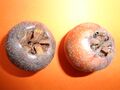 Bletted (left) and unbletted (right) medlar fruit
 -
 Ripe (bletted) and unripe medlar fruit
 -
 Medlar tree in late autumn with ripe fruits (Switzerland, ETH Zurich)


انظر أيضاً
وصلات خارجية

- ^ قالب:استشهاد بويكي بيانات
- ^ قالب:استشهاد بويكي بيانات
- ^ قالب:استشهاد بويكي بيانات
- ^ قالب:استشهاد بويكي بيانات
- ^ أ ب ت قالب:استشهاد بويكي بيانات خطأ استشهاد: وسم
<ref>غير صالح؛ الاسم ":0" معرف أكثر من مرة بمحتويات مختلفة. - ^ قالب:استشهاد بويكي بيانات
- ^ أ ب قالب:استشهاد بويكي بيانات
- ^ أ ب ت ث ج ح خ د ذ ر قالب:استشهاد بويكي بيانات خطأ استشهاد: وسم
<ref>غير صالح؛ الاسم ":2" معرف أكثر من مرة بمحتويات مختلفة. - ^ قالب:استشهاد بويكي بيانات
- ^ "The Essential Guide to probably everything you need to know about Growing Medlar – Mespilus germanica". The Permaculture Research Institute (in الإنجليزية الأمريكية). 2021-05-24. Retrieved 2021-11-14.
- ^ أ ب ""Mespilus germanica Medlar PFAF Plant Database"".
- ^ أ ب ت ث ج ح Minotta, Gianfranco (2014), "Mespilus germanica", in Stimm, Bernd; Roloff, Andreas; Lang, Ulla M et al. (in de), Enzyklopädie der Holzgewächse: Handbuch und Atlas der Dendrologie, American Cancer Society, pp. 1–6, doi:, ISBN 978-3-527-67851-8
- ^ أ ب ت ث "Erhaltungskonzept Mispel" (PDF).
- ^ أ ب Mitchell, Alan (1978). A Field Guide to the Trees of Britain and Northern Europe (2 ed.). Collins. p. 277.
- ^ قاعدة البيانات الأوروبية-المتوسطية للنباتات Archived 2018-01-09 at the Wayback Machine.خريطة انتشار الزعرور الجرماني (بالإنكليزية). تاريخ الولوج 27 نيسان 2012. Archived 2018-01-09 at the Wayback Machine
- ^ Campbell, C.S.; Evans, R.C.; Morgan, D.R.; Dickinson, T.A.; Arsenault, M.P. (2007). "Phylogeny of subtribe Pyrinae (formerly the Maloideae, Rosaceae): Limited resolution of a complex evolutionary history" (PDF). Plant Systematics and Evolution. 266 (1–2): 119–145. Bibcode:2007PSyEv.266..119C. doi:10.1007/s00606-007-0545-y. S2CID 13639534.
- ^ Die Asperl Mespilus germanica L. Georg Schramayr, Verein Regionale Gehölzvermehrung. St. Pölten. 2013. ISBN 978-3-901542-41-1. OCLC 967971863.
{{cite book}}: CS1 maint: location missing publisher (link) CS1 maint: others (link) - ^ Cristofori, V.; Silvestri, C.; Pica, A.L.; Bertazza, G.; Bignami, C. (2019-12-29). "Evaluation of four medlar cultivars: agronomical, pomological and qualitative traits". European Journal of Horticultural Science. 84 (6): 350–358. doi:10.17660/ejhs.2019/84.6.4. hdl:11380/1200235. ISSN 1611-4426. S2CID 214450102.
- ^ أ ب Schmid, Rudolf; Phipps, James B.; O'Kennon, Robert J.; Lance, Ron W. (November 2003). "Hawthorns and Medlars". Taxon. 52 (4): 884. Bibcode:2003Taxon..52S.884S. doi:10.2307/3647377. JSTOR 3647377.
- ^ Lothian, Thomas (1991). The complete book of fruit growing in Australia. Port Melbourne, Victoria.
{{cite book}}: CS1 maint: location missing publisher (link) - ^ Schütt. Enzyklopädie der Laubbäume. p. 336.
- ^ "RHS Plantfinder – Mespilus germanica 'Nottingham'". Retrieved 4 April 2018.
- ^ "AGM Plants – Ornamental" (PDF). Royal Horticultural Society. July 2017. p. 64. Retrieved 4 April 2018.
- ^ Dipartimento di Scienze Agrarie e Forestali, Università degli Studi della Tuscia, Viterbo, Italy; Cristofori, V.; Silvestri, C.; Dipartimento di Scienze Agrarie e Forestali, Università degli Studi della Tuscia, Viterbo, Italy; Pica, A.L.; Dipartimento di Scienze Agrarie e Forestali, Università degli Studi della Tuscia, Viterbo, Italy; Bertazza, G.; Istituto di Biometeorologia, Consiglio Nazionale delle Ricerche, Bologna, Italy; Bignami, C.; Dipartimento di Scienze della Vita, Università degli Studi di Modena e Reggio Emilia, Reggio Emilia, Italy (2019-12-29). "Evaluation of four medlar cultivars: agronomical, pomological and qualitative traits". European Journal of Horticultural Science. 84 (6): 350–358. doi:10.17660/eJHS.2019/84.6.4. hdl:11380/1200235. S2CID 214450102.
{{cite journal}}: CS1 maint: multiple names: authors list (link) - ^ Baird, John R.; Thieret, John W. (July 1989). "The medlar (Mespilus germanica, Rosaceae) from antiquity to obscurity". Economic Botany. 43 (3): 328–372. Bibcode:1989EcBot..43..328B. doi:10.1007/bf02858732. ISSN 0013-0001. S2CID 40866174.
- ^ أ ب Gorvett, Zaria (25 March 2021). "The forgotten medieval fruit with a vulgar name". BBC News Online. Retrieved 10 October 2024.
- ^ أ ب ت ث ج Glew, Robert H.; Ayaz, Faik A.; Sanz, Carlos; VanderJagt, D.J.; Huang, H.-S.; Chuang, L.-T.; Strnad, M. (1 November 2003). "Changes in sugars, organic acids and amino acids in medlar (Mespilus germanica L.) during fruit development and maturation". Food Chemistry (in الإنجليزية). 83 (3): 363–369. Bibcode:2003FoodC..83..363G. doi:10.1016/S0308-8146(03)00097-9.
- ^ Rop, Otakar; Sochor, Jiri; Jurikova, Tunde; Zitka, Ondrej; Skutkova, Helena; Mlcek, Jiri; Salas, Petr; Krska, Boris; Babula, Petr; Adam, Vojtech; Kramarova, Daniela (2010-12-28). "Effect of Five Different Stages of Ripening on Chemical Compounds in Medlar (Mespilus germanica L.)". Molecules (in الإنجليزية). 16 (1): 74–91. doi:10.3390/molecules16010074. ISSN 1420-3049. PMC 6259355. PMID 21189456.
- ^ أ ب Martin, James. "Medlars recipes". British Broadcasting Corporation. Retrieved 8 July 2013.
- ^ "Nigel Slater on... medlars". Royal Horticultural Society. Archived from the original on 13 October 2012. Retrieved 8 July 2013.
- ^ Lehnert, Charly (2014). Das saarländische Geheichnis Bd. 1. Saarbrücken. ISBN 978-3-939286-18-9. OCLC 892065284.
{{cite book}}: CS1 maint: location missing publisher (link) - ^ McAdam, Diana (12 October 2007). "Goji berries: The new superfruit". The (Daily) Telegraph. Retrieved 8 July 2013.
- ^ Qasemi, Zeinab; Jafari, Dariush; Jafari, Kourosh; Esmaeili, Hossein (2021-08-23). "Heterogeneous aluminum oxide/calcium oxide catalyzed transesterification of Mespilus germanica triglyceride for biodiesel production". Environmental Progress & Sustainable Energy. 41 (2) e13738. doi:10.1002/ep.13738. ISSN 1944-7442. S2CID 238740226.
- ^ Khedri, Ali; Jafari, Dariush; Esfandyari, Morteza (2021-07-27). "Adsorption of Nickel(II) Ions from Synthetic Wastewater Using Activated Carbon Prepared from Mespilus germanica Leaf". Arabian Journal for Science and Engineering. 47 (5): 6155–6166. doi:10.1007/s13369-021-06014-7. ISSN 2193-567X. S2CID 237723962.
- ^ Foroohimanjili, Fatemeh; Mirzaie, Amir; Hamdi, Seyed Mohammad Mehdi; Noorbazargan, Hassan; Hedayati Ch, Mojtaba; Dolatabadi, Aghigh; Rezaie, Hossein; Bishak, Faezeh M. (2020-01-29). "Antibacterial, antibiofilm, and antiquorum sensing activities of phytosynthesized silver nanoparticles fabricated from Mespilus germanica extract against multidrug resistance of Klebsiella pneumoniae clinical strains". Journal of Basic Microbiology. 60 (3): 216–230. doi:10.1002/jobm.201900511. ISSN 0233-111X. PMID 31994223. S2CID 210949728.
- ^ أ ب D., Ercisli, S. Sengul, M. Yildiz, H. Sener, D. Duralija, B. Voca, S. Dujmovic Purgar (2012-10-16). Phytochemical and antioxidant characteristics of medlar fruits (Mespilus germanica L.). Journal of Applied Botany and Food Quality. OCLC 825218272.
{{cite book}}: CS1 maint: multiple names: authors list (link) - ^ G. Bounous, E. Zanini: Variabilità di alcune componenti e caratteri biometrici dei frutti di 6 specie arboree ed arbustive. Proc. workshop "Lampone mirtillo ed altri piccoli frutti", Trento, 1987, 189–197 (Zitiert nach Schuck et al.: Enzyklopädie der Laubbäume).
- ^ Peyre (1945). Les Arbres & Leurs Fruits, Usage Medicaux Pharmaceutiques & Dietetiques.
- ^ أ ب Steffen Guido Fleischhauer, Jürgen Guthmann, Roland Spiegelberger (2015) (in German), Essbare Wildpflanzen 200 Arten bestimmen und verwenden (17. Auflage ed.), AT Verlag, p. 69, ISBN 978-3-03800-886 6
- ^ Oxford English Dictionary, “open-arse (n.),” December 2025, https://doi.org/10.1093/OED/6270407864.
- ^ II, 2, 59.
- ^ Book 4, Section 14.
- ^ "The House by the Medlar Tree | novel by Verga". Britannica.