خالكيديكي
Chalkidiki
Περιφερειακή ενότητα Χαλκιδικής | |
|---|---|
 بلديات خالكيذيكي | |
 خالكيذيكي في اليونان | |
| الإحداثيات: 40°20′N 23°30′E / 40.333°N 23.500°E | |
| البلد | اليونان |
| المنطقة | مقدونيا الوسطى |
| التأسيس | 2011 |
| العاصمة | پوليگيروس |
| الحكومة | |
| • نائب الحاكم | Ioannis Giorgos |
| المساحة | |
• الإجمالي | 2٬918 كم² (1٬127 ميل²) |
| التعداد (2011) | |
• الإجمالي | 105٬908 |
| • الكثافة | 36/km2 (94/sq mi) |
| منطقة التوقيت | UTC+2 (EET) |
| • الصيف (التوقيت الصيفي) | UTC+3 (EEST) |
| الرمز البريدي | 63x xx |
| Area codes | 237x0, 239x0 |
| رمز ISO 3166 | GR-64 |
| لوحات السيارات | ΧΚ |
| الموقع الإلكتروني | www |
خالكيذيكي (باليونانية: Χαλκιδική [xalciðiˈci]؛ إنگليزية: Chalcidice أو Chalkidiki) هي شبه جزيرة ووحدة محلية في اليونان، وجزء من مقدونيا الوسطى في شمال اليونان. جبل آثوس الذاتي الحكم يشكل الجزء الشرقي من شبه الجزيرة، ولكنه ليس جزءاً من الوحدة المحلية. عاصمة خالكيذيكي هي پوليگيروس التي تقع في وسط شبه الجزيرة.
الاسم
Chalkidiki also spelled Halkidiki (/kælˈkɪdɪki/) or Chalcidice (/kælˈsɪdɪsi/) is named after the ancient Greek city-state of Chalcis in Euboea, which colonised the area in the 8th century BC.[citation needed]
الجغرافيا

Chalkidiki consists of a large peninsula in the northwestern Aegean Sea, resembling a hand with three 'fingers' (though in Greek these peninsulas are often referred to as 'legs'). From west to east, these are Kassandra (highest peak 350 m), Sithonia (highest peak Mt Itamos 817 m), and Athos, a special polity within Greece known for its monasteries and its highest peak reaching 2,033 metres above sea level. These 'fingers' are separated by two gulfs, the Toronean Gulf and the Singitic Gulf.
Chalkidiki borders on the regional unit of Thessaloniki to the north, and is bounded by the Thermaic Gulf on the west, and the Strymonian Gulf and Ierissos Gulf on the east (which are separated by the Brostomnitsa peninsula).
The Cholomontas mountains lie in the north-central part of Chalkidiki, with the highest peak reaching 1,165 metres above sea level. Chalkidiki has a few rivers running from Mt Cholomontas south to the sea, these include the Havrias, Vatonias (Olynthios) and Psychros rivers. Chalkidiki also has a few islands including the inhabited Ammouliani and Diaporos both in the Singitic Gulf, and the uninhabited Kelyfos island in the Toronean Gulf.
Its largest towns are Nea Moudania (Νέα Μουδανιά), Nea Kallikrateia (Νέα Καλλικράτεια) and the capital town of Polygyros (Πολύγυρος).
There are several summer resorts on the beaches of all three fingers where other minor towns and villages are located, such as at Yerakini (Gerakina Beach) and Psakoudia in central Chalkidiki, Kallithea, Chanioti and Pefkochori in the Kassandra peninsula, Nikiti and Neos Marmaras (Porto Carras) in the Sithonia peninsula, and Ouranoupolis at Mount Athos. A popular village in winter is Arnaia for its architecture and mountain scenery.
المناخ
The climate of Chalkidiki is mainly Mediterranean (Koppen: Csa) with cool, wet winters and hot, relatively dry summers. Snowfalls are possible but not long-lasting during the winter months, while occasional thunderstorms may occur during the summer. Few areas such as Neos Marmaras have a hot semi-arid climate (Köppen climate classification: BSh).[1][2]
| بيانات المناخ لـ Neos Marmaras 6 m a.s.l. | |||||||||||||
|---|---|---|---|---|---|---|---|---|---|---|---|---|---|
| الشهر | ينا | فب | مار | أبر | ماي | يون | يول | أغس | سبت | أكت | نوف | ديس | السنة |
| القصوى القياسية °س (°ف) | 20.7 (69.3) |
22.8 (73.0) |
22.8 (73.0) |
26.5 (79.7) |
32.4 (90.3) |
36.4 (97.5) |
39.9 (103.8) |
41.6 (106.9) |
37.0 (98.6) |
29.3 (84.7) |
26.1 (79.0) |
19.8 (67.6) |
41.6 (106.9) |
| متوسط القصوى اليومية °س (°ف) | 12.2 (54.0) |
14.1 (57.4) |
15.6 (60.1) |
19.5 (67.1) |
24.3 (75.7) |
29.3 (84.7) |
32.1 (89.8) |
32.4 (90.3) |
27.8 (82.0) |
22.2 (72.0) |
18.1 (64.6) |
14.0 (57.2) |
21.8 (71.2) |
| المتوسط اليومي °س (°ف) | 9.4 (48.9) |
11.0 (51.8) |
12.2 (54.0) |
15.4 (59.7) |
20.0 (68.0) |
24.9 (76.8) |
27.7 (81.9) |
28.0 (82.4) |
23.9 (75.0) |
18.9 (66.0) |
15.2 (59.4) |
11.3 (52.3) |
18.2 (64.7) |
| متوسط الدنيا اليومية °س (°ف) | 6.5 (43.7) |
7.9 (46.2) |
8.7 (47.7) |
11.3 (52.3) |
15.6 (60.1) |
20.5 (68.9) |
23.2 (73.8) |
23.6 (74.5) |
20.0 (68.0) |
15.6 (60.1) |
12.2 (54.0) |
8.6 (47.5) |
14.5 (58.1) |
| الصغرى القياسية °س (°ف) | −4.2 (24.4) |
−0.5 (31.1) |
0.6 (33.1) |
4.2 (39.6) |
10.5 (50.9) |
13.1 (55.6) |
16.3 (61.3) |
18.6 (65.5) |
13.2 (55.8) |
9.9 (49.8) |
3.7 (38.7) |
−0.6 (30.9) |
−4.2 (24.4) |
| متوسط تساقط الأمطار mm (inches) | 62.4 (2.46) |
28.9 (1.14) |
50.1 (1.97) |
27.4 (1.08) |
21.7 (0.85) |
33.9 (1.33) |
28.0 (1.10) |
11.6 (0.46) |
29.5 (1.16) |
36.8 (1.45) |
41.8 (1.65) |
60.3 (2.37) |
432.4 (17.02) |
| Source: National Observatory of Athens (Feb 2014 – Jul 2024),[3] Neos Marmaras N.O.A station [2] and World Meteorological Organization[4] | |||||||||||||
التاريخ


Ancient
The first Greek settlers in this area came from Chalcis and Eretria, ancient Ionian cities in Euboea, around the 8th century BC who founded cities such as Mende,[5] Toroni and Scione.[6] A second wave came from Andros in the 6th century BC[7] who founded cities such as Akanthos.[8] Halkidiki became an important theatre of the Peloponnesian War between Athens and Sparta. Stageira was the birthplace of the great philosopher Aristotle.
Later, the whole peninsula was annexed by Philip II and it became part of Macedon, while Aristotle became the tutor of Philip's son, Alexander the Great. After the death of Alexander the Great, the peninsula was part of Macedon ruled by the Antipatrid and then the Antigonid dynasties. After the end of the wars between the Macedonians and the Romans, the Macedonian kingdom became part of the Roman empire, along with the rest of Greece. At the end of the Roman Republic (in 43 BC) a Roman colony was settled in Cassandreia, which was later (in 30 BC) resettled by Augustus.[9]
العصور الوسطى

During the following centuries, Chalkidiki was part of the Byzantine theme of Thessalonica. On a chrysobull of Emperor Basil I, dated 885, the Holy Mountain (Mount Athos) was proclaimed a place of monks, and no laymen or farmers or cattle-breeders were allowed to be settled there. With the support of Nikephoros II Phokas, the Great Lavra monastery was founded soon afterwards. Athos with its monasteries has been self-governing ever since. Today, over 2,000 monks from Greece and many other Orthodox Christian countries, such as Romania, Moldova, Georgia, Bulgaria, Serbia, and Russia, live an ascetic life in Athos, isolated from the rest of the world.
After a short period of domination by the Latin Kingdom of Thessalonica, the area became again Byzantine until its conquest by the Ottomans in 1430. During the Ottoman period, the peninsula was important for its gold mining.
التاريخ الحديث

In 1821, the Greek War of Independence started and the Greeks of Chalkidiki revolted under the command of Emmanouel Pappas, a member of Filiki Eteria, and other local fighters. The revolt was progressing slowly and unsystematically. The insurrection was confined to the peninsulas of Mount Athos and Kassandra. One of the main goals was to restrain and detain the coming of the Ottoman army from Constantinople, until the revolution in the south, mainly in the Peloponnese, became stable. Finally, the revolt resulted in a decisive Ottoman victory at Kassandra. The survivors, among them Pappas, were rescued by the Psarian fleet, which took them mainly to Skiathos, Skopelos and Skyros. The Ottomans proceeded in retaliation and many villages were burnt.
Finally, the peninsula was incorporated into the Greek Kingdom in 1912-1913 after the Macedonian Struggle and the Balkan Wars. Many Greek refugees from East Thrace and Anatolia (modern Turkey) were settled in parts of Chalkidiki after the 1923 population exchange between Greece and Turkey, adding to the indigenous Greek population.
In the 1980s, a tourism boom came to Chalkidiki and took over agriculture as the primary industry.[10] In June 2003, at the holiday resort of Porto Carras located in Neos Marmaras, Sithonia, leaders of the European Union presented the first draft of the European Constitution (see History of the European Constitution for developments after this point).
المواقع القديمة


- Acanthus
- Acrothoi
- Aege
- Alapta
- Aphytis
- Apollonia (Chalcidice)
- Charadrus
- Cleonae (Chalcidice)
- Galepsus
- Mekyberna
- Mende
- Neapolis, Chalcidice
- Olophyxus
- Olynthus
- Palaiochori "Neposi" castle
- Polichne
- Potidaea
- Scione
- Scolus
- Sermylia
- Stageira
- Spartolus
- Thyssus
- Torone
- Xerxes Canal
الآثار
In June 2022, archaeologists announced the discovery of a poorly preserved single-edged sabre among the ruins of a monastery on the coast of Chalcidice. Alongside the curved sword, excavators revealed evidence of a fire, a large cache of 14th-century glazed pottery vessels, as well as other weapons, including axes and arrowheads.[11]
الاقتصاد
الزراعة
The peninsula is notable for its olive oil and olives production. Also various types of wine are produced.
السياحة
Chalkidiki has been a popular summer tourist destination since the late 1950s when people from Thessaloniki started spending their summer holidays in the coastal villages. In the beginning tourists rented rooms in the houses of locals. By the 1960s, tourists from Austria and Germany started to visit Chalkidiki more frequently. Since the start of the big tourist boom in the 1970s, the whole region has been captured by tourism.[12] In the region there is a golf course, with plans for four others in the future.
التعدين
Gold was mined in the region during antiquity by Philip II of Macedon and the next rulers. Since 2013, a revival of mining for gold and other minerals has occurred, and a number of concessions have been granted to Eldorado Gold of Canada. Critics claim that mining adversely affects tourism and the environment.[13] Plus, the movement took panhellenic and international affection in the name of "Chalkidiki SOS" with major strikes and protests at European capitals during the years.[14]
الإدارة
The Chalkidiki regional unit is subdivided into five municipalities (numbered as in the infobox map):[15]
- Aristotelis (2)
- Kassandra (4)
- Nea Propontida (3)
- Polygyros (1)
- Sithonia (5)
المقاطعة
كجزء من إصلاح كاليكراتس الحكومي 2011، الوحدة المحلية خالكيذيكي خُلِقت من المقاطعة السابقة خالكيذيكي (باليونانية: Νομός Χαλκιδικής). The prefecture had the same territory as the present regional unit. At the same time, the municipalities were reorganised, according to the table below.[15] As part of the reforms, Chalkidiki's five municipalities (δήμοι, dhími) were created by combining former municipalities, which were in turn demoted to municipal units (δημοτικές ενότητες, dhimotikés enótites), according to the table below.[15]
| البلدية الجديدة | البلديات القديمة | المقر |
|---|---|---|
| أرسطوطليس | أرنايا | Ierissos |
| Panagia | ||
| Stagira-Akanthos | ||
| Kassandra | Kassandra | كسندريا |
| Pallini | ||
| Nea Propontida | كاليكراتية | نيا مودانيا |
| مودانيا | ||
| تريگليا | ||
| Polygyros | Polygyros | Polygyros |
| أنثيمونتاس | ||
| Zervochoria | ||
| أورميليا | ||
| Sithonia | Sithonia | Nikiti |
| توروني |
النقاط الادارية
- Province of Chalkidiki – Polygyros
- Province of Arnaia
Note: Provinces no longer hold any legal status in Greece.
التلفزيون
- TV Halkidiki – Nea Moudania
- Super TV – Nea Moudania
النقل
- Motorways:
- A25 (Thessaloniki, Airport, Nea Moudania)
أشهر سكانها

- Paeonius of Mende (late 5th-century BC), sculptor
- Philippus of Mende, Plato's student, astronomer
- Nicomachus, Aristotle's father
- Aristobulus of Cassandreia (375–301 BC), historian, architect
- Aristotle (384 BC in Stageira–322 BC), philosopher
- Andronicus the Olynthian (c. 370 BC), Phrourarchus of Tyre, appointed by Antigonus
- Callisthenes (360–328 BC), historian
- Crates of Olynthus, Alexander's hydraulic engineer
- Bubalus of Cassandreia (304 BC), keles (horse) competing in the flat race of the Lykaia[16]
- Poseidippus of Cassandreia (c. 310 – c. 240 BC), comic poet
- Erginus (son of Simylus) from Cassandreia, citharede winner in Soteria c. 260 BC[17]
- Athanasios Stageiritis, professor of Greek language at the Imperial Academy in Vienna. Publisher of the fortnightly literary journal "Kalliope" in Vienna from 1819 to 1821
- Stamatios Kapsas, revolutionary of the Greek War of Independence (1821–1830)
- Kyrkos Papageorgakis, revolutionary of the Greek War of Independence (1821–1830)
- Dimitrios Argyriou, revolutionary of the Greek War of Independence (1821–1830)
- Georgios Philippopoulos, revolutionary of the Greek War of Independence, Greek army officer
- Archbishop Demetrios of America
- Kosmas Doumbiotis (1826-1922), Greek army officer
- Xenophon Paionidis (1863-1933), architect
- Georgios Papanikolaou (1875 in Polygyros–1949), doctor, author, fighter of Greek Struggle for Macedonia and founder of the pan-chalcidikian association of Thessaloniki (1903)
- Manolis Mitsias (1944 in Doumpia), singer
- Sokratis Malamas (1957 in Sykia), singer
- Giorgos Pyrpasopoulos (1974), actor
- Stefanos Athanasiadis, PAOK and Greek footballer.
- Dimitri Vegas & Like Mike, Greek DJs.
- Georgios Samaras, footballer (from his father's, Ioannis Samaras, side)
- Christos Zabounis, a pro-royalist author and editor
معرض صور
-
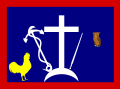 Flag of the revolutionaries during the Greek War of Independence
 -
Bust of Stamatios Kapsas
-
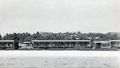 Xenia hotel in Paliouri, Chalkidiki (1962)
 -
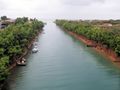 Potidea Kanal
 -
 Hotel Athos
 -
 Karvourotripes beach
 -
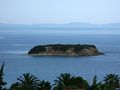 Small island near Nikiti
 -
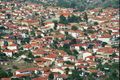 View of Sykia
 -
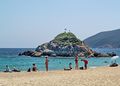 Beach in Sykia
 -
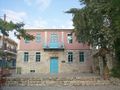 Folklore museum in Afytos
 -
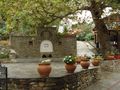 Traditional style square in Nikiti
 -
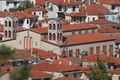 Agios Nikolaos village
 -
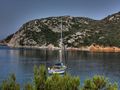 Porto Koufo
 -
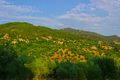 View of Parthenonas village
.svg&filetimestamp=20190219150253&)


انظر أيضاً

| Chalcidice
]].الهامش
- ^ Petrou, Alec Moustris, John. "meteo.gr – Προγνώσεις καιρού για όλη την Ελλάδα". meteo.gr – Προγνώσεις καιρού για όλη την Ελλάδα (in اليونانية). Retrieved 23 January 2025.
{{cite web}}: CS1 maint: multiple names: authors list (link) - ^ أ ب "Latest Conditions in Neos Marmaras". penteli.meteo.gr. Retrieved 16 January 2025.
- ^ "N.O.A Monthly Bulletins".|source 2=
- ^ "World Meteorological Organization". Retrieved 14 July 2023.
- ^ Thucydides, Book 4, 123
- ^ N. G. L. Hammond, A History of Macedonia, Vol. 1: Historical Geography and Prehistory (Clarendon Press, 1972), p. 426.
- ^ The Cyclades: Discovering the Greek Islands of the Aegean By John Freely p. 82
- ^ Thucydides, Book 4, p. 84
- ^ [1] Archived 24 أبريل 2017 at the Wayback Machine D. C. Samsaris,The Roman Colony of Cassandreia in Macedonia (Colonia Iulia Augusta Cassandrensis) (in Greek), Dodona 16(1), 1987, 353–437
- ^ "THE HISTORY OF KASSANDRA, HALKIDIKI!!". Transfer Thessaloniki (in الإنجليزية الأمريكية). 18 March 2018. Archived from the original on 9 July 2021. Retrieved 9 March 2021.
- ^ Tom Metcalfe (7 June 2022). "Rusty saber, possibly wielded by medieval Turkish pirates, unearthed in Greece". livescience.com (in الإنجليزية). Retrieved 16 August 2022.
- ^ Deltsou, Eleftheria (2007). "Second homes and tourism in a Greek village". Ethnologia Europaea: Journal of European Ethnology. 37 (1–2): 124.
- ^ Suzanne Daley (13 January 2013). "Greece Sees Gold Boom, but at a Price". The New York Times. Retrieved 14 January 2013.
- ^ "Σκουριές: Ένταση στην πορεία κατά της εξόρυξης χρυσού".
- ^ أ ب ت "ΦΕΚ A 87/2010, Kallikratis reform law text" (in اليونانية). Government Gazette.
- ^ Arkadia — Lykaion — Epigraphical Database
- ^ Phocis — Delphi — Epigraphical Database
وصلات خارجية
 Media related to Chalcidice at Wikimedia Commons
التقسيمات الادارية في منطقة مقدونيا الوسطى. | ||
|---|---|---|
| ||
| خالكيذيكي |  | |
| إيماثيا | ||
| كيلكيس | ||
| بيلا | ||
| بييريا | ||
| سيرس | ||
| سالونيك | ||
| ||


- Pages using gadget WikiMiniAtlas
- CS1 اليونانية-language sources (el)
- CS1 الإنجليزية الأمريكية-language sources (en-us)
- Short description is different from Wikidata
- Articles with hatnote templates targeting a nonexistent page
- Coordinates on Wikidata
- Pages using infobox settlement with deprecated parameters
- Articles containing Greek-language text
- Articles containing إنگليزية-language text
- Pages using Lang-xx templates
- Articles with unsourced statements from May 2026
- Chalkidiki
- أشباه جزر في اليونان
- Tourism in Greece
- الوحدات المحلية في اليونان
- بذرة اليونان
- مقاطعات اليونان