قوس النصر، باريس
| Arc de Triomphe | |
|---|---|
Arc de triomphe de l'Étoile | |
 | |
 | |
| الأسماء البديلة | Arc de Triomphe de l'Étoile |
| معلومات عامة | |
| النوع | Triumphal arch |
| الطراز المعماري | Neoclassicism |
| الموقع | Place Charles de Gaulle, Paris, France |
| الإحداثيات | 48°52′25.6″N 2°17′42.1″E / 48.873778°N 2.295028°E |
| بدء الإنشاء | 15 August 1806[1] |
| اِفتـُتـِح | 28 July 1836[2] |
| الارتفاع | 49.54 m (162.5 ft) |
| الأبعاد | |
| أبعاد أخرى | Wide: 44.82 m (147.0 ft) Deep: 22.21 m (72.9 ft) |
| التصميم والإنشاء | |
| المعماري | Jean-François Chalgrin (1806–1811) Louis-Robert Goust (1811–1814, 1823–1830) Jean-Nicolas Huyot (1823–1825, 1826–1832) Guillaume-Abel Blouet (1832–1836) |
Arc de Triomphe de l'Étoile (UK: /ˌɑːrk də ˈtriːɒmf, - ˈtriːoʊmf/,[3][4] US: /- triːˈoʊmf/,[5] فرنسية: [aʁk də tʁijɔ̃f də letwal] استمع ; "Triumphal Arch of the Star"), often simply called the Arc de Triomphe, is one of the most famous monuments in Paris, France. It is located at the western end of the Champs-Élysées, at the centre of the Place Charles de Gaulle—formerly known as the "Place de l'Étoile"—named for the star-shaped configuration formed by the convergence of twelve radiating avenues. The monument is situated at the intersection of three arrondissements: the 16th (to the south and west), the 17th (to the north), and the 8th (to the east). Commissioned to honor those who fought and died for France during the French Revolutionary and Napoleonic Wars, the Arc bears the names of French victories and its generals engraved on its inner and outer surfaces. Beneath its vault lies the Tomb of the Unknown Soldier from World War I, marked by an eternal flame commemorating unidentified fallen soldiers of the French Nation.
بدأ العمل في قوس النصر L'Arc de Triomphe في بداية القرن التاسع عشر ، وأراده نابليون بونابرت رمزا يخلد إنتصارات الجيوش الإمبراطورية . إلا أن إنجازه الفعلى تم سنة 1836 ايام لوي فيليب Louis Philippe.
وقام بتصميم القوس الذى يبلغ إرتفاعه 49,50 متر المهندس شالغران على هضبة (شايو) ليكّون مركز نجمة تنطلق منها خمس جادات رئيسية ، أضيفت اليها فيما بعد ، أثناء إعادة تخطيط العاصمة على يد البارون هوسمان سبع جادات كبري (1854).
History
Construction and late 19th century
The Arc de Triomphe is located on the right bank of the Seine river at the centre of a dodecagonal configuration of Place Charles de Gaulle.

It was commissioned in 1806, after the victory at Austerlitz by Emperor Napoleon I at the peak of his successes. Laying the foundations alone took two years and in 1810, when Napoleon entered Paris from the west with his new bride, Archduchess Marie-Louise of Austria, he had a wooden mock-up of the completed arch constructed. The architect, Jean-François Chalgrin, died in 1811 and the work was taken over by Louis-Robert Goust.[6]
.jpg&filetimestamp=20230712211110&)
During the Bourbon Restoration, construction was halted until 1823, and it would not be completed until the reign of Louis Philippe I in 1836, by architects Louis-Robert Goust and Jean-Nicolas Huyot, under the direction of Louis-Étienne Héricart de Thury, then by Guillaume-Abel Blouet.[6] The final cost was reported at about 10 million francs (equivalent to an estimated €65 million or $75 million in 2020).[7][8]
Various designs were proposed to crown the monument with a monumental sculptural group, yet none was permanently realized. In 1838, Bernard Seurre submitted La France victorieuse ("Victorious France"), depicting a chariot drawn by six horses. In 1840, this proposal gave way to a temporary sculptural group representing Napoleon I, installed above the arch by the architect Guillaume-Abel Blouet for the return of the Emperor's remains. In preparing this installation, Blouet returned to a scheme he had drafted in 1834, modifying it by substituting the originally intended allegorical figure of France with that of the Emperor.[9]
From 1882 to 1886, a quadriga by Alexandre Falguière was erected above the arch. The work, entitled Triomphe de la Révolution ("The Triumph of the Revolution"), depicted a chariot drawn by horses advancing "to crush Anarchy and Despotism".[10] Executed in plaster, the group was hoisted to the summit of the monument in order to assess its visual effect. The result was judged unconvincing; although the sculpture remained in place for four years, its material deteriorated under exposure to the elements and it was ultimately removed. Following this episode, the proposal to crown the monument was ultimately abandoned.
-
 The unfinished Arc de Triomphe between the toll houses of the Barrière de l'Étoile, 1818
 -
 Sculptural group representing Napoleon I, installed on the Arc de Triomphe in 1840 for the return of his remains to France
 -
 The Place de l'Étoile and Arc de Triomphe, 1868
 -
 Quadriga installed on the Arc de Triomphe between 1882 and 1886, visible during the funeral of Victor Hugo on 31 May 1885
.jpg&filetimestamp=20260916180541&)


.jpg&filetimestamp=20260916181805&)
القرن العشرون
Details
The four main sculptural groups on each of the Arc's pillars are:
- The Departure of the Volunteers of 1792, also called La Marseillaise, by François Rude (southern façade, right). This sculptural group celebrates the cause of the French First Republic during the Battle of Valmy. Above the volunteers is the winged personification of Liberty. The group served as a recruitment tool in the early months of World War I and encouraged the French to invest in war loans in 1915–1916.[11]
- The Triumph of 1810, by Jean-Pierre Cortot (southern façade, left). This group celebrates the Treaty of Schönbrunn and features Napoleon, crowned by the goddess of Victory.
- The Resistance of 1814, by Antoine Étex (northern façade, right). This group commemorates the French Resistance to the Allied Armies during the War of the Sixth Coalition.
- The Peace of 1815, by Antoine Étex (northern façade, left). This group commemorates the Treaty of Paris, concluded in that year.
-
 The Departure of the Volunteers of 1792 (La Marseillaise)
 -
 The Triumph of 1810
 -
 The Resistance of 1814
 -
 The Peace of 1815


Six reliefs sculpted on the façades of the arch, representing important moments of the French Revolution and of the Napoleonic era include:
- The Battle of Aboukir, 25 July 1799, by Bernard Seurre (southern façade, left).
- The Funeral of General Marceau, 21 September 1796, by Henri Lemaire (southern façade, right).
- The Battle of Jemappes, 6 November 1792, by Carlo Marochetti (eastern façade).
- The Capture of Alexandria, 3 July 1798, by John-Étienne Chaponnière (northern façade, left).
- The Crossing of the Arcole Bridge, 15 November 1796, by Jean-Jacques Feuchère (northern façade, right).
- The Battle of Austerlitz, 2 December 1805, by Théodore Gechter (western façade).
-
 The Battle of Jemappes, 6 November 1792
 -
 The Battle of Austerlitz, 2 December 1805


-
 The Battle of Aboukir, 25 July 1799
 -
 The Funeral of General Marceau, 21 September 1796
 -
 The Capture of Alexandria, 3 July 1798
 -
 The Crossing of the Arcole Bridge, 15 November 1796


The names of 158 battles fought by the French First Republic and the First French Empire are engraved on the monument.[12] Among them, 30 battles are engraved on the attic, and 96 battles are engraved on the inner façades, under the great arches.
-
 List of battles engraved under the great arches of the monument

The names of 660 military leaders who served during the French First Republic and the First French Empire are engraved on the inner façades of the small arches.[13] Underlined names signify those who died on the battlefield.
-
 Northern pillar
 -
 Eastern pillar
 -
 Southern pillar
 -
 Western pillar


The spandrels of the great arches are decorated with allegorical figures representing characters in Roman mythology (by James Pradier). The ceilings of the monument are adorned with sculpted roses.
-
 Figure of Pheme (northern façade, left spandrel)
 -
 Figure of Victoria (northern façade, right spandrel)
 -
 Ceiling of the great archway
 -
 Ceilings of the great and small archways


Access
The Arc de Triomphe is accessible by the RER and Metro, with the closest stop being Charles de Gaulle–Étoile. Due to heavy traffic on the roundabout of which the Arc is the centre, pedestrians use two underpasses accessible from the Champs-Élysées and the Grande Armée avenues. The ascent to the rooftop terrace comprises 284 steps. It begins with a 240-step spiral staircase leading to the mezzanine floor in the attic of the monument. Above the mezzanine is the museum hall, where large models of the Arc and interactive exhibits on its history, construction, and cultural significance are displayed. Approximately 40 further steps lead to the rooftop terrace, offering panoramic views of Paris.[14] Elevators providing access to the museum and rooftop terrace are available.[15]
-
 Spiral staircase within one of the four pillars of the arch
 -
 Mezzanine floor in the attic, below the museum hall
 -
 Museum hall in the attic, below the rooftop terrace
 -
 Stairs leading to the rooftop terrace
.jpg&filetimestamp=20260916185640&)
.jpg&filetimestamp=20260916180558&)
.jpg&filetimestamp=20260916181634&)
.jpg&filetimestamp=20260916185548&)
The location of the Arc, as well as the Place de l'Étoile, is shared between three arrondissements: the 16th (to the south and west), the 17th (to the north), and the 8th (to the east).
-
 Paris seen from the rooftop terrace of the Arc de Triomphe

Replicas
While many structures around the world resemble the Arc de Triomphe, some were actually inspired by it. Replicas that used its design as a model include the Rosedale World War I Memorial Arch in Kansas City, United States (1924); the Arcul de Triumf in Bucharest, Romania (1936); the Arch of Triumph in Pyongyang, North Korea (1982); a miniature version at the Paris Casino in Las Vegas, United States (1999); and the Simpang Lima Gumul Monument in Kediri, Indonesia (2008).[16]
-
 Rosedale Arch in Kansas City, United States
 -
Arcul de Triumf in Bucharest, Romania
-
 Arch of Triumph in Pyongyang, North Korea
 -
 Paris Casino in Las Vegas, United States
 -
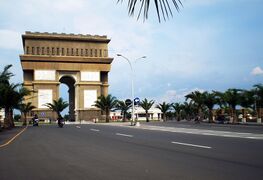 Simpang Lima Gumul Monument in Kediri, Indonesia

_05.JPG&filetimestamp=20260916180533&)
_Arc_de_Triomphe.JPG&filetimestamp=20260916185456&)

See also
- Names inscribed on the Arc de Triomphe
- Battles inscribed on the Arc de Triomphe
- List of works by James Pradier
- Napoleon's tomb
- Galerie des Batailles
- Bastille Day military parade
- List of tourist attractions in Paris
- List of post-Roman triumphal arches
References
- ^ Raymond, Gino (30 أكتوبر 2008). Historical dictionary of France. Scarecrow Press. p. 9. ISBN 978-0-8108-5095-8. Archived from the original on 12 يناير 2023. Retrieved 28 يوليو 2011.
- ^ Fleischmann, Hector (1914). An unknown son of Napoleon. John Lane company. p. 204. Retrieved 28 يوليو 2011.
- ^ "Arc de Triomphe". Lexico UK English Dictionary. Oxford University Press. Archived from the original on 18 أغسطس 2020.
- ^ "Arc de Triomphe". Collins English Dictionary. HarperCollins. Archived from the original on 22 أغسطس 2019. Retrieved 22 أغسطس 2019.
- ^ "Arc de triomphe". Merriam-Webster.com Dictionary. Merriam-Webster. OCLC 1032680871. Retrieved 22 أغسطس 2019.
- ^ أ ب "History of the Arc de triomphe". Paris-arc-de-triomphe.fr (Centre des monuments nationaux). Retrieved 1 نوفمبر 2025.
- ^ L'Abeille (in الفرنسية). Petit Séminaire de Québec. 1848. Archived from the original on 12 يناير 2023. Retrieved 25 نوفمبر 2021.
- ^ "Historical Currency Converter". Historicalstatistics.org. Archived from the original on 20 يناير 2016. Retrieved 5 أكتوبر 2021.
- ^ "7. A crowning for the Arc de Triomphe". Learning Resource - The Sculpted Decorations. Centre des monuments nationaux. p. 19.
- ^ L'Art moderne. Imp. Ve (i.e. 5th) Monnom. 1882. p. 318. Archived from the original on 20 نوفمبر 2023. Retrieved 18 مارس 2023.
- ^ Forrest, Alan (28 مايو 2009). The Legacy of the French Revolutionary Wars. Cambridge University Press. p. 38. ISBN 978-1-1394-8924-9.
- ^ Baedeker, Karl (1860). Guide à Paris par Baedeker: Arc de Triomphe de l'Étoile. Paris: A. Bohné. p. 91. Archived from the original on 12 يناير 2023. Retrieved 13 أغسطس 2021.
- ^ Divry, Arnauld (2023). "Les 660 noms inscrits sur l'Arc de Triomphe de Paris". arnauld-divry.ovh. Retrieved 25 أغسطس 2024.
- ^ "The panorama". Paris-arc-de-triomphe.fr (Centre des monuments nationaux). Retrieved 4 يناير 2025.
- ^ "Practical information". Paris-arc-de-triomphe.fr (Centre des monuments nationaux). Retrieved 17 سبتمبر 2025.
- ^ "These Arc de Triomphe Around the World… And in Montpellier?". La Comédie de Vanneau. 20 نوفمبر 2020. Archived from the original on 21 أبريل 2023. Retrieved 21 أبريل 2023.
External links
| Find more about قوس النصر، باريس at Wikipedia's sister projects | |

|
Media from Commons |

|
Travel guide from Wikivoyage |

|
Database entry Q64436 on Wikidata |
- Official website of the Arc de Triomphe
- Official website of the association La Flamme sous l'Arc de Triomphe (in فرنسية)
- Unveiling the Majesty of the Arc de Triomphe: A Symbol of Parisian Grandeur
- Inscriptions on the Arc de Triomphe
- Clarification of history of Arc de Triomphe
- Satellite view of the Arc de Triomphe on Google Maps
- View from the rooftop terrace of the Arc de Triomphe on YouTube

| International | |
|---|---|
| National | |


- Pages using gadget WikiMiniAtlas
- CS1 الفرنسية-language sources (fr)
- Short description is different from Wikidata
- Use dmy dates from August 2023
- Articles containing فرنسية-language text
- Coordinates on Wikidata
- Pages with فرنسية IPA
- Pages including recorded pronunciations
- Articles containing إنگليزية-language text
- Pages with empty portal template
- Articles with فرنسية-language sources (fr)
- Arc de Triomphe
- Triumphal arches in France
- Monuments and memorials related to Napoleonic Wars
- Buildings and structures completed in 1836
- Monuments and memorials in Paris
- Neoclassical architecture in Paris
- Buildings and structures in the 8th arrondissement of Paris
- Buildings and structures in the 16th arrondissement of Paris
- Buildings and structures in the 17th arrondissement of Paris
- Landmarks in France
- Champs-Élysées
- Terminating vistas in Paris
- Monuments of the Centre des monuments nationaux
- Jean-François Chalgrin buildings
- باريس
- معالم فرنسية
- صفحات مع الخرائط