أروكاريا عمودية
| أروكاريا عمودية | |
|---|---|

| |
التصنيف العلمي 
| |
| أصنوفة غير معروفة (أصلحها): | Araucaria sect. Eutacta |
| Species: | Template:Taxonomy/AraucariaA. columnaris
|
| Binomial name | |
| Template:Taxonomy/AraucariaAraucaria columnaris | |
| Synonyms[2] | |
| |

Araucaria columnaris, the coral reef araucaria, Cook pine (or Cook's pine), New Caledonia pine, Cook araucaria, or columnar araucaria, is a species of conifer in the family Araucariaceae.
التوزع
The tree is endemic to New Caledonia in the Melanesia region of the Pacific.
It was first classified by Johann Reinhold Forster, a botanist on the second voyage of Captain James Cook to circumnavigate the globe as far south as possible. It is named directly after Cook, and not from the Cook Islands.
الوصف
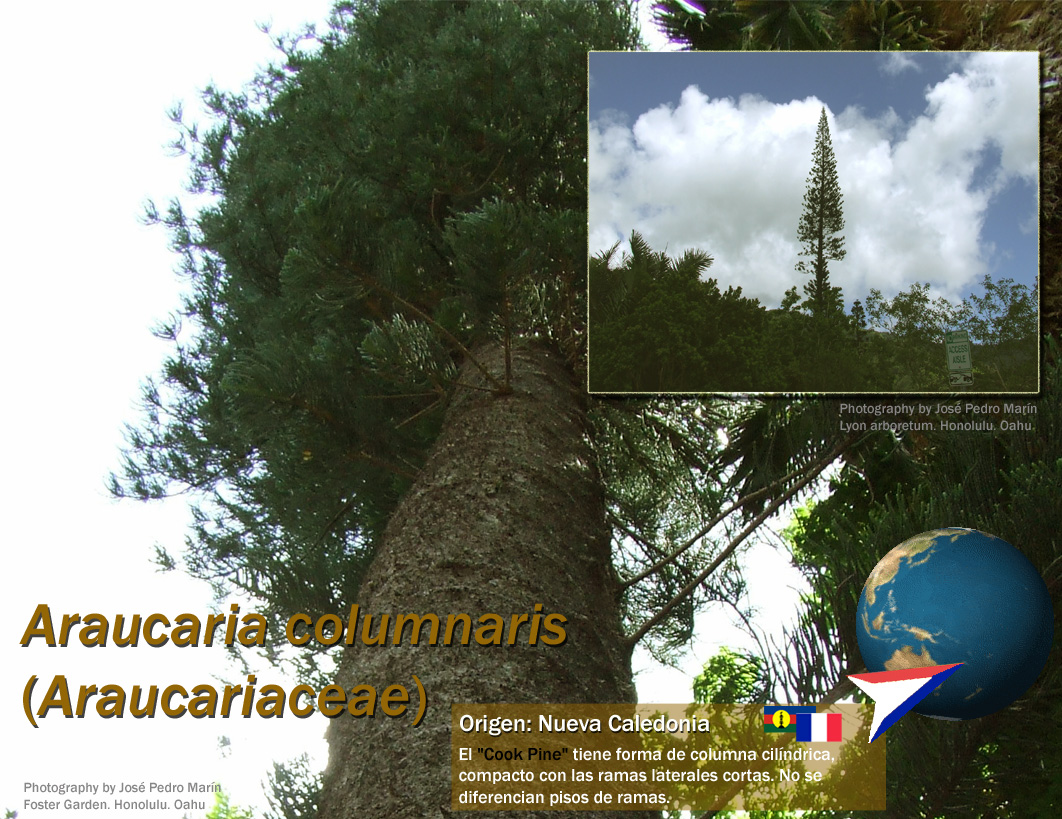
Araucaria columnaris is a distinctive narrowly conical tree growing up to 60 m (200 ft) tall in its native habit. The trees have a slender, spire-like crown.[3] The shape of young trees strongly resembles A. heterophylla. The bark peels off in thin paper-like sheets or strips and is rough, grey, and resinous.[3] The relatively short, mostly horizontal branches are in whorls around the slender, upright to slightly leaning trunk. The branches are lined with cord-like, horizontal branchlets. The branchlets are covered with small, green, incurved, point-tipped, spirally arranged, overlapping leaves. The young leaves are needle-like, while the broader adult leaves are triangular and scale-like.[3]
The female seed cones are scaly, egg-shaped, and 10–15 cm (4–6 in) long by 7–11 cm (3–4 in) wide. The smaller, more numerous male pollen cones are at the tips of the branchlets and are scaly, foxtail-shaped, and 5 cm (2 بوصات) long.[3]
A 2017 study found that trees tend to have a tilt dependent on the hemisphere of their location, growing upright on the Equator but leaning south in the northern hemisphere and north in the southern hemisphere.[4]
Ornamental tree
It is cultivated in gardens and public landscapes in Queensland and Victoria State of Australia, northern New Zealand, Southern California, Puerto Rico, Mexico, India, Philippines, Hawaii, South Brazil, Singapore, and Southeast Brazil.[3] Many of the "Norfolk Island pines" that grow in Hawaii, including their descendants used as potted ornamentals on the U.S. mainland, are actually A. columnaris, the two species having been confused when introduced.[5] The stoutest recorded, an ornamental specimen at Ulupalakua, Maui, Hawaiʻi is only 1.2 m (3 ft 11 in) in diameter at breast height.[6]
-
 Male cones
 -
 Female cones
 -
 Foliage


المراجع
- ^ Thomas, P. (2010). "Araucaria columnaris". IUCN Red List of Threatened Species. 2010 e.T42196A10661112. doi:10.2305/IUCN.UK.2010-2.RLTS.T42196A10661112.en. Retrieved 14 November 2021.
- ^ "Araucaria columnaris (G.Forst.) Hook.". World Checklist of Selected Plant Families. Royal Botanic Gardens, Kew. Retrieved 13 December 2017 – via The Plant List. Note that this website has been superseded by World Flora Online
- ^ أ ب ت ث ج "Araucaria columnaris". The Gymnosperm Database.
- ^ Johns, J. W.; Yost, J. M.; Nicolle, D.; Igic, B.; Ritter, M. K. (2017). "Worldwide hemisphere-dependent lean in Cook pines". Ecology. 98 (9): 2482–2484. Bibcode:2017Ecol...98.2482J. doi:10.1002/ecy.1850. PMID 28556968.
- ^ Armstrong, Wayne P. "The Araucaria Family: Past & Present". Pacific Horticulture Society. Retrieved 6 March 2021.
- ^ Earle, Christopher J. (February 22, 2025). "Gymnosperm Database". Retrieved May 23, 2025.
وصلات خارجية

| أروكاريا عمودية
]].- Endemia.NewCaledonia — Araucaria columnaris — distribution maps & text info.
- Conifers.org: Araucaria columnaris (coral reef araucaria) — description & images.
- Foster Garden (Honolulu, Hawaiʻi) — Araucaria columnaris image.
- University of Murcia.es: World Plants virtual gallery photos of Araucaria columnaris
- Short description is different from Wikidata
- أنواع القائمة الحمراء غير المهددة
- Automatic taxobox cleanup
- Araucaria
- Endemic flora of New Caledonia
- Trees of New Caledonia
- Least concern flora of Oceania
- Taxa named by Johann Reinhold Forster
- Taxa named by William Jackson Hooker
- Garden plants of Oceania
- أشجار الزينة
- Taxonomy articles created by Polbot