تحت فصيلة: Thalassorninae (One genus in Africa, most closely related to the subfamily Dendrocygninae, though also showing convergent similarities to the subfamily Oxyurinae)
تحت فصيلة: الأوزيات, swans and geese (Three to seven extant genera with 25–30 living species, mainly cool temperate Northern Hemisphere but also some Southern Hemisphere species, with the swans in one genus [two genera in some treatments], and the geese in three genera [two genera in some treatments]. Some other species are sometimes placed herein, but seem somewhat more distinct [see below])
Cygnus, true swans (7 species, 4 sometimes separated in Olor)
تحت فصيلة: Stictonettinae (One genus in Australia, formerly included in the Oxyurinae, but with anatomy suggesting a distinct ancient lineage perhaps closest to the Anserinae, especially the Cape Barren Goose)
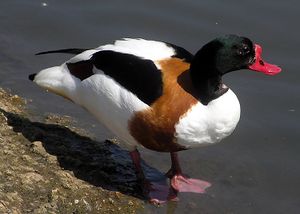
تحت فصيلة: Tadorninae – shelducks and sheldgeeseMale Common Shelduck(This group of larger, often semi-terrestrial waterfowl can be seen as intermediate between Anserinae and Anatinae. The 1986 revision[1] has resulted in the inclusion of 10 extant genera with about two dozen living species [one probably extinct] in this subfamily, mostly from the Southern Hemisphere but a few in the Northern Hemisphere, but the affiliations of several presumed tadornine genera has later been questioned[2] and the group in the traditional lineup is likely to be paraphyletic)
Subfamily: Anatinae, dabbling ducks and moa-nalos (The dabbling duck group, of worldwide distribution, were previously restricted to just one or two genera, but had been extended[1] to include 8 extant genera and about 55 living species, including several genera formerly known as the "perching ducks"; mtDNA on the other hand confirms that the genus Anas is over-lumped and casts doubt on the diving duck affiliations of several genera [see below]. The moa-nalos, of which 4 species in 3 genera are known to date, are a peculiar group of flightless, extinct Anatidae from the Hawaiian Islands. Gigantic in size and with massive bills, they were believed to be geese, but have been shown to be actually very closely related to mallard. They evolved filling the ecological niche of turtles, ungulates and other megaherbivores.)
Anas: wigeons, gadwalls, teals, pintails, mallards, shovelers, etc. (40–50 living species, 3 extinct) – paraphyletic
Subfamily: Aythyinae, diving ducks (Some 15 species of diving ducks, of worldwide distribution, in 2–4 genera; The 1986 morphological analysis[1] suggested that the probably extinct Pink-headed Duck of India, previously treated separately in Rhodonessa, should be placed in Netta, but this has been questioned.[3] Furthermore, while morphologically close to dabbling ducks, the mtDNA data indicates that a treatment as distinct subfamily is indeed correct, with the Tadorninae being actually closer to dabbling ducks than the diving ducks are[2])
Netta, Red-crested Pochard and allies (4 species, one probably extinct)
Subfamily: Merginae, eiders, scoters, sawbills and other sea-ducks Common Goldeneye couple, male on the right. (There are 9 extant genera and some 20 living species; most of this group occur in the Northern Hemisphere, but a few [mostly extinct] mergansers in the Southern Hemisphere)
UnresolvedThe rare White-winged Wood Duck, a species of unclear affiliation.Wood DuckAix sponsaThe largest degree of uncertainty concerns whether a number of genera are closer to the shelducks or to the dabbling ducks. See also the monotypic subfamilies above, and the "perching ducks"
Coscoroba, Coscoroba Swan – Anserinae or same subfamily as Cereopsis?
Cereopsis, Cape Barren Goose – Anserinae, Tadorninae, or own subfamily?
Sarkidiornis, Comb Duck – Tadorninae or closer to dabbling ducks?
Tachyeres, steamer ducks (4 species) – Tadorninae or closer to dabbling ducks?
Cyanochen, Blue-winged Goose – Tadorninae or more distant clade?
Nettapus, pygmy geese (3 species) – Anatinae or part of Southern Hemisphere radiation?
Pteronetta, Hartlaub's Duck – traditionally dabbling ducks, but may be closer to Cyanochen
Cairina, Muscovy Duck and White-winged Wood Duck (2 species) – traditionally dabbling ducks, but may be paraphyletic, with one species in Tadorninae and the other closer to diving ducks
Aix, Mandarin Duck and Wood Duck (2 species) – dabbling ducks or Tadorninae?
Callonetta, Ringed Teal – dabbling ducks or Tadorninae?
Chenonetta, Maned Duck (1 living species) – dabbling ducks or Tadorninae? Includes Euryanas.
Marmaronetta, Marbled Duck – Formerly dabbling ducks; actually a diving duck or a distinct subfamily
Burney, David A.; James, Helen F.; Burney, Lida Pigott; Olson, Storrs L.; Kikuchi, William; Wagner, Warren L.; Burney, Mara; McCloskey, Deirdre; Kikuchi, Delores; Grady, Frederick V.; Gage, Reginald II & Nishek, Robert (2001): Fossil Evidence for a Diverse Biota from Kauaʻi and Its Transformation since Human Arrival. Ecological Monographs71(4): 615–641. DOI:10.2307/3100038
Carboneras, Carles (1992): Family Anatidae (Ducks, Geese and Swans). In:del Hoyo, Josep; Elliott, Andrew & Sargatal, Jordi (eds.): Handbook of Birds of the World (Volume 1: Ostrich to Ducks): 536–629. Lynx Edicions, Barcelona. ISBN 84-87334-10-5
Collar, N. J.; Andreev, A. V.; Chan, S.; Crosby, M. J.; Subramanya, S. & Tobias, J. A. (eds.) (2001): Pink-headed Duck. In:Threatened Birds of Asia: The BirdLife International Red Data Book: 489–501. BirdLife International. ISBN 0-946888-44-2 HTML fulltext
Gál, Erika; Hír, János; Kessler, Eugén & Kókay, József (1998–99): Középsõ-miocén õsmaradványok, a Mátraszõlõs, Rákóczi-kápolna alatti útbevágásból. I. A Mátraszõlõs 1. lelõhely [Middle Miocene fossils from the sections at the Rákóczi chapel at Mátraszőlős. Locality Mátraszõlõs I.]. Folia Historico Naturalia Musei Matraensis23: 33–78. [Hungarian with English abstract] PDF fulltext
Johnsgard, Paul A. (2010): Ducks, Geese, and Swans of the World, Revised editionPDF fulltext
Johnsgard, Paul A. (2010): Waterfowl of North America, Revised editionPDF fulltext
Johnson, Kevin P. & Sorenson, Michael D. (1999): Phylogeny and biogeography of dabbling ducks (genus Anas): a comparison of molecular and morphological evidence. Auk116(3): 792–805. PDF fulltext
Livezey, Bradley C. (1986): A phylogenetic analysis of recent anseriform genera using morphological characters. Auk103(4): 737–754. PDF fulltextDjVu fulltext
Madge, Steve & Burn, Hilary (1987): Wildfowl : an identification guide to the ducks, geese and swans of the world. Christopher Helm, London. ISBN 0-7470-2201-1
Short, Lester L. (1970): A new anseriform genus and species from the Nebraska Pliocene. Auk87(3): 537–543. PDF fulltext
Sraml, M.; Christidis, L.; Easteal, S.; Horn, P. & Collet, C. (1996): Molecular Relationships Within Australasian Waterfowl (Anseriformes). Australian Journal of Zoology44(1): 47–58. doi:10.1071/ZO9960047 (HTML abstract)
Steadman, David William (1999): The Prehistory of Vertebrates, Especially Birds, on Tinian, Aguiguan, and Rota, Northern Mariana Islands. Micronesica31(2): 319–345. PDF fulltext
Terres, John K. & National Audubon Society (NAS) (1991): The Audubon Society Encyclopedia of North American Birds. Wings Books, New York. Reprint of 1980 edition. ISBN 0517032880
Todd, Frank S. (1991). Forshaw, Joseph (ed.). Encyclopaedia of Animals: Birds. London: Merehurst Press. pp. 81–87. ISBN1-85391-186-0.