المستقر الشمسي Solar apex
| المستقر الشمسي Solar apex |
|---|
 (RA) 18س 28د 0ث (dec) 30°N |
| الذَنَب الشمسي Solar antapex |
 (RA) 6س 28د 0ث (dec) 30°S |

المستقر الشمسي solar apex، أو ذروة مسار الشمس، ويشير إلى الاتجاه الذي تسافر فيه الشمسي بالنسبة لـالمعيار المحلي للسكون. وينبغي عدم الخلط بينه وبين الحركة الظاهرة للشمس عبر كل كوكبات البروج، التي هي خداع بصري يسببه مدار الأرض.
الاتجاه
The solar apex is in the constellation of Hercules near the star Vega.[1]
For more than 30 years before 1986 the speed of the Sun towards the solar apex was taken to be about 20 km/s[2] but all later studies give a smaller component in the vector toward galactic longitude 90°, reducing overall speed to about 13.4 km/s.[3] This speed is not to be confused with the orbital speed of the Sun around the Galactic Center, which is about 220 km/s and is included in the movement of the Local standard of rest. Thus the Sun moves towards the apex (a relatively local point) at about 1⁄13 our spiral arm's orbital speed. The Sun's motion in the Milky Way is not confined to the galactic plane; it also shifts ("bobs") up and down with respect to the plane over millions of years.[4]
التاريخ
The nature and extent of the solar motion was first demonstrated by William Herschel in 1783, who also first determined the direction for the solar apex, as Lambda Herculis, 10° away from today's accepted position.[5][6] Herschel was not an observer–he relied on star motions reported in existing catalogs by Nevil Maskelyne and Jérôme Lalande- and he was not an especially skilled mathematician but his result was close to modern values.[7]
Many calculations of the solar apex have been published as new catalogues of stars were published.[8] The catalog from the Hipparcos astrometric satellite and measurements with objective prisms lead to a new set of values.[9] These two results do not agree. The calculation of the local standard of rest itself is subject to issues due to inhomogeneous stellar velocities[10] and high sensitivity to parameters.[11]
الذنب الشمسي
الذَنَب الشمسي solar antapex، الاتجاه المعاكس للمستقر الشمسي، ويقع بالقرب من النجم فرد الكلب الأكبر.[12]
معرض
- تمثيل حركات النجوم حول المستقر والذَنَب
-
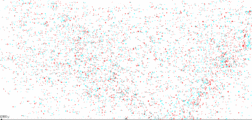 حركة النجوم حول المستقر. لرؤية هذه الصورة تحتاج نظارات ثلاثية الأبعاد (أحمر-أخضر أو أحمر-أزرق).
 -
 حركة النجوم حول المستقر. لرؤية هذه الصورة تحتاج نظارات ثلاثية الأبعاد (أحمر-أخضر أو أحمر-أزرق).
 -
 حركة النجوم حول الذنب. لرؤية هذه الصورة تحتاج نظارات ثلاثية الأبعاد (أحمر-أخضر أو أحمر-أزرق).
 -
 حركة النجوم حول المستقر والذنب. لرؤية هذه الصورة تحتاج نظارات ثلاثية الأبعاد (أحمر-أخضر أو أحمر-أزرق).


انظر أيضاً
- Manuel Foster Observatory – southern observatory established for the determination of the Solar Apex by W. W. Campbell
المراجع
- ^ Raymo, Chet (1990). Three Hundred and Sixty Five Starry Nights: An Introduction to Astronomy for Every Night of the Year. Touchstone. ISBN 9780671766061.
- ^ Kerr, Frank J.; Lynden-Bell, Donald (August 1986). "Review of Galactic Constants". Monthly Notices of the Royal Astronomical Society. 221 (4): 1023–1038. Bibcode:1986MNRAS.221.1023K. doi:10.1093/mnras/221.4.1023. See also Table 3 on page 13 of Kogut, A.; et al. (1993). "Dipole Anisotropy in the COBE Differential Microwave Radiometers First-Year Sky Maps". Astrophysical Journal. 419: 1. arXiv:astro-ph/9312056. Bibcode:1993ApJ...419....1K. doi:10.1086/173453. S2CID 209835274.
- ^ U, V, and W (vectors) are ح. 10.0, 5.25 and 7.17 km/s respectively, Dehnen, Walter; Binney, James J. (1998). "Local Stellar Kinematics from Hipparcos Data". Monthly Notices of the Royal Astronomical Society. 298 (2): 387–394. arXiv:astro-ph/9710077. Bibcode:1998MNRAS.298..387D. doi:10.1046/j.1365-8711.1998.01600.x. S2CID 15936627.
- ^ Frisch, Priscilla (2000). "The Galactic Environment of the Sun". American Scientist. Vol. 88, no. 1. p. 52. Archived from the original on 2007-11-24.
- ^ Lankford, John (1997). History of Astronomy: An Encyclopedia. Garland Encyclopedias in the History of Science. Vol. 1. Taylor & Francis. p. 258. ISBN 0-8153-0322-X.
- ^ Herschel, William (1783). "On the Proper Motion of the Sun and Solar System; With an Account of Several Changes That Have Happened among the Fixed Stars since the Time of Mr. Flamstead [sic]". Philosophical Transactions of the Royal Society of London. 73: 247–83. doi:10.1098/rstl.1783.0017. JSTOR 106492. S2CID 186213288.
- ^ Hoskin, Michael (1980), "Herschel's Determination of the Solar Apex", Journal for the History of Astronomy 11 (3): 153–163, doi:, Bibcode: 1980JHA....11..153H.
- ^ Walkey, O. R. (1946-08-01). "An Abstract on the Solar Apex". Monthly Notices of the Royal Astronomical Society. 106 (4): 274–279. doi:10.1093/mnras/106.4.274. ISSN 0035-8711.
- ^ Fehrenbach, Ch.; Duflot, M.; Burnage, R. (April 2001). "New determination of the solar apex". Astronomy & Astrophysics. 369 (1): 65–73. Bibcode:2001A&A...369...65F. doi:10.1051/0004-6361:20010100. ISSN 0004-6361.
- ^ Francis, Charles; Anderson, Erik (2009-10-01). "Calculation of the local standard of rest from 20 574 local stars in the New Hipparcos Reduction with known radial velocities". New Astronomy. 14 (7): 615–629. arXiv:0812.4032. Bibcode:2009NewA...14..615F. doi:10.1016/j.newast.2009.03.004. ISSN 1384-1076.
- ^ Bobylev, V. V.; Bajkova, A. T. (2014-04-21). "The local standard of rest from data on young objects with account for the Galactic spiral density wave". Monthly Notices of the Royal Astronomical Society. 441 (1): 142–149. arXiv:1404.6987. doi:10.1093/mnras/stu563. ISSN 1365-2966.
- ^ "Furud". stars.astro.illinois.edu. Retrieved 2024-05-26.


