پوليكراتيس
| Polycrates | |||||
|---|---|---|---|---|---|
| Tyrant of Samos | |||||
 Polycrates with Pharaoh Amasis II (19th century illustration). | |||||
| العهد | 540s – 522 BC | ||||
| سبقه | Aeaces I? | ||||
| تبعه | Maeandrus | ||||
| وُلِد | Samos | ||||
| توفي | 522 BC Magnesia, Achaemenid Empire | ||||
| |||||
| البيت | Aeacids | ||||
| الأب | Aeaces I | ||||
پوليكراتيس (باليونانية: Πολυκράτης؛ إنگليزية: Polycrates)، ابن أياكس Aeaces، كان طاغية ساموس من ح. 538 ق.م. حتى 522 ق.م.
تولى السلطة أثناء مهرجان هيرا مع شقيقَيه پانتاگنوتس وسيلوسون، ولكنه سرعان ما قتل پانتاگنوتس ونفى پانتاگنوتس لينفرد بالحكم. ثم تحالف مع أماسيس الثاني، فرعون مصر، وكذلك مع طاغية ناخوس ليگداميس. وبأسطول مكون من 100 سفينة عليه 1,000 من الرماة، فقد نهب جزر بحر إيجة ومدن ساحل أيونيا في آسيا الصغرى.
العائلة
Polycrates' family background is not clearly known to us. J.P. Barron proposed that Polycrates' ancestors formed a dynasty that ruled Samos from around 600 BC.[1] A shadowy figure, Syloson, son of Calliteles might have been the founder of this dynasty. Barron further proposed that Polycrates' father, Aeaces, ruled Samos around the middle of the sixth century. An inscription survives from this period, in which an individual called Aeaces dedicates some plunder to Hera.[2] Barron's analysis was broadly accepted by Graham Shipley, but has been challenged by Aideen Carty.[3][4]
Polycrates had two brothers, Pantagnotus and Syloson, who were originally his co-rulers. Syloson ruled Samos again after Polycrates' death, and was succeeded by his own son, Aeaces. Herodotus mentions a daughter in his account of Polycrates' death.[استشهاد ناقص]
العهد
تأسيس سلطته
In the mid-sixth century BCE, there was apparently a period of civil strife in Samos. This conflict is mentioned by Herodotus in the context of Polycrates' rise to power.[5] John Boardman and Graham Shipley have cited archaeological evidence for serious disruption in this period. Around 550 BC, they say, funerary stele were shattered and aristocratic burials in the West Cemetery at Samos cease, while the first great temple of Hera, known as the Rhoikos temple, was destroyed - only a decade after it was built.[6][7] However, more recent archaeological research has challenged this picture, showing that the destruction of the Rhoikos temple was a structural failure resulting from subsidence under the foundations, and that the West Cemetery fell out of use gradually over the course of the second half of the sixth century.[8] Aideen Carty argues that shifts in the deposition of Laconian pottery on Samos suggest the development of pro- and anti-Spartan factions on the island, one faction associated with the Heraion and the other with the Artemision of Samos.[9]
Herodotus reports that Polycrates took power with his brothers Pantagnotus and Syloson and a force of only fifteen men.[10] This coup seems to have taken place in 540 BC or slightly earlier.[11] Initially, Polycrates ruled along with his brothers, but soon had Pantagnotus killed and then exiled Syloson to take full control for himself.[5] According to a Roman-period author, Polyaenus, there was a religious procession in armour out of the city of Samos to the Heraion, led by Pantagnotus and Syloson. When the procession was over, the Samians removed their armour to sacrifice, and Pantagnotus and Syloson seized the chance to murder their enemies. At the same time, Polycrates seized Astypalaea, the citadel of the city of Samos. The tyrant of Naxos, Lygdamis, invaded with a force to support Polycrates.[12] However, it is uncertain whether Polyaenus' account describes Polycrates' initial seizure of power or the conflict with his brothers which left him as sole ruler.[13]
Thalassocracy


Polycrates recruited an army of 1,000 archers and assembled a navy of 100 penteconters, which became the most powerful navy in the Greek world –– Herodotus says that Polycrates was the first Greek ruler to understand the importance of sea power and Thucydides includes him in his list of thalassocracies in the Aegean.[14] With these forces he implemented a plan to bring all the Greek islands and cities of Ionia under his rule. Polycrates' rise to power took place in the period when the Achaemenid Empire under Cyrus conquered western Anatolia. In theory, the Aegean islanders had accepted Persian overlordship after Cyrus conquered Lydia in 546 BC, but in practice the political situation in the Aegean was complicated. This confusion may have contributed to Polycrates' success in projecting his power.[15]
Few specifics of Polycrates' naval activities and conquests are preserved. Herodotus refers to an attack on Miletus, in which the Lesbians came to the aid of Miletos and Polycrates won a great naval victory, capturing and enslaving large numbers of Lesbian sailors.[16] The Milesians had become key Persian allies and this victory is probably identical with a victory over Persian navy mentioned in Thucydides and some other historians.[17] Thucydides emphasises his conquest of Delos, the key religious centre of the Aegean.[18] Polycrates formed an alliance with King Amasis of Egypt and A. Carty suggests that Polycrates assisted Amasis in the conquest of Cyprus.[15] In general, though, the ancient sources stress not specific campaigns, but wide-ranging raiding, which may have been more like piracy than campaigns of conquest. Herodotus says that he "raided everyone without any discrimination. For he said that a friend would be more appreciative if what was taken from him was returned than if it had not first been snatched away."[19] Aideen Carty argues that the focus of this raiding was the acquisition of slaves whom he exported to Egypt to serve as mercenaries in Amasis' army.[20]
The nature of Polycrates' navy is debated. Some scholars have conceived of his penteconters as powerful warships in a state navy which owned, crewed and operated them in accordance with Polycrates' command.[21] Other scholars consider this picture anachronistic; they present the penteconters as trading and raiding vessels that were owned privately by individual Samian aristocrats, who were essentially autonomous pirates only loosely constrained by Polycrates and the Samian state.[22] In addition to these ships, Polycrates is said to have commissioned a new type of ship called the Samaina, a decked ship with two banks of oars, apparently a merchant galley designed for the rapid transport of goods or troops.[23]
التمرد والغارة الاسبرطية


Herodotus states that Polycrates later established a fleet of 40 triremes, probably becoming the first Greek state with a fleet of such ships, which he crewed with sailors he considered to be politically dangerous, and sent to the Persian king Cambyses with instructions to put the crews to death.[24] Modern scholars consider this story unlikely.[25] The dispatch of these ships is usually connected with the Persian invasion of Egypt in 525 BC. Herman Wallinga argues that the ships were built at Amasis' expense, crewed by Polycrates, and sent by him to fight against the Persians.[26] By contrast, Hans Van Wees thinks that this fleet was a gift from the Persians, crewed by Polycrates, in order to assist the Persians against Amasis.[27]
The naval detachment turned back to attack Polycrates. They defeated him at sea but could not take the island. The rebels then sailed to mainland Greece and allied with Sparta and Corinth. Sparta and Corinth invaded the island of Samos in support of the Samian rebels around 520 BC. After 40 days they withdrew their unsuccessful siege.[28]
"It's said that Polycrates was one of the earliest known coin counterfeiters. Herodotus wrote that Polycrates bought off the besieging Spartans in 525/4 B.C. with counterfeit Samian coins. Some of these fakes still exist and are described in Spink's coin catalogue."[29]
الغزو الفارسي والوفاة
Herodotus also tells the story of Polycrates' death.[30] Near the end of the reign of Cambyses (around 522 BC), the satrap of Sardis, Oroetes, planned to kill Polycrates, either because he had been unable to add Samos to Persia's territory, or because Polycrates had snubbed a Persian ambassador. Prior to this, according to Diodorus Siculus, some Lydians fleeing Oroestes' domineering rule sought sanctuary on Samos. Polycrates at first received them, but then put them to the sword and confiscated the possessions that they had brought (Diodorus Siculus, Library 10.16.4). Polycrates was invited to Magnesia, where Oroetes lived. Oroetes claimed that he wanted a promise of refuge on Samos in the event that Cambyses turned on him and that in return he would give Polycrates a large amount of money. Polycrates was convinced and went to Magnesia, where he was assassinated. Herodotus is vague about the manner of Polycrates' death, saying only that it was an undignified end for a glorious ruler; he may have been impaled and his dead body was crucified.[31] Herodotus claims that Polycrates' daughter warned him not to go to Magnesia, reporting a prophetic dream that she had had of him hanging in the air, being washed by Zeus and anointed by the sun god Helios. His death fulfilled this prophecy as when it rained he was 'washed by Zeus' and when the sun shone he was 'anointed by Helios', as the moisture was sweated from him.[32]
After the murder of Polycrates by Oroetes, Samos was ruled by Maeandrius.[28] After some time, Syloson, the brother of Polycrates, was installed as governor of Samos by Achaemenid ruler Darius I, receiving the help of general Otanes to expel the impostor who had taken control after Oroetes.[33][34]
ساموس تحت حكم بوليكراتيس
مشاريع التشييد

Under Polycrates the Samians developed an engineering and technological expertise to a level unusual in ancient Greece.[35] In the midst of his account of Polycrates, Herodotus presents three astounding engineering works of the Samians. The first of these is an aqueduct in the form of a tunnel 1،036 متر (3،399 ft) long which can still be seen and which is known as the Tunnel of Eupalinos. The tunnel was constructed by two teams tunnelling from opposite sides of a ridge who met in the middle with an error of only a few metres — a remarkable engineering feat for the time, and one which probably reflects the practical geometry skills which the Samians had learned from the Egyptians. Polycrates also sponsored construction of a large temple of Hera, the Heraion, to which Amasis dedicated many gifts, and which at 346 أقدام (105 m) long was one of the three largest temples in the Greek world, and he upgraded the harbour of his capital city (modern Pythagorion), ordering the construction of a deep-water mole nearly a quarter mile long, which is still used to shelter Greek fishing boats today.[36] Although these projects are often associated with Polycrates on the strength of the passage of Herodotus, he is actually very vague about when these projects were carried out and what - if anything - they had to do with Polycrates.[37] Archaeological work has made the picture more complicated, suggesting that the Tunnel of Eupalinos may have been dug before his reign and that Polycrates continued projects that were already in course at the Heraion.
الأنشطة الدينية والثقافية
One use to which Polycrates put his powerful navy was controlling the island of Delos, one of the most important religious centres in Greece, control of which would bolster Polycrates' claim to be the leader of the Ionian Greeks.[38][35] Thucydides reports that Polycrates chained Delos to the neighbouring island of Rhenaia.[18] In 522 BC Polycrates celebrated an unusual double festival in honour of the god Apollo of Delos and of Delphi; it has been suggested that the Homeric Hymn to Apollo, sometimes attributed to Cynaethus of Chios, was composed for this occasion.[39][40]
Polycrates lived amid great luxury and spectacle and was a patron of the poets Anacreon and Ibycus.[41][42] The philosopher Pythagoras was also on Samos during his reign but left for Croton about 531 BC, perhaps out of dissatisfaction with his dictatorship.[43][35] He also attracted to his court, sometimes by offering generous subsidies, an array of prominent craftsmen and professionals from throughout the Greek world, including Eupalinos, the architect of the Tunnel, who was originally from Megara, the famous physician Demodocus of Croton, Rhoikos the architect of the Heraion, and the master metal-worker Theodoros, who had made a famous silver bowl which Croesus dedicated at Delphi and which is described by Herodotus, and who also made the ring which was Polycrates' most treasured personal possession. Polycrates established a library on Samos, and showed a sophisticated approach to economic development, importing improved breeds of sheep, goats, and dogs from elsewhere in the Greek world.[36]
خاتم بوليكراتيس
في الأسطورة

According to Herodotus, Amasis thought Polycrates was too successful, and advised him to throw away whatever he valued most in order to escape a reversal of fortune. Polycrates followed the advice and threw a jewel-encrusted ring into the sea; however, a few days later, a fisherman caught a large fish that he wished to share with the tyrant. While Polycrates' cooks were preparing the fish for eating, they discovered the ring inside of it. Polycrates told Amasis of his good fortune, and Amasis immediately broke off their alliance, believing that such a lucky man would eventually come to a disastrous end.[44] Within Herodotus' work, this story serves to advance general themes about the mutability of fortune and how to judge success. Most subsequent references to Polycrates in literature and other media have focused on this story.
علاقته بمصر
حسب هيرودوت، فإن أماسيس اعتقد أن بوليكراتيس كان ناجحاً أكثر من الازم، لذا فقد نصحه بأن يتخلص من أغلى شيء لديه لكي ينجو من سوء العاقبة. وقد اتبع بوليكراتيس النصيحة ورمى بخاتم مرصع بالجواهر في البحر؛ إلا أنه بعد بضعة أيام، اصطاد صياد سمكة كبيرة فأحب أن يهديها لطاغية المدينة. وبينما طهاة بوليكراتيس يعدون السمكة، عثروا على الخاتم داخلها. وعندما أخبر بويكراتيس صديقه أماسيس بحسن حظه، فض أماسيس تحالفه مع بويكراتيس على الفور، لإيمانه بأن هذا الرجل المحظوظ ستكون خاتمته كارثية.
إلا أن التحالف، أغلب الظن، قد انفض لأن بوليكراتيس تحالف مع ملك الفرس قمبيز الثاني ضد مصر. ففي ذلك الوقت، كان بوليكراتيس قد صنع أسطولاً من 40 ثلاثية المجاديف، مما جعله في الأغلب أول دولة يونانية ذات أسطول من تلك الفئة من السفن. وقد شغـَّل في تلك السفن الرجال الذين كان يرى أنهم يشكلون خطراً سياسياً عليه، وأوصى قمبيز أن يعدمهم؛ إلا أن المبعدين يبدوا أنهم خمنوا خطة بوليكراتيس، فعادوا من مصر ليهاجموا الطاغية. وقد هزموا بوليكراتيس في البحر ولكنهم لم يستطيعوا الاستيلاء على الجزيرة. ثم أبحروا إلى بر اليونان الرئيسي وتحالفوا مع اسبرطة وكورنثة، الذين غزوا الجزيرة. وبعد 40 يوم سحبوا حصارهم غير الناجح.
الذكرى الثقافية
Polycrates' Ring (German: Der Ring des Polykrates) is a lyrical ballad written in June 1797 by Friedrich Schiller and first published in his 1798 Musen-Almanach annual. It is about how the greatest success gives reason to fear disaster. Schiller relied on the accounts of the fate of Polycrates, tyrant of Samos, in Herodotus' Histories, Book III.
The early 20th century opera Der Ring des Polykrates by Erich Wolfgang Korngold retells the story of Polycrates as a modern fable.
Polycrates is mentioned in Byron's famous stanzas "The Isles of Greece:"
- Fill high the bowl with Samian wine!
- We will not think of themes like these!
- It made Anacreon's song divine:
- He served—but served Polycrates—
- A tyrant; but our masters then
- Were still, at least, our countrymen.
In modern folkloristics, the tale of Polycrates' Ring originated the Aarne–Thompson–Uther tale type ATU 736A, named after this episode. The story is acknowledged by scholarship as "widespread"[45] and "attested in numerous literatures and languages".[46]
مقتله
كما يخبرنا هيرودوت بقصة وفاة بوليكراتيس. وبالقرب من نهاية حكم قمبيز، خطط حاكم سرديس، اوروئتس، لقتل بوليكراتيس، إما لأنه لم يتمكن من ضم ساموس إلى الممتلكات الفارسية، أو لأن بوليكراتيس أساء الرد على مبعوث فارسي. على اي حال، فقد دُعِي بوليكراتيس إلى سرديس، وبالرغم من تحذيرات العرافين لابنته، فقد ذهب ولقي مصرعه هناك. طريقة القتل لم يسجلها هيرودوت، لأنها يبدو أنها كانت نهاية غير كريمة لطاغية مجيد، إلا أنه قد يكون قد وُضِع على الخازوق[47] وقد صـُلـِب جسده الميت.
انجازاته
وصلت ساموس إلى أوج عظمتها في الربع الثالث من القرن السادس تحت حكم بوليكراتيز Polycrates. وقد استطاع هذا الطاغية بفضل المال الذي تدره عليه رسوم الميناء أن يقضي فترة من البطالة كانت تنذر الجزيرة بأوخم العواقب، فوضع خطة لإقامة منشآت عامة أثارت إعجاب هيرودوت. وكان أعظم مشروعاته نفق يوپالينوس Eupalinos في الجبل لنقل الماء إلى المدينة مسافة 4500 قدم. وفي وسعنا أن نستدل بعض الاستدلال على مهارة اليونان الرياضية والهندسة، إذا عرفنا أن الثقبين الذين بدءا من اتجاهين متضادين التقيا في وسط النفق، وأن الخطأ في تقديرهم عند التقائهما لم يزد على ثماني عشرة قدماً في الاتجاه وعلى تسع أقدام في الارتفاع.
وقد كان بوليكراتيس، أغلب الظن، راعياً للشاعر أنكريون.
معرض صور
-
 The crucifixion of Polycrates by Oroetes.
 -
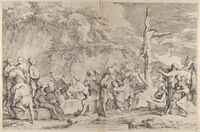 The crucifixion of Polycrates the tyrant after his capture by the Persians.
 -
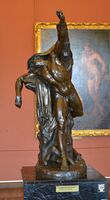


_01.jpg&filetimestamp=20181025210855&)
انظر أيضاً
الهامش
- ^ Barron, John P. (1964). "The Sixth-Century Tyranny at Samos". The Classical Quarterly. 14 (2): 210–229. doi:10.1017/S0009838800023764. JSTOR 637725. S2CID 170412189.
- ^ IG XII.6.2 561
- ^ Shipley, Graham J. (1987). A History of Samos, 800-188 BC. Oxford: Oxford University Press. pp. 40–1 & 69. ISBN 9780198148685.
- ^ Carty (2015) 23-66.
- ^ أ ب Herodotus Histories 3.39
- ^ Boardman, John (1959). "Chian and Early Ionic architecture". The Antiquaries Journal. 39 (3–4): 170–218. doi:10.1017/S0003581500083128. S2CID 164059218.
- ^ Shipley (1987) 79
- ^ Carty (2005) 92-93 & 102-105
- ^ Carty (2005) 94-102
- ^ Herodotus Histories 3.39 & 3.120.
- ^ Carty (2015) 75-89. Eusebius Chronicon puts this event in 533 BC, but this is generally agreed to be too late: White (1954), Cadoux (1956). Carty moves it back to c. 550 BC.
- ^ Polyaenus 1.23.
- ^ Carty (2005)117-20
- ^ Herodotus 3.122; Thucydides 1.13.6
- ^ أ ب Carty (2005), 131-5
- ^ Herodotus 3.39
- ^ Thucydides 1.13.6; Carty (2005), 133
- ^ أ ب Thucydides 1.13, 3.104
- ^ Herodotus 3.39, Diodorus Siculus, Bibliotheke 10.16.1; P. de Souza, Piracy in the Graeco-Roman World (1999), 25
- ^ Carty (2005) 144-8
- ^ L. Casson Ships and Seafaring in Ancient Times (1994) 51-3; L. Scott "Were there Polis Navies in Archaic Greece?" in G. J. Oliver et al., The Sea in Antiquity (2000) 108
- ^ de Souza, (1999), 284; Carty (2015) 139-41.
- ^ Photius Lexicon sv. Σαμίων ὁ δῆμός; Plutarch, Pericles 26; Wallinga (1993) 95-7; De Souza (1998) 283; Carty (2005) 141-4
- ^ Herodotus, Histories 3.39
- ^ Carty (2005) 136
- ^ H. T. Wallinga, Ships and Sea-Power before the Great Persian War (1993), 88 and 117.
- ^ H. Van Wees, Greek Warfare (2004), 306 n. 19
- ^ أ ب Hart, John (2014). Herodotus and Greek History (Routledge Revivals) (in الإنجليزية). Routledge. p. 88. ISBN 9781317678373.
- ^ The Counterfeit Coin Storey by Ken Peters ISBN 0-9543487-0-2
- ^ "Herodotus (Polycrates)". global.oup.com. Archived from the original on 2018-07-30. Retrieved 2018-04-14.
- ^ Herodotus, Histories 3.125.3
- ^ Herodotus, Histories 3.126
- ^ Herodotus, iii.142-144.
- ^ Dandamaev, M. A. (1989). A Political History of the Achaemenid Empire. BRILL. p. 148. ISBN 978-9004091726.
The island was plundered and incorporated into the Achaemenid empire. Syloson was appointed as its vassal ruler.
- ^ أ ب ت Grant, Michael. The rise of the Greeks (1st American ed.). New York: Scribners. pp. 153–156.
- ^ أ ب Burn, A. R. (1968). The lyric age of Greece. St. Martin's Press: Minerva. pp. 314–318.
- ^ Carty (2015) 15
- ^ Bury, J. B.; Mieggs, Russell (1956). A history of Greece to the death of Alexander the Great (3 ed.). London: Macmillan. pp. 232–234.
- ^ Suda sv Pythia kai Delia
- ^ Walter Burkert, 'Kynaithos, Polycrates and the Homeric Hymn to Apollo' in Arktouros: Hellenic studies presented to B. M. W. Knox ed. G. W. Bowersock, W. Burkert, M. C. J. Putnam (Berlin: De Gruyter, 1979), pp. 53–62.
- ^ Athenaeus, Deipnosophistae 12.540c-d
- ^ See papyrus fragment of a poem by Ibycus that mentions Polycrates at Oxyrhynchus Online: ‘With them you too, Polycrates, shall have immortal fame for beauty as long as my song and fame endure.’
- ^ Aristoxenus F16
- ^ Herodotus 3.40-42
- ^ Brockington, Mary. "Discovery in the Morrois: Antecedents and Analogues." The Modern Language Review 93, no. 1 (1998): 1-15. doi:10.2307/3733618.
- ^ Parsons, Ben. "‘I Was Beaten and I Beat’: Responding to Discipline." In: Punishment and Medieval Education, 165-206. Woodbridge, Suffolk, UK; Rochester, NY, USA: Boydell & Brewer, 2018. doi:10.2307/j.ctv1qv17q.10.
- ^ Herodotus. The Histories (an introduction and notes by John M. Marincola). Penguin Classics, 2003. Page 224.
وصلات خارجية
- Livius, Polycrates of Samos by Jona Lendering
- Short description matches Wikidata
- Short description is different from Wikidata
- Articles containing Greek-language text
- Articles containing إنگليزية-language text
- Pages using Lang-xx templates
- Articles with incomplete citations from November 2025
- All articles with incomplete citations
- وفيات 515 ق.م.
- يونانيو القرن السادس ق.م.
- ساموسيون قدماء
- حكام يونانيون قدماء
- أشخاص أعدموا صلباً
- يونانيون قدماء أعدموا
- طغاة قدماء
- اعدامات القرن السادس ق.م.
- شخصيات في هيرودوت