مسجد جواثا
| Jawatha Mosque | |
|---|---|
عربية: مَسْجِد جَوَاثَا | |
 | |
| الدين | |
| الارتباط | Sunni Islam |
| الوضع الكنسي أو التنظيمي | Mosque |
| الوضع | Active |
| الموقع | |
| الموقع | Al-Ahsa, Eastern Province |
| البلد | Saudi Arabia |
  تظهر داخل السعودية | |
| الإحداثيات الجغرافية | 25°28′11″N 49°40′43″E / 25.46972°N 49.67861°E |
| العمارة | |
| النوع المعماري | Mosque architecture |
| اكتمل |
|
| النوع | Cultural |
| الحيثية | iii, iv, v |
| صـُنــِّف | 2018 |
| إدراج الأب | Al-Ahsa Oasis, an Evolving Cultural Landscape |
| الرقم المرجعي | 1563-009 |
| [1][2] | |
The Jawatha Mosque (عربية: مَسْجِد جَوَاثَا, romanized: Masjid Jawāthā), also incorrectly spelled Al-Jawan, is a Sunni Islam mosque, located in the historic Jawatha area, about 12 km (7.5 mi) northeast of Hofuf, Al-Ahsa, Saudi Arabia. It was the earliest known mosque built in eastern Arabia. Most of the original structure fell into ruins.[2] However, it was restored in 2007 by the Saudi Commission for Tourism and National Heritage, using a design similar to that of Masmak Fort in Riyadh.[3]
Construction
Sources give the date of the mosque's original construction as either هـ 7 (628/629)[4][1] or هـ 16 (637/638).[2][4][5] It was built by the Bani Abd al-Qays tribe, which lived there before and during the early Islamic period.[1][4] This mosque is believed to be the first mosque built in Eastern Province and where the second Friday congregation prayer in Islam was offered, the first being held in the Prophet's Mosque in Medina.[1][4] According to legend, when the Hajr Al-Aswad (Black Stone) was stolen from Mecca by the Qarmatians, it was kept in this mosque for nearly 22 years.[3]
Before the 2007 restoration, most of the mosque's original structure had fallen apart, with only a small number of its arches surviving. These remains include two pointed keel arches from one arcade of the mosque and a part of the qibla wall consisting of three keel-arch niches, and probably dated to the 9th century CE.[5][4] The central niche of the qibla wall is larger than the other two and acts as the mihrab, which projects from the outer side of the wall.[6]
معرض الصور
-
 صورة داخلية للمسجد بعد ترميمه
 -
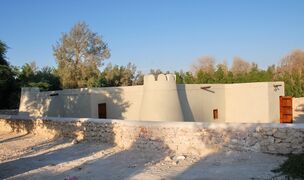 صورة نهارية للمسجد
 -
 صورة جانبية وتظهر فيها بوابة المسجد
 -
 صورة قريبة لبوابة المسجد
 -
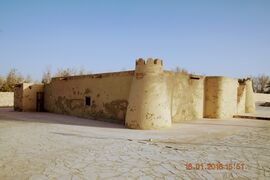 المسجد في 2018
 -
 المسجد في 2011


See also
References
- ^ أ ب ت ث Abdul-Ali (August 24, 2005), Jawatha Mosque in danger of going down, Al-Ahsa: Jafariya News, http://www.jafariyanews.com/2k5_news/aug/24jawatha_mosque.htm
- ^ أ ب ت Wood, Roger (1975). "An introduction to Saudi Arabian antiquities". Saudi Arabia: Idārat al-Āthār wa-al-Matāḥif. Dept. of Antiquities and Museums, Ministry of Education, Kingdom of Saudi Arabia. p. 151. Retrieved 18 October 2010.
- ^ أ ب "Jawatha Mosque". Madain Project. Retrieved 15 November 2023.
- ^ أ ب ت ث ج Zami, M. Sharif (2014). "Conservation of architectural heritage in Saudi Arabia: The case study of Jawatha Mosque". In Correia, Mariana; Carlos, Gilberto; Rocha, Sandra (eds.). Vernacular Heritage and Earthen Architecture: Contributions for Sustainable Development (Proceedings of CIAV 2013) (in الإنجليزية). CRC Press. pp. 189–193. ISBN 9781138000834.
- ^ أ ب Peterson, J. E. (2020). Historical Dictionary of Saudi Arabia (in الإنجليزية). Rowman & Littlefield. pp. xxvi, 35. ISBN 978-1-5381-1980-8.
- ^ King, Geoffrey R. D. (1986). The historical mosques of Saudi Arabia (in الإنجليزية). Longman. pp. 168–169. ISBN 0582783925.
|  | |

 | هذا article about a mosque or other Islamic place of worship in Saudi Arabia هو بذرة. بإمكانك مساعدة المعرفة بأن تنمـِّـيـه. |
- Pages using gadget WikiMiniAtlas
- Articles containing explicitly cited عربية-language text
- Coordinates on Wikidata
- مقالات ينقصها مصادر موثوقة
- مقالات ينقصها مصادر موثوقة from November 2023
- Pages with empty portal template
- مساجد السعودية
- الإسلام في السعودية
- 636 establishments
- 7th-century mosques
- History of Eastern Province, Saudi Arabia
- Religious buildings and structures completed in the 630s
- Sunni mosques in Saudi Arabia
- All stub articles
- Saudi Arabian mosque stubs